New Highs, Real-World Assets, and the Risk the Buyback Story Leaves Out
When we published Article 9, the HYPE token had just broken $62 on May 21st — a fresh all-time high, and the strongest single-day move of any top-100 crypto asset that quarter. The case we made was structural: institutional rails were opening up, and Hyperliquid looked like the venue positioned to catch the flow.
That case kept playing out. HYPE went on to break $76.70 on June 16th — up another 24% past the level that made headlines a month earlier. Then it gave a chunk of that back. As this goes to print, HYPE is trading in the high $50s to low $60s, testing support, after a whale-driven sell-off and a broader strong risk-off market.
Both things are true at once, and neither cancels the other out. That’s the piece this article is for — not “is the thesis still alive” (it clearly is), but “what actually changed in the seven weeks since we last looked,” including the parts of the story that got less airtime than the price chart.
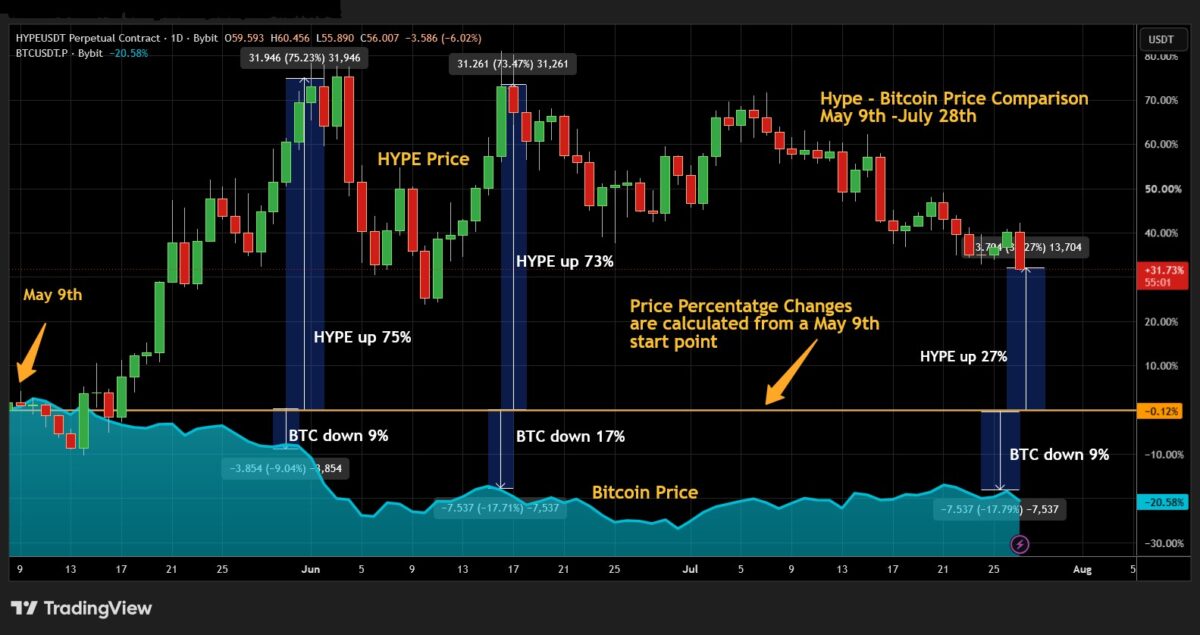
HYPE’s Q2 2026 Reality Check price path: the May 21 ATH, the June 16 ATH, and the July pullback that followed. Source: TradingView.
🎧 Listen to the Podcast
Prefer audio? This article is also available as a deep-dive podcast discussion.
Duration: 06 minutes
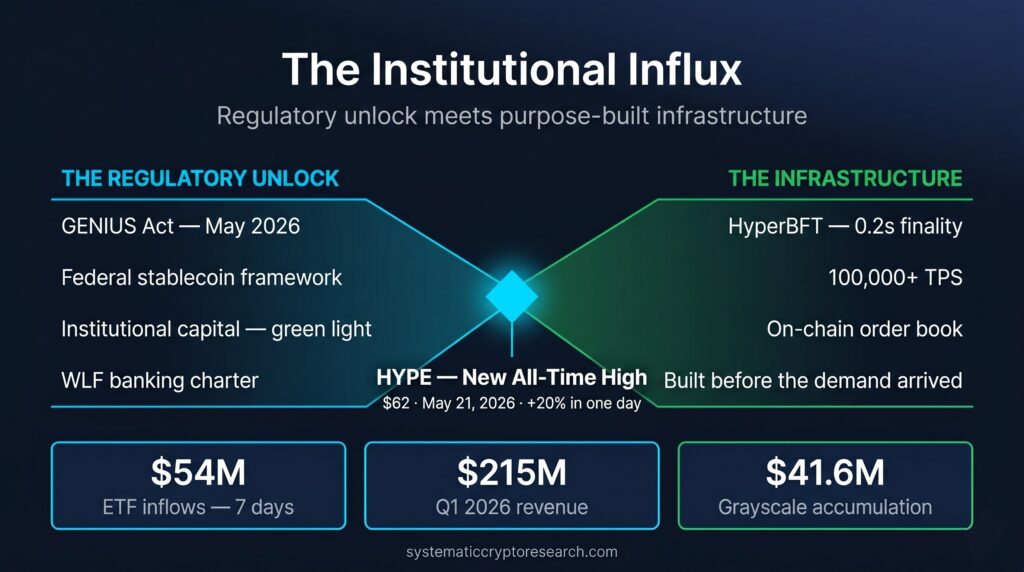
For the GENIUS Act regulatory unlock and the original institutional-influx case, see Article 9: “HYPE and the Institutional Influx: What’s Actually Happening Right Now.”
The Buyback Engine Kept Running — But Not Evenly
The Assistance Fund is still the mechanical core of the HYPE thesis: roughly 97–99% of protocol trading fees route straight into open-market HYPE purchases, no discretion involved. Cumulative purchases crossed $2 billion in mid-May — a milestone reached less than 18 months after the Fund’s January 2025 launch — and the pace has kept climbing alongside trading volume: protocol fee revenue is now running at roughly $1.1–1.3 billion annualised, as of mid-2026. The July 6th HYPE ‘token unlock’ — 9.92 million HYPE, worth roughly $645 million — landed against a buyback fund sitting on about 4.6 times that amount. In plain terms: for every dollar of new tokens hitting the market the day of the token unlock, there was roughly $4.60 of standing buy bid already there — real demand, funded by trading fees rather than a discretionary decision to buy. On paper, that’s a lot of cushion for the supply pressure it has to absorb.
Here’s the part that doesn’t show up in that headline number. Buyback spending is not flat — it moves with trading volume, and trading volume is cyclical. Quarterly purchases actually fell through the second half of last year: $316.76 million in Q3 2025, down to $255.05 million in Q4, down again to $192.25 million in Q1 2026 — a roughly 40% contraction in the Assistance Fund standing buy bid over two quarters, during the exact stretch HYPE was setting records. Price and engine were moving in opposite directions, and the institutional-demand narrative doesn’t explain why.
A procyclical buyback is a token-repurchase mechanism funded by a share of protocol revenue rather than a fixed dollar or token commitment — its purchasing power rises and falls with trading volume instead of providing constant support. References: DEXTools (2026) — on-chain unlock analysis, source for the quarterly Assistance Fund figures cited in this article; Kapron, Z., Forbes (2026) — original reporting on the Assistance Fund mechanism; CoinGecko via crypto.news/MEXC (2025) — independent third-party confirmation of Hyperliquid’s buyback scale relative to other crypto protocols.
This isn’t a reason to dismiss the buyback mechanism — it’s real revenue, not token issuance or treasury depletion, which is more than most crypto buyback programs can claim. And it’s worth being precise about what “reduced” actually means here: even at its lowest recent quarter, this is a continuous, non-discretionary buyer showing up on real trading orders and execution every single week — not a promise a team can quietly pause the moment it gets expensive to maintain, which is the position most speculative tokens without any revenue-funded support are actually in. That difference is a plausible part of why this pullback has landed in the 20–25% range rather than the 50–80% collapses that tend to follow once sentiment turns on tokens with nothing structural underneath them.
None of that makes it a floor, though — it makes it a lever. “Not a floor” isn’t a knock on the mechanism; it’s the honest description of what happened these past two months: real, working support that softened the drawdown without preventing one. The risk isn’t that the buyback stops mattering — it’s that it scales down hardest in exactly the conditions, a genuine sustained drawdown, where holders would want it scaling up. That said, Hyperliquid’s design of the Assistance fund is about transferring wealth created by trading on the platform to the HYPE holding community. The HYPE coin is a rare crypto example of an equity coin, similar to a premium dividend yield stock.
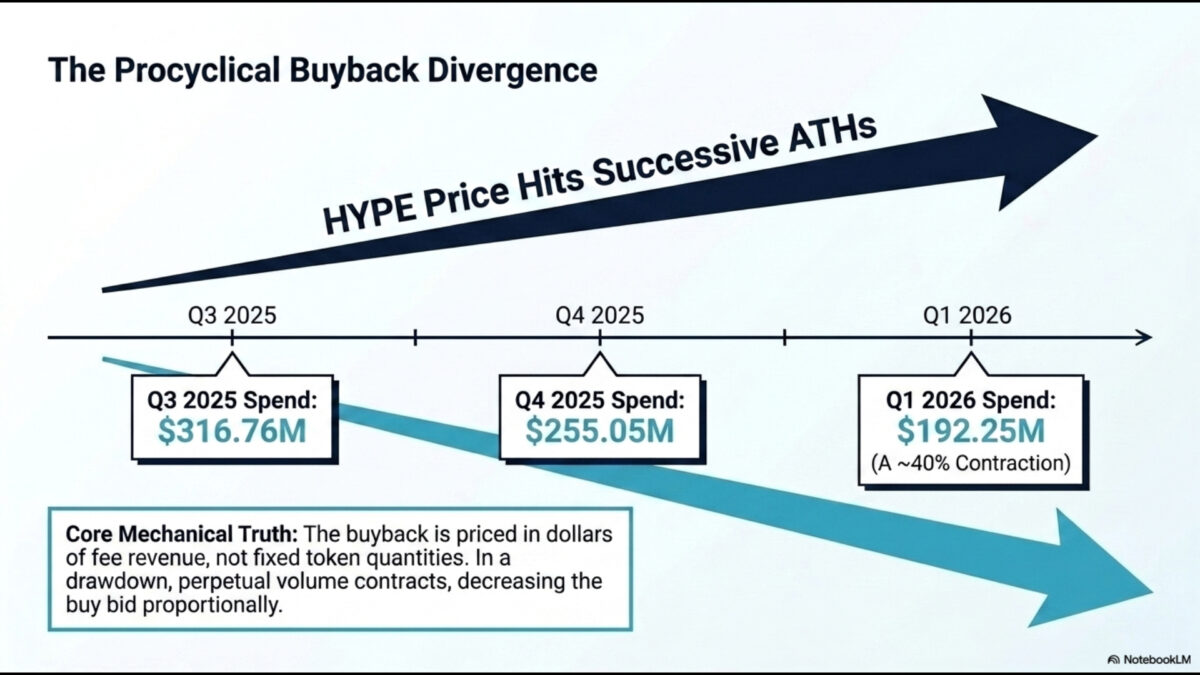
The procyclical divergence: quarterly Assistance Fund buybacks fell as HYPE’s price climbed toward its Q2 highs.
Real-World Assets: The Growth Story Article 9 Didn’t Cover
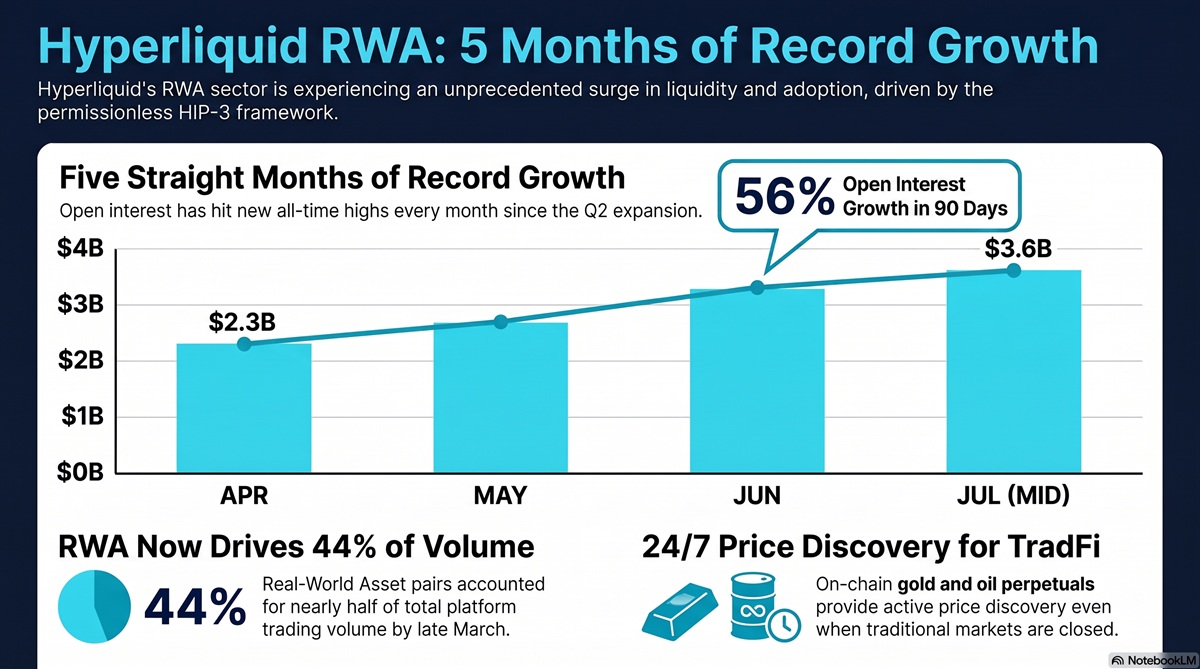
Article 9 was written before Hyperliquid’s real-world-asset expansion had much of a track record. It does now. HIP-3 (Hyperliquid Improvement Proposal 3) — the framework that lets anyone stake 500,000 HYPE (roughly $25–35M at current prices) to permissionlessly deploy a perpetual market on Hyperliquid’s infrastructure — launched in October 2025 and has posted five straight months of record open interest since. RWA open interest went from $2.3 billion in April, to $2.65 billion in May, to $3 billion in June, to $3.6 billion by mid-July — against a platform-wide open interest record of $11 billion. By late March, RWA pairs already accounted for 44% of total platform trading volume.
The pattern that stands out: RWA perps trade when traditional markets are closed. Oil and gold perpetuals on Hyperliquid moved on geopolitical news over a February weekend while CME (Chicago Mercantile Exchange) and the NYSE sat dark — and traditional markets converged toward the on-chain price when they reopened Monday. That’s a genuinely new kind of price discovery, not a marketing claim.
In January, Dreamcash, Tether, and Selini Capital jointly launched HIP-3 RWA perpetuals collateralised in Tether’s new on-chain stablecoin, USDT0 — a signal that stablecoin infrastructure itself is being built around this market, not bolted onto it after the fact. HIP-4, which launched May 2nd, extends the same permissionless model to prediction markets — fully collateralised, expiry-based contracts settling on real-world outcomes. These developments are the postive side of HYPE’s Q2 Reality Check.
Prediction markets are having a moment of their own, and HIP-4, (Hyperliquid Improvement Proposal 4) puts Hyperliquid squarely inside it — as a competitor, not a collaborator. Polymarket, the category’s dominant name, has gone from a niche 2020 startup to a platform carrying a roughly $15 billion valuation after Intercontinental Exchange — the company that owns the New York Stock Exchange — committed $600 million in direct backing. The sector itself is scaling fast: global prediction-market volume hit $25.7 billion in March 2026 alone, with Bernstein projecting the full 2026 total could reach $240 billion. Polymarket crossed $10 billion in monthly volume for the first time that same month, and posted a record $10.8 billion in June on the back of World Cup betting activity — though rival Kalshi, freshly valued at $22 billion, is currently running nearly three times Polymarket’s volume. What makes this relevant to a HYPE thesis isn’t crypto-market beta: prediction-market activity swings on election cycles, sports calendars, and macro data releases, largely independent of whether crypto itself is risk-on or risk-off. HIP-4 is Hyperliquid’s direct entry into that volume: fully collateralised, expiry-based binary contracts built into the same account traders already use for perpetuals and spot, explicitly positioned to take share from Polymarket and Kalshi rather than route volume through them.
A prediction market lets traders take positions on the outcome of real-world events — elections, macroeconomic data, sports — with contracts that settle at a fixed value once the outcome is known, rather than tracking an asset’s ongoing price. The category has scaled fast: global prediction-market volume reached $25.7 billion in March 2026, and Bernstein projects the full 2026 total could reach $240 billion. Polymarket, the sector’s largest platform, carries a roughly $15 billion valuation backed by a $600 million direct investment from Intercontinental Exchange (parent of the NYSE); rival Kalshi is valued at $22 billion. References: TradingKey (2026) — Polymarket funding round and ICE investment; Bernstein Research via TradingKey (2026) — full-year 2026 prediction market volume projection; Value Add VC (2026) — Kalshi/Polymarket valuation and volume comparison.
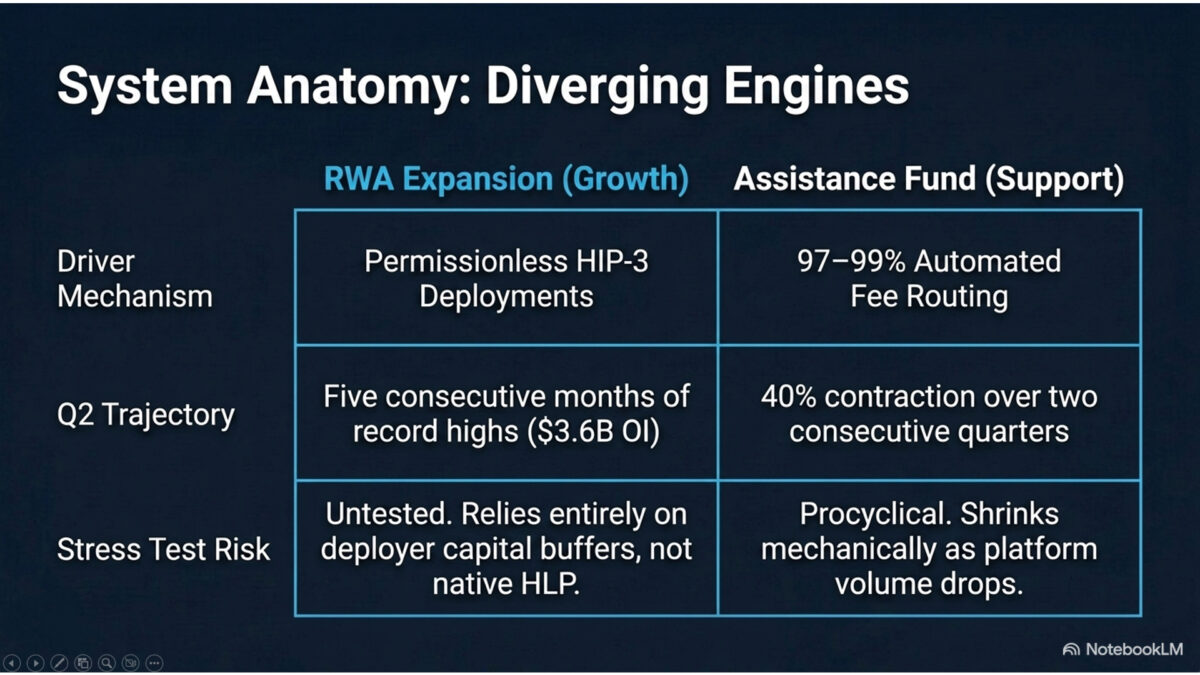
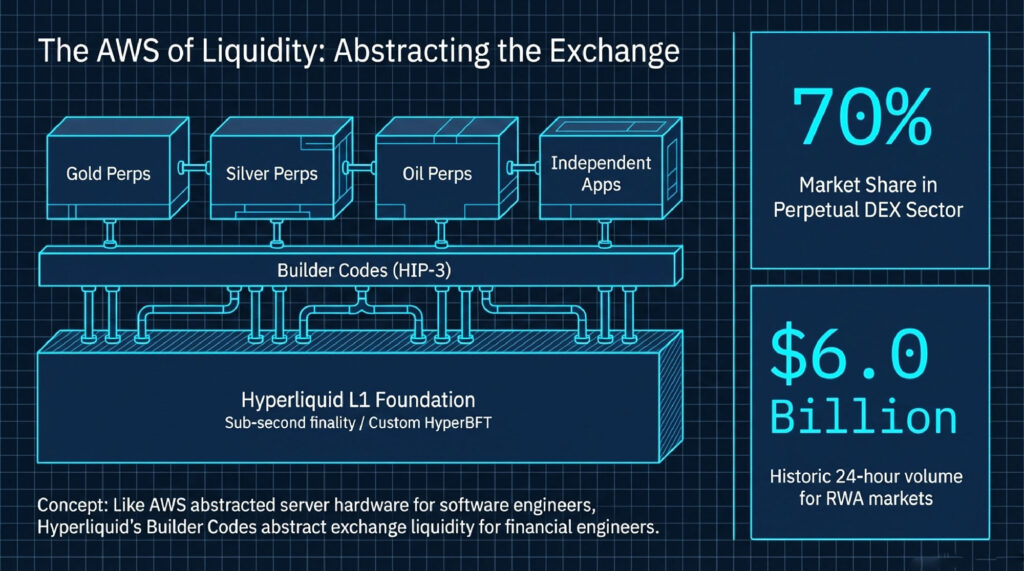
System anatomy: how Hyperliquid’s platform products relate to Assistance Fund support — and where the stress-test risk actually sits.
For HyperBFT consensus and the full HIP-3 technical architecture, see our Hyperliquid L1 Technical Deep Dive.
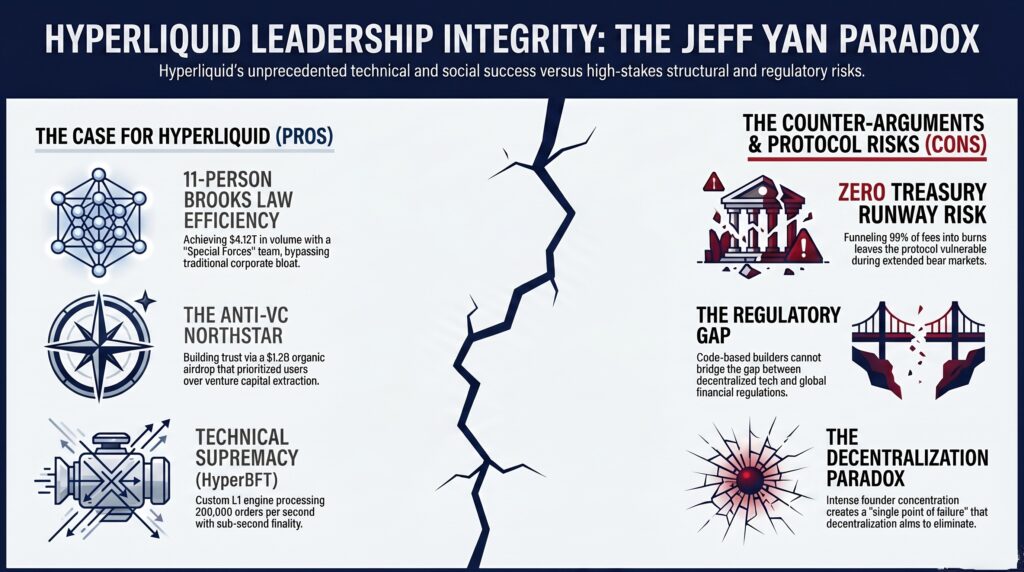
Zoom out and the liquidity structure underneath all of this isn’t a gap — it reads like a deliberate trade. Hyperliquid doesn’t have to build or capitalize every new market itself: anyone willing to stake 500,000 HYPE and carry the liquidity risk can plug straight into infrastructure the protocol has already built, and Hyperliquid takes its cut of the activity without taking on that operational risk. The deployer carries it instead — which doubles as the accountability mechanism keeping a permissionless system honest. Under-capitalize your market and it’s your liquidity that breaks, not the protocol’s. High risk for the deployer, real scalability for Hyperliquid, and — so far — no bailout smoothing over the difference. Whether that holds under genuine platform-wide stress is still unproven; RWA/HIP-3 hasn’t been tested by a real liquidity crunch yet.
The honest caveat, and it matters: HIP-3 markets are not covered by Hyperliquid’s native liquidity vault, the Hyperliquidity Provider (HLP). Each market’s liquidity depends entirely on whoever deployed it. A well-capitalised deployer like Dreamcash or TradeXYZ is a different risk than an under-capitalised one chasing the same 500,000-HYPE stake requirement. “RWA on Hyperliquid” isn’t one risk profile — it’s as many risk profiles as there are deployers, and that distinction gets lost in most of the coverage.
A HIP-3 market’s liquidity depends entirely on its individual deployer’s capitalisation, not on Hyperliquid’s shared liquidity vault. That concentration is already visible in practice: one deployer, TradeXYZ, accounts for over 90% of all HIP-3 open interest, and Blockworks Research has flagged the deployer economics as a structural risk — a roughly $30M lockup plus auction costs can stretch a smaller deployer’s break-even period to four years. References: Hyperliquid Docs (2025) — official HIP-3 staking and slashing mechanics; Blockworks Research via crypto.news (2026) — deployer concentration and break-even economics finding; CoinGecko Research (2026) — analysis of the capital barrier concentrating deployment among well-capitalised teams.
Institutional Adoption Escalated, Not Just Continued
Article 9 covered the opening moves — the THYP/BHYP spot ETF launches in mid-May and roughly $54 million in inflows over their first week. That flow didn’t stall; it built. By mid-June, cumulative inflows across the two funds had reached $172 million, even as US spot Bitcoin ETFs shed nearly $5.6 billion over the same stretch — a genuine divergence, not noise.
Two developments since are worth more attention than they’ve gotten. First, on July 18th, T. Rowe Price — a firm running actively managed funds, not passive index trackers — launched a multi-token digital-asset ETF listing HYPE as roughly a 6% core holding. That’s a different category of buyer than the ETF-arbitrage crowd: an active manager making a discretionary allocation call. Second, Hyperliquid Strategies (Nasdaq: PURR) was added to the Russell 3000 Index in June, putting Hyperliquid-linked equity exposure inside index funds that never intended to make a crypto bet.
“It’s bigger than Nasdaq.” — Intercontinental Exchange (ICE) CEO Jeff Sprecher, discussing Hyperliquid on stage at the Bernstein Annual Strategic Decision Conference, May 27th.
That quote lands harder given who said it: ICE runs the New York Stock Exchange, and had itself been pushing regulators to scrutinize Hyperliquid weeks earlier (more on that below). Grayscale’s GHYP application — a third spot ETF — is still pending, with an amendment cadence suggesting a decision by Q3 2026.
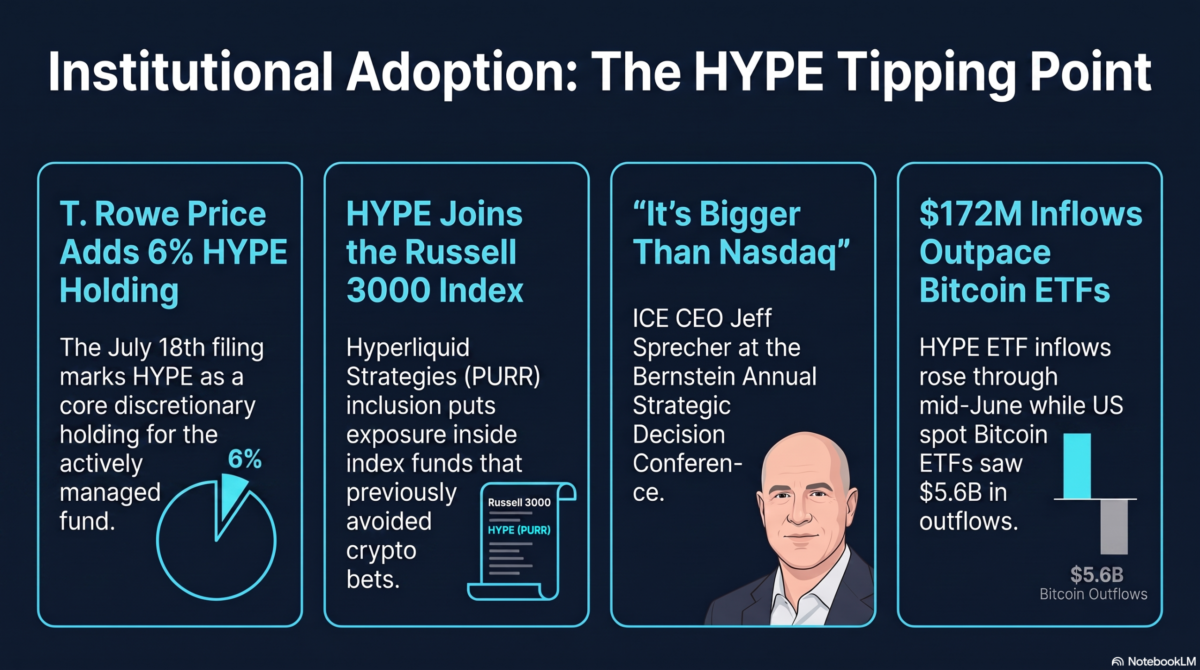
The institutional tipping point: T. Rowe Price’s active allocation, ICE CEO Jeff Sprecher’s comments, and Russell 3000 inclusion, side by side.
None of this reads as retail momentum. It reads as the plumbing of traditional finance being built out toward Hyperliquid, piece by piece, largely without a corresponding retail news cycle.
The Risk Picture: This Isn’t One Opportunity, It’s Four
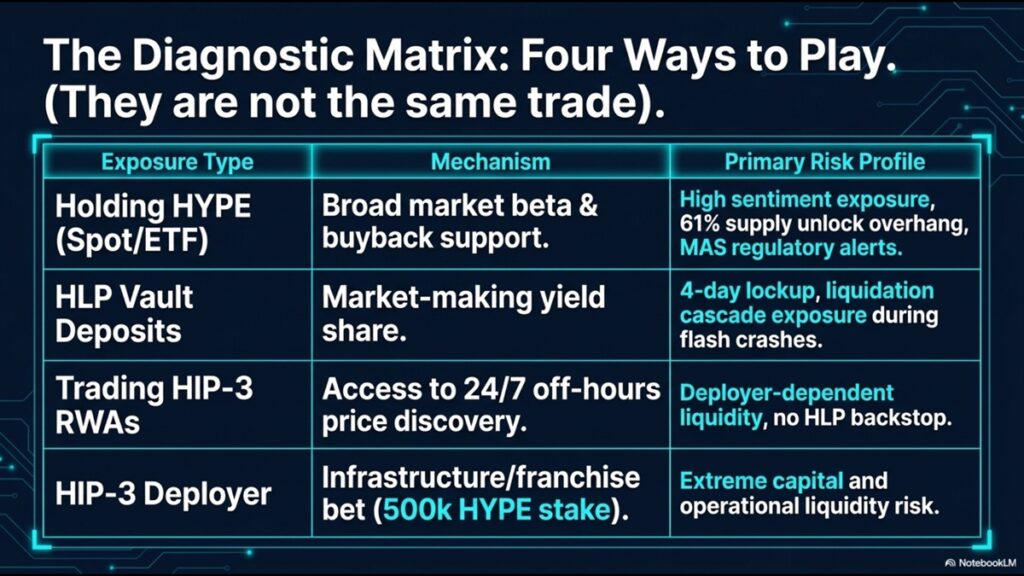
Here’s where most coverage of Hyperliquid — including, to be fair, some of ours — collapses several distinct things into one “HYPE opportunity.” They’re not the same trade, and they don’t carry the same risk.
Holding HYPE — spot or via ETF. Straightforward market beta on the whole ecosystem, plus everything above: procyclical buyback support, ~61% of supply still unlocking on a monthly schedule through 2027, and now genuine regulatory overhang — Singapore’s Monetary Authority (MAS) added Hyperliquid to its Investor Alert List in late June, following an earlier UK warning, and CME and ICE executives asked the Commodity Futures Trading Commission (CFTC) in May to review Hyperliquid’s commodity perpetuals. HYPE fell roughly 6% on that report alone. This is the most liquid, most passive way in — and the one most exposed to sentiment swings.
HLP vault deposits. The full tail-risk treatment already exists in Article 9’s section on the HLP Vault — the short version: a 4-day lockup and genuine liquidation-cascade exposure during stress events, in exchange for a share of market-making yield. Different risk entirely from just holding the token.
Trading HIP-3 RWA perpetuals. Deployer-dependent liquidity, as above — not backstopped by HLP, and the fastest-growing category on the platform by a wide margin.
Becoming a HIP-3 deployer. The 500,000-HYPE stake (~$25–35M) to launch your own market is a different animal again — closer to a franchise or infrastructure bet than a trading position, with operational risk none of the above categories carry.
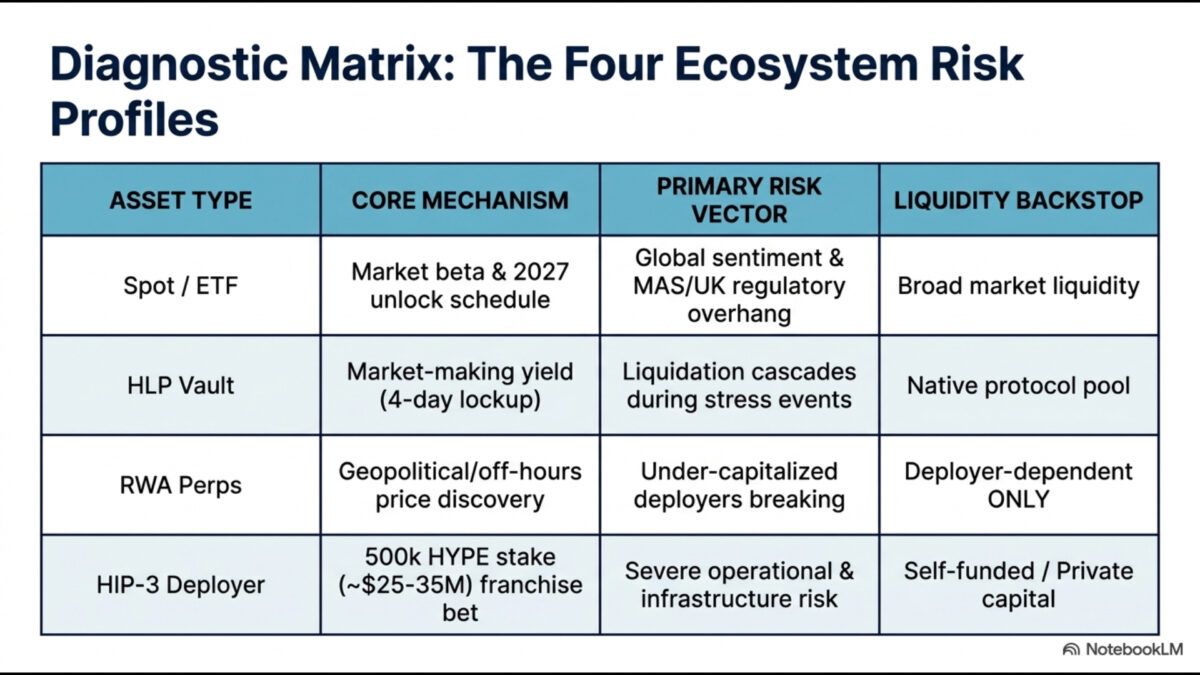
Diagnostic matrix: the four Hyperliquid ecosystem exposure types, and how their risk profiles actually differ.
Where I sit across these, for context: my own position is concentrated in a long-term trend-following automated system that’s currently being converted into a Hyperliquid Vault, with an equity token — TREND — planned to launch alongside it later this year. From there, my next move is diversifying into the HLP vault and other Hyperliquid trading vaults as more come online, rather than adding exposure through spot or ETF. That’s a deliberate choice, not a default: I see ETF exposure carrying extra cost that dilutes the return the Hyperliquid ecosystem itself is generating, and I think the legacy ETF wrapper carries its own set of risks going forward. Right now I’d rather have direct exposure to what I see as the actual edge — Hyperliquid’s leadership, technical execution, and community-first design — than pay for a layer of TradFi packaging on top of it.
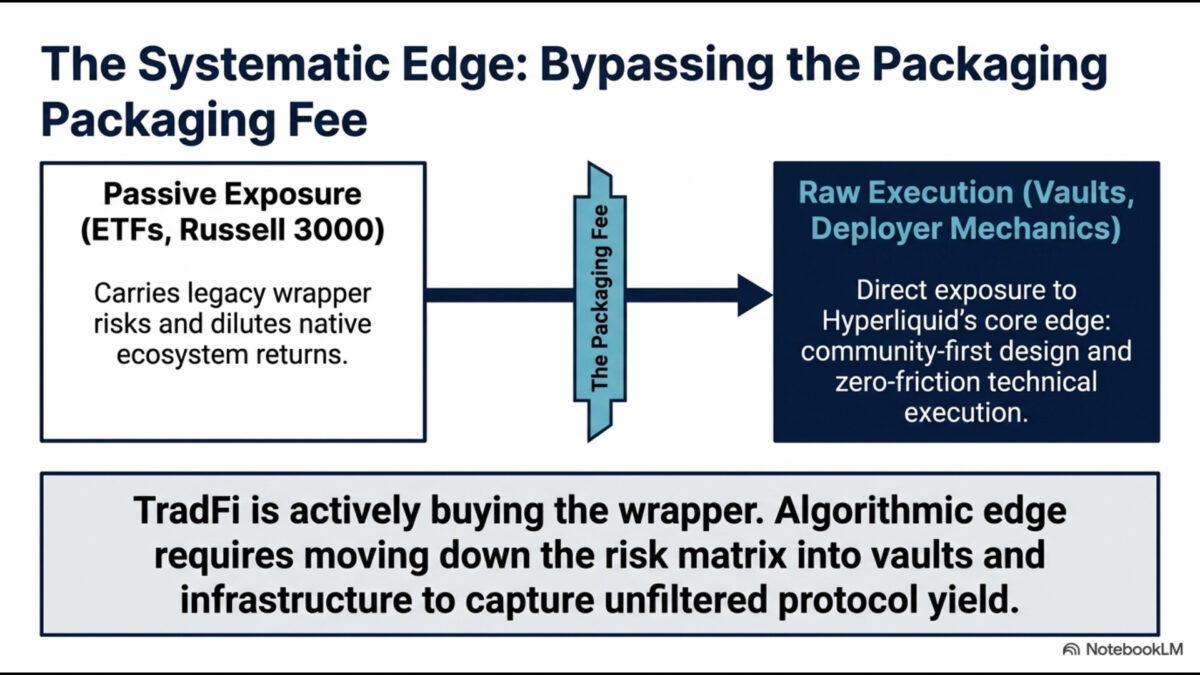
The Hyperliquid opportunity basket — where the upside sits across each of the four exposure types.
📄 Read the Transcript and Counterargument Analysis
What You Can Do Next
Visit Hyperliquid
Follow the link below to go to the Hyperliquid trading platform. Once you are there, you can read their documentation, explore the perpetual futures trading deck or check out the public vaults where users earn passive income staking or partnering with other pro traders. If you want to trade on Hyperliquid, it is pretty simple. You set up an account with your crypto wallet and trade on spot and perpetual futures markets. Important Note: If you do decide to trade at Hyperliquid, go there with my link below, and you will receive a 4% discount on all fees. This adds up to a big saving over time. You will also help me to continue with my work on this website.
If you want to do a deep dive on this subject, we encourage you to read our ‘Deep Research Report’ on this topic
Visit Hyperliquid’s Trading Platform
Security Note: SCR and the HyperTrend Team advise that when you set up a trading account at Hyperliquid to use a secure hard wallet like Ledger or Trezor.
Explore the HyperTrend Opportunity
If you are interested in the mathematical models behind the 1.81 Sharpe Ratio HyperTrend has achieved and how you can get involved, start with the HyperTrend introduction video. It breaks down how they use Ridge Optimization to navigate these high-speed markets.
Watch the HyperTrend Intro Video
Additional Research Resources:
- Quantitative Math: Read about Ridge Optimization Math
- Meet the HyperTrend Team: Inside the HyperTrend Team
- Institutional Influx: Article 9 — HYPE and the Institutional Influx
- Institutional Influx Debate: [A9 PODCAST URL — MISSING, see note] Article 9 Podcast — The Institutional Influx Debate
- Technical Architecture: Hyperliquid L1 Technical Deep Dive
- Custody Model: [TITLE MISMATCH — MAY NOT BE A1, see note] Smart Contract Custody vs. CEX Custody
Disclosure: I don’t currently hold spot HYPE, and don’t have near-term plans to — not for lack of interest, but because if I had more capital to deploy into the ecosystem, I’d choose other Hyperliquid opportunities over simply holding the token. My real exposure is through a long-term trend-following system I run, currently being converted into a Hyperliquid Vault with its own token, TREND, launching later this year. It’s a HyperTrend/FINREV play first and foremost, but it’s meaningfully connected to Hyperliquid itself — it runs on the Hyperliquid strategy playbook and passes Hyperliquid ecosystem benefits through to participants. This is not financial advice — do your own research before allocating capital to any of the exposure types discussed above.