Hyperliquid Scaling and Risk
This podcast debate transcript accompanies the pillar article on HYPE’s Q2 2026 performance. The episode examines the counterargument the article’s resilience case doesn’t fully resolve: whether the Assistance Fund’s mathematical buyback support is genuine structural strength, or whether it has simply never been tested by the kind of sustained, market-wide drawdown its procyclical design is actually vulnerable to.
“For the full case on HYPE’s Q2 2026 Reality Check numbers — including the procyclical buyback mechanics, the HIP-3 deployer risk model, and the four-risk-profile breakdown — read the pillar article this debate was built around.”
⚡ Listen to the Article 10 Podcast on Spotify
📖 Read the Full Article 10: HYPE’s Q2 2026 Reality Check
Podcast Episode: 10 — Hyperliquid Scaling and Risk
Duration: [XX] minutes
Published: [date — set at simultaneous publish]
Topic: A structured debate on whether Hyperliquid’s Q2 2026 growth — buybacks, RWA expansion, institutional inflows — reflects genuine resilience, or risk that hasn’t yet been tested by real market stress.
📻 About This Podcast
This podcast was generated using Google’s NotebookLM from the research in this article. The conversational debate format explores the concepts from multiple perspectives—examining both advantages and potential concerns—which can help clarify complex ideas that might be dense in written form.
This is a supplementary tool. The article contains the full technical analysis and primary sources. The podcast is for those who prefer audio learning or want to hear counterarguments explored through discussion.
📖 Read the Full Article: HYPE’s Q2 2026 Reality Check
⚡ What This Debate Revealed That the Article Didn’t Cover
The pillar article makes a strong case that Hyperliquid’s Assistance Fund and its deployer-carries-the-risk model are real, working support — not smoke and mirrors. The debate surfaced three specific challenges worth pressure-testing before taking that as settled:
- The “one brand” illusion hides four different risk profiles. Users see one platform, one buyback fund, one resilience headline — and assume it covers everything. HIP-3 markets specifically sit entirely outside that safety net, dependent on whichever deployer capitalised them.
- This isn’t scrutiny of “growth” — it’s scrutiny of unlicensed commodity derivatives. Hyperliquid is explicitly running unlicensed, 24/7 commodity perpetuals that bypass traditional clearing houses entirely. That’s the structural reason regulators are engaging, not simply a function of the platform getting bigger.
- The stress test that’s been passed isn’t the stress test that matters. The July unlock was absorbed during otherwise-healthy trading conditions. It hasn’t yet been tested against a genuine, sustained, market-wide crash — the exact scenario where volume, and therefore buyback funding, contracts at the moment supply pressure would be highest.
🧠 SCR Analysis: Where the Debate Lands
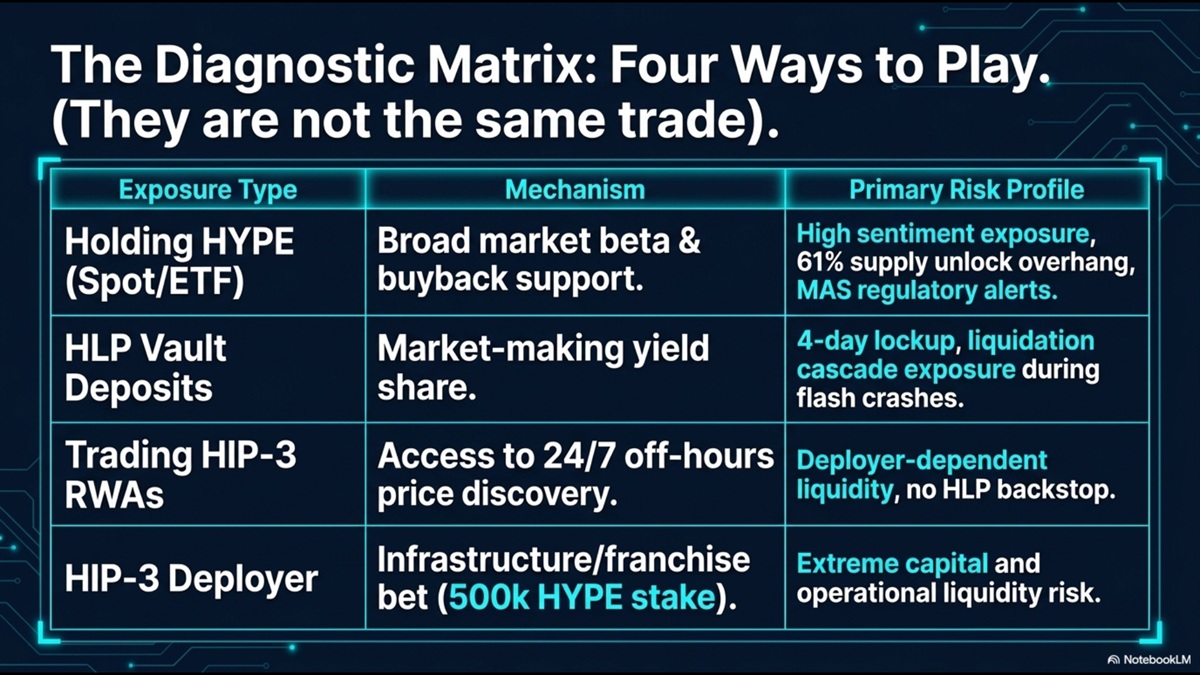
The skepticism raised above isn’t speculative — it’s the same conclusion this article reaches independently. The “illusion of platform-wide safety” point matches exactly what the four-way exposure breakdown lays out: HIP-3 markets are explicitly not covered by Hyperliquid’s native liquidity vault, and treating “Hyperliquid exposure” as one trade is precisely where the risk hides. The regulatory framing is accurate too, and matches our own reporting — Singapore’s MAS and CME/ICE pressure on the CFTC are real, current developments, not hypothetical.
The stress-test point is the sharpest objection in the whole debate, and it’s worth being precise rather than picking a side. The Q3 2025–Q1 2026 data this article reports — a roughly 40% decline in quarterly buyback spend during the exact stretch HYPE was rallying — is real evidence the mechanism is procyclical. What it doesn’t yet show is how the mechanism behaves in a genuine, sustained downturn, because that scenario hasn’t happened yet.
The SCR verdict: this is real, working, non-discretionary support — not a guarantee. “Mathematically resilient” is presently true. Whether it holds under real stress is presently unknown. Both are worth knowing before allocating capital to any of the four exposure types this episode covers.
Episode Summary
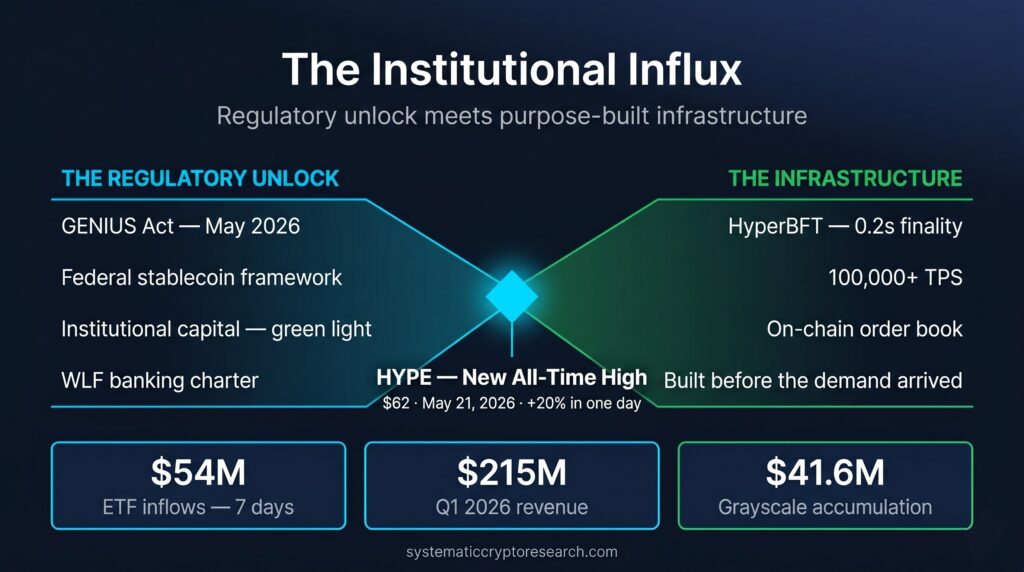
This episode stages a structured debate over whether Hyperliquid’s Q2 2026, scaling and risk— new all-time highs, a growing real-world-asset market, and escalating institutional adoption — sits on genuinely resilient foundations or on risk the headline numbers obscure. One side argues the Assistance Fund’s non-discretionary buyback, the HIP-3 deployer model’s isolation of operational risk, and the sheer weight of institutional validation (T. Rowe Price, Russell 3000 inclusion) add up to mathematical resilience. The opposing view warns that treating “Hyperliquid exposure” as one trade hides four genuinely different risk profiles, that the buyback mechanism is procyclical by design and hasn’t yet been tested by a real sustained drawdown, and that the same growth drawing institutional praise is also what’s drawing direct regulatory scrutiny from Singapore’s MAS and CME/ICE pressure on the CFTC. The debate covers the July 6th unlock stress test, the four ecosystem risk profiles, the HIP-3 deployer-capitalised liquidity model, and whether “mathematically resilient” and “genuinely untested” can both be true at once.
Full Transcript
Host: Welcome to the debate. When engineers build a suspension bridge, they don’t just calculate the weight of the cars on it — they calculate how it handles hurricane winds.
Expert: Exactly.
Host: So today we’re looking at Hyperliquid. It’s processing billions in trades right now and drawing massive Wall Street attention. But what happens when that wind picks up — is the foundation actually solid, or is it fundamentally fractured? I’ll be arguing that their technical advancements, and really their community-first strategy, have built a genuinely resilient decentralized trading engine.
Expert: And I take the position that this rapid expansion masks some incredibly dangerous, unbundled risk profiles. The market sees this as one monolith, but underneath, the liquidity is highly localized, and those core structural support mechanisms are severely procyclical.
Host: Let’s look at what they actually pulled off in Q2 2026. The HIP-3 framework is a huge technical breakthrough for permissionless expansion. Deployers have to stake 500,000 HYPE tokens — roughly $30 million — just to launch one single perpetual market.
Expert: Just to launch.
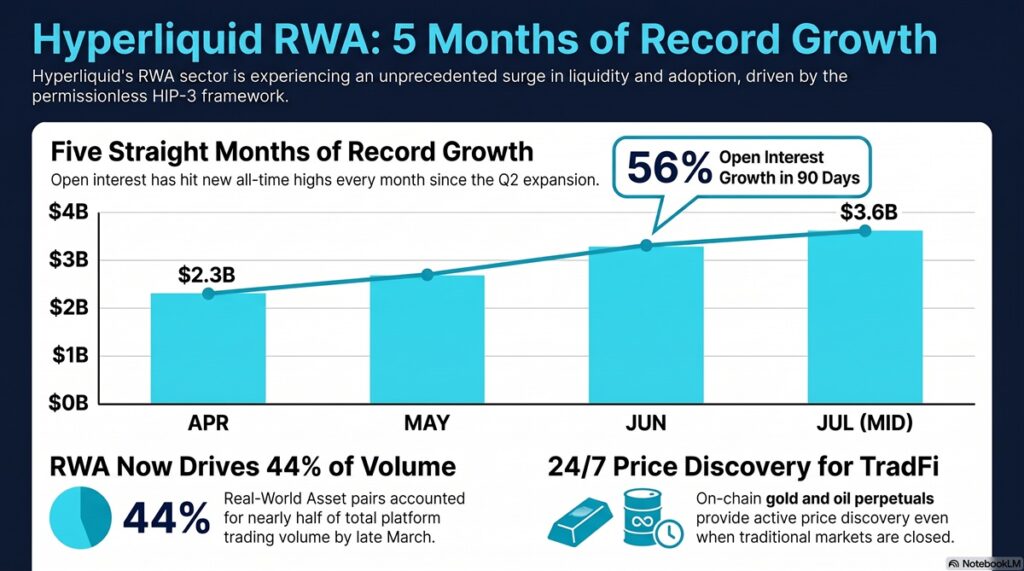
Host: Right — just to launch. But because of that skin in the game, we saw real-world-asset open interest explode to $3.6 billion by mid-July. We have genuinely new 24/7 price discovery. Remember that geopolitical news weekend in February, when traditional markets were completely locked up? While TradFi was asleep, Hyperliquid’s oil and gold markets were aggressively moving. Wall Street literally had to wake up Monday morning and converge to Hyperliquid’s prices. That is profound efficiency.
Expert: The efficiency is impressive, sure, but it creates a really dangerous oversimplification for the average user. People talk about “getting Hyperliquid exposure” as if it’s one simple trade.
Host: Well, they’re buying into the ecosystem.
Expert: But it’s actually four distinctly different risk profiles. You can hold spot HYPE, provide liquidity to the vault, trade the new HIP-3 markets, or deploy them. And the most critical misunderstanding across all of this is the core buyback engine. It is procyclical.
Host: I wouldn’t say inherently.
Expert: It is. It thrives when times are good, and it starves when times are bad.
Host: Hold on — let’s look at the actual mechanics before calling it a starvation risk. 97 to 99% of trading fees route directly into open-market buy bids. It just mechanically buys, as long as there’s volume. Look at the stress test: when over $600 million in tokens unlocked in July, the system absorbed it instantly, because the standing Assistance Fund had four and a half times that amount already waiting. For every dollar of new supply, there was $4.50 of standing demand. That’s pure mathematical resilience.
Expert: But how is that standing demand actually funded?
Host: It’s driven exclusively by trading volume.
Expert: It’s like… it’s an umbrella that actively shrinks just as a hurricane makes landfall. That’s a bit dramatic, but it’s true — if the broader market faces a genuine sustained crash, perpetual trading volume contracts rapidly. So exactly when holders desperately need a market buyer to cushion the fall, that standing buy bid evaporates, because the fee revenue just isn’t there to fund it. We already saw this: between Q3 2025 and Q1 2026, buybacks shrank by roughly 40%, precisely while token prices were hitting all-time highs.
Host: Okay, but the system isn’t meant to be a static bailout fund — it’s a dynamic shock absorber. And that philosophy of pushing operational reality to the edges is exactly why the exchange scales so efficiently.
Expert: By pushing the risk onto the users.
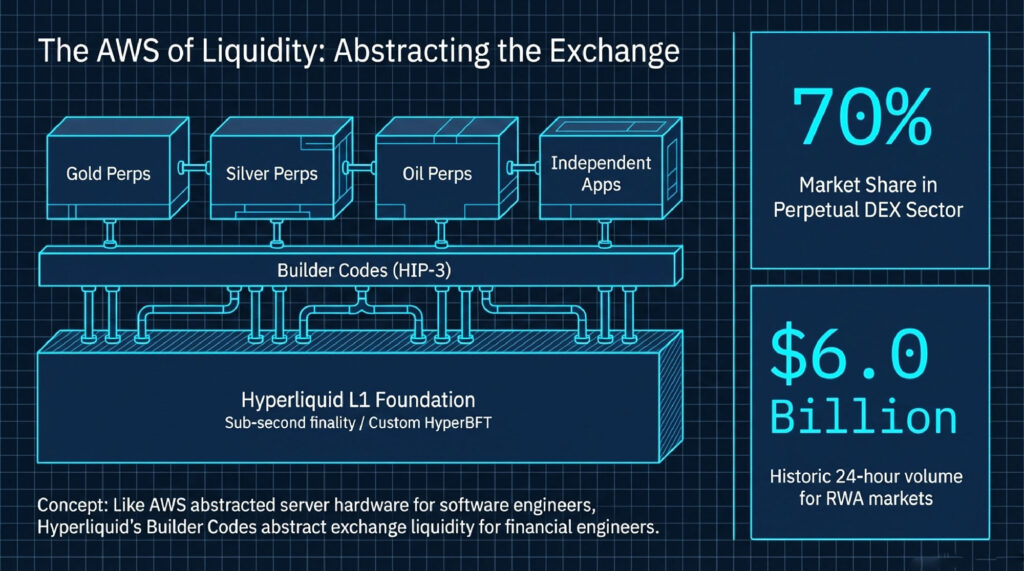
Host: By making the HIP-3 deployers carry the operational risk of their own markets. That’s how Hyperliquid can scale infinitely. If a deployer under-capitalizes their specific market, sure, that local liquidity breaks — but the protocol itself doesn’t absorb the contagion.
Expert: That isolates the protocol. But it completely blindsides the user. It creates a total illusion of platform-wide safety.
Host: How so?
Expert: Most retail participants have no idea these new HIP-3 markets are explicitly not covered by the native HLP vault — the main community liquidity pool supporting Hyperliquid’s trading. So if a small team scrapes together the $30 million to deploy a market and then fails to maintain it, anyone trading that specific asset faces a severe liquidity crunch. Users think they’re shielded by Hyperliquid’s massive scale, but they’re entirely exposed to these under-capitalized, localized risks.
Host: While retail users might struggle with unbundling those local liquidity risks at first, institutional players actually prefer this modular design. That’s exactly why traditional finance is trying to rewrite its plumbing around this infrastructure.
Expert: Really — Wall Street likes the fragmentation?
Host: They like the structural edge. Look at active managers like T. Rowe Price allocating 6% of a new ETF to HYPE. Look at ICE CEO Jeff Sprecher publicly stating Hyperliquid is “bigger than Nasdaq.” They’re validating this community-first, decentralized structure because it structurally works.
Expert: And that exact institutional spotlight is bringing a severe regulatory overhang. Why do you think traditional exchange CEOs are talking about them on stage?
Host: Because of the sheer volume.
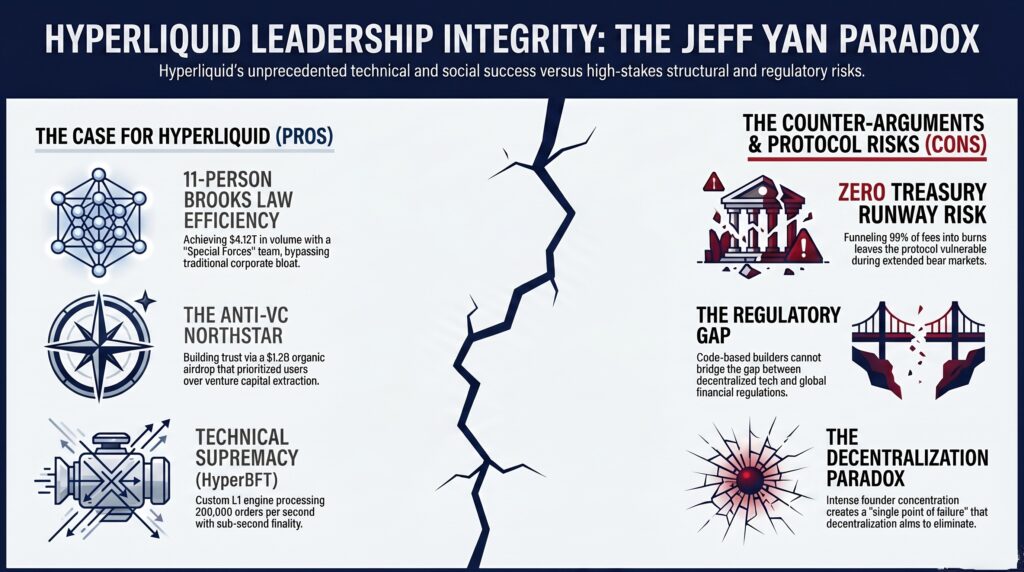
Expert: Because Hyperliquid is running unlicensed, 24/7 commodity perpetuals that entirely bypass traditional clearing houses. That’s why regulators care — Singapore’s MAS already put them on an Investor Alert List, and CME and ICE executives are directly lobbying the CFTC to intervene.
Host: Well, naturally — simple spot holding becomes wildly vulnerable to sentiment shocks when you’re systematically threatening the traditional clearing model. Regulatory scrutiny is just the price of disrupting a legacy system. Ultimately, Hyperliquid’s technical execution has forged an undeniable shift in financial infrastructure, and traditional markets are now just forced to react to it.
Expert: But to participate safely, you have to meticulously unbundle those four specific operational risks. If you don’t map out exactly where your liquidity comes from, you’re flying blind in a system that can pull its support just when you need it most.
Host: Analyzing these distinct risk profiles is absolutely essential for understanding the true nature of decentralized scaling. We’ll leave it to you to form your own conclusion on where the balance lies.
📖 Read the Full Article: HYPE’s Q2 2026 Reality Check
Key Takeaways
- The Assistance Fund Is Non-Discretionary — Roughly 97–99% of protocol trading fees route directly into open-market HYPE purchases. No team decision is involved; it mechanically buys as long as there’s volume.
- The July Stress Test Was Real, and It Passed — A $645 million unlock was absorbed instantly against a standing buyback fund roughly 4.6 times that size — genuine, non-discretionary demand meeting genuine supply pressure.
- But the Mechanism Is Procyclical by Design — Buyback spending fell roughly 40% between Q3 2025 and Q1 2026, even as HYPE hit new highs, because it’s funded by trading fees rather than held at a fixed level.
- “Hyperliquid Exposure” Isn’t One Trade — Holding HYPE, HLP vault deposits, trading HIP-3 markets, and deploying HIP-3 markets are four genuinely different risk profiles, not variations on the same bet.
- HIP-3 Markets Sit Outside the Safety Net — HLP, Hyperliquid’s native liquidity vault, does not cover HIP-3 markets. Liquidity depends entirely on the individual deployer’s capitalisation.
- Institutional Validation and Regulatory Scrutiny Are Two Sides of the Same Growth — T. Rowe Price’s allocation and Russell 3000 inclusion are real, but the same scale is drawing direct attention from Singapore’s MAS and CME/ICE pressure on the CFTC.
- The Test That’s Been Passed Isn’t the Test That Matters Most — July’s unlock was absorbed during otherwise-healthy trading conditions. The mechanism hasn’t yet faced a genuine, sustained, market-wide crash — the scenario its procyclical design is actually vulnerable to.
🏦 Ready to Explore the Hyperliquid Ecosystem?
Follow the link below to visit the Hyperliquid trading platform. Once you are there, you can read their documentation, explore the perpetual futures trading deck, or check out the public vaults where users earn passive income staking or partnering with other professional traders. If you want to trade on Hyperliquid, it is pretty simple — you set up an account with your crypto wallet and trade on spot and perpetual futures markets.
Important Note: If you do decide to trade at Hyperliquid, go there with my link below and you will receive a 4% discount on all fees. This adds up to a significant saving over time, and you will also help me to continue with my work on this website.
Visit Hyperliquid’s Trading Platform
Security Note: SCR and the HyperTrend Team advise that when you set up a trading account at Hyperliquid, you use a secure hard wallet like Ledger or Trezor.
Explore the HyperTrend Opportunity
If you are interested in the mathematical models behind the 1.81 Sharpe Ratio HyperTrend has achieved — and how you can get involved — start with the HyperTrend introduction video. It breaks down how they use Ridge Optimisation to navigate these high-speed markets.
Watch the HyperTrend Intro Video
Resources Mentioned
- Assistance Fund — Hyperliquid’s non-discretionary buyback mechanism; ~97–99% of protocol trading fees route into open-market HYPE purchases
- HIP-3 (Hyperliquid Improvement Proposal 3) — Permissionless framework allowing a deployer to stake 500,000 HYPE (~$30M) to launch a perpetual market
- HLP (Hyperliquidity Provider) — Hyperliquid’s native, shared liquidity vault; does not cover HIP-3 markets
- MAS — Monetary Authority of Singapore; added Hyperliquid to its Investor Alert List in June 2026
- CFTC — Commodity Futures Trading Commission; asked by CME and ICE executives in May 2026 to review Hyperliquid’s commodity perpetuals
- CME / ICE — Chicago Mercantile Exchange / Intercontinental Exchange; traditional derivatives exchanges pushing for regulatory review
- T. Rowe Price — Active asset manager; launched a multi-token digital-asset ETF listing HYPE as roughly a 6% core holding, July 2026
- Russell 3000 — US equity index; Hyperliquid Strategies (Nasdaq: PURR) added in June 2026
About This Podcast
This debate stress-tests the resilience case this Q2 2026 update makes for Hyperliquid — the Assistance Fund’s buyback mechanics, the HIP-3 deployer model, and the wave of institutional validation the ecosystem has attracted. For anyone weighing exposure to HYPE, the HLP vault, or HIP-3 markets directly, the tension between “mathematically resilient” and “genuinely untested” is exactly the distinction worth sitting with before allocating capital.
Related Articles
- HYPE and the Institutional Influx: What’s Actually Happening Right Now
- The Jeff Yan Paradox: Hyperliquid Leadership & Integrity
- The HyperTrend Vault Launch: Institutional-Grade Wealth Building
- Why a Proven Crypto Trading System is Rebuilding as a Hyperliquid Vault
Transcript generated from NotebookLM podcast discussion. Edited for clarity and formatted for web publication.