How Vault Infrastructure Creates the Structural Edge Retail Investors Never Access
This podcast debate transcript accompanies the pillar article on the HyperTrend Vault launch and its institutional HFT infrastructure. The episode examines the counterarguments the article’s structural edge case doesn’t fully address: whether smart contract risk undermines the two-key custody advantage, whether a 63% CAGR projection survives skeptical scrutiny, and what the psychological reality of extended sideways performance means for investors who understand the math but have never lived through a flat period.
“For the full vault launch guide — including two-key custody architecture, airdrop mechanics, and the institutional HFT execution model — read the pillar article this debate was built on.”
⚡Listen to the Article 06 Podcast on Spotify
📖 Read the Full Article: The HyperTrend Vault Launch: Your Practical Guide to Institutional-Grade Wealth Building
Podcast Episode: 06 – The Vault Architecture Debate
Duration: ~18 minutes
Published: February 2026
Topic: Can retail investors access institutional-grade high-frequency trading through vault infrastructure?
📻 About This Podcast
This podcast was generated using Google’s NotebookLM from the research in this article. The conversational debate format explores the concepts from multiple perspectives—examining both advantages and potential concerns—which can help clarify complex ideas that might be dense in written form.
This is a supplementary tool. The article contains the full technical analysis and primary sources. The podcast is for those who prefer audio learning or want to hear counterarguments explored through discussion.
⚠️ The Counterargument You’ll Hear
The sceptical voice in this episode raises legitimate concerns: a 63% CAGR projection outperforms virtually every hedge fund in history, pooled capital means surrendering direct custody to a smart contract, and Hyperliquid is a new chain untested at scale. The “Hotel California problem”—easy to deposit, unclear how to exit—is a structural risk in any vault model. These objections are not dismissed. They are part of the architecture debate.
🔬 SCR Analysis
The counterarguments are structurally sound—and the source material acknowledges them. What makes the vault architecture defensible is the two-key custody model: the algorithm can execute trades but cannot transfer ownership of capital. The move to Hyperliquid isn’t about chasing novelty; it’s about zero gas fees enabling maker rebate harvesting at scale, which is mathematically impossible on Ethereum. The real question for any investor isn’t whether risks exist—they do—but whether the risk profile (smart contract exposure, drawdown tolerance) fits their position size and time horizon.
📖 Read the Full Article 06: The HyperTrend Vault Launch: Your Practical Guide to Institutional-Grade Wealth Building
Episode Summary
This debate examines the launch of the HyperTrend Vault on Hyperliquid blockchain—a system bringing institutional-grade high-frequency trading to retail investors. While one side highlights the mathematical edge and unprecedented compounding potential of pooled capital models with maker rebates and funding rate arbitrage, the sceptical perspective warns of smart contract risks, liquidity concerns, and the psychological challenge of extended sideways performance. The discussion explores whether transparent, on-chain vault architecture represents genuine progress or adds dangerous complexity to wealth preservation.
April 2026 update: The date for public launch of HyperTrend Vault and TREND coin has not yet been made public, but the HyperTrend algorithm is up and running and making money in its Hyperliquid Vault. Currently, the algorithm is running in beta mode testing with internal funds. Reports are that it is performing well.
A maker rebate is a payment from an exchange to a trader who adds liquidity to the order book by placing a limit order—rather than consuming it with a market order. On Hyperliquid’s zero-gas infrastructure, the HyperTrend Vault can place thousands of limit orders per day, capturing fractional rebates on each fill. This creates an income stream completely decoupled from whether the market is rising or falling. It is one of the core reasons pooled capital on-chain unlocks strategies that are mathematically impossible for individual retail accounts. Refernces: Currently, Hyperliquid website and Github Hyperliquid document archieve has provided the most authoritative sources to explain the technical mechanics of their ‘order book system’ and how it results in member benefits.
“The maker rebates concept introduced in this episode’s Key Concept callout is explained in the context of the full vault fee and rebate structure in the pillar article.”
📖 Read the Full Article 06: The HyperTrend Vault Launch: Your Practical Guide to Institutional-Grade Wealth Building
Full Podcast Transcript
Host: Welcome to the debate. Today, we’re dissecting a well, a really pivotal moment in automated trading. We’re looking at the launch of the HyperTrend vault on the Hyperliquid blockchain. And this isn’t just another product launch. It feels like a fundamental shift in how retail capital can you know interact with institutional level strategies. The big question is this. Is this a genuine leap forward, or is it just a new labyrinth of complexity that the average investor really isn’t ready for?
Expert: It’s good to be here, and honestly, the timing is critical. We’re recording this on Valentine’s Day 2026. The vault is live, money is flowing in, and we’re staring right at the Trend token generation event in March. There’s a lot of noise, a lot of hype, and frankly, a lot we need to cut through.
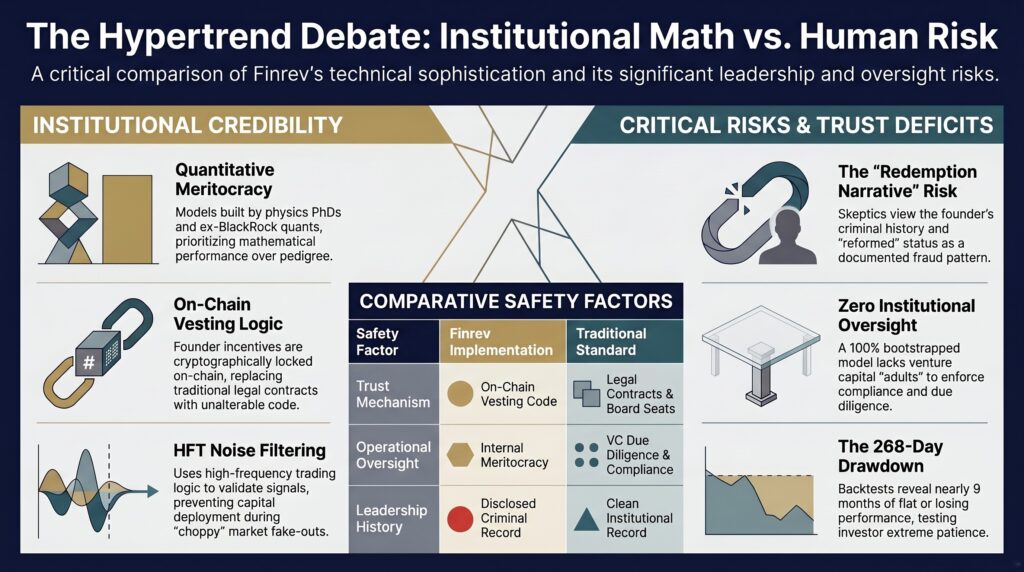
Host: Absolutely. So, to frame this, I’m coming at it from the Trader Army perspective. My focus is on the math, the market physics and the raw efficiency of the system they’ve built. I’m looking at it through the lens of the quants, the ex-BlackRock types and PhDs behind it. For me, it’s about the data.
Expert: And I’m coming from the other side. I’m the sceptical investor who’s seen a few cycles. I’ll be drawing on some analogies from well, marine ecology, something the researcher Vince often talks about, to question how safe this really is. I mean, nature teaches us that overly complex systems are often the first to collapse. I need to know if this is a robust ecosystem or just a fragile coral reef waiting for a shock.
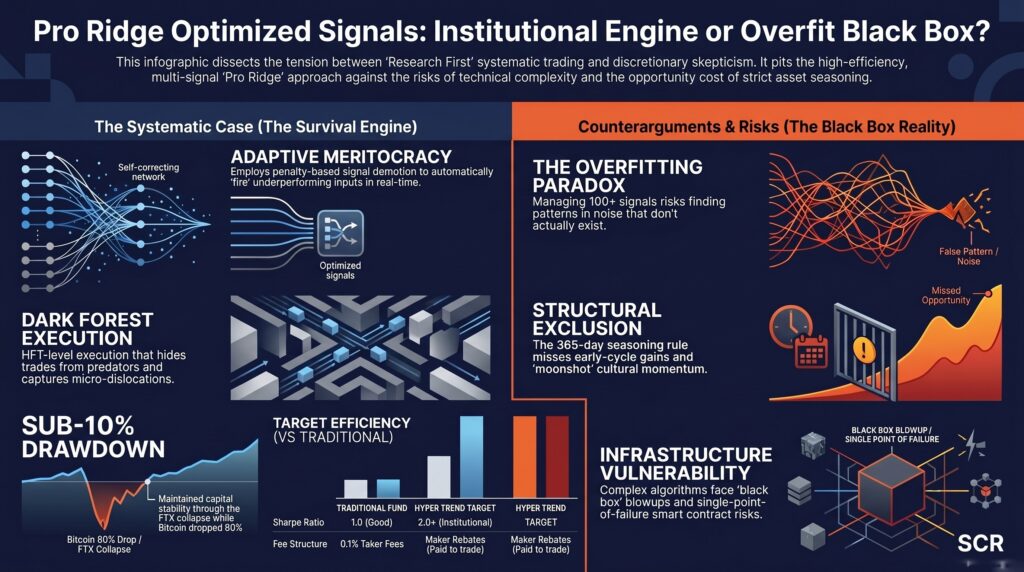
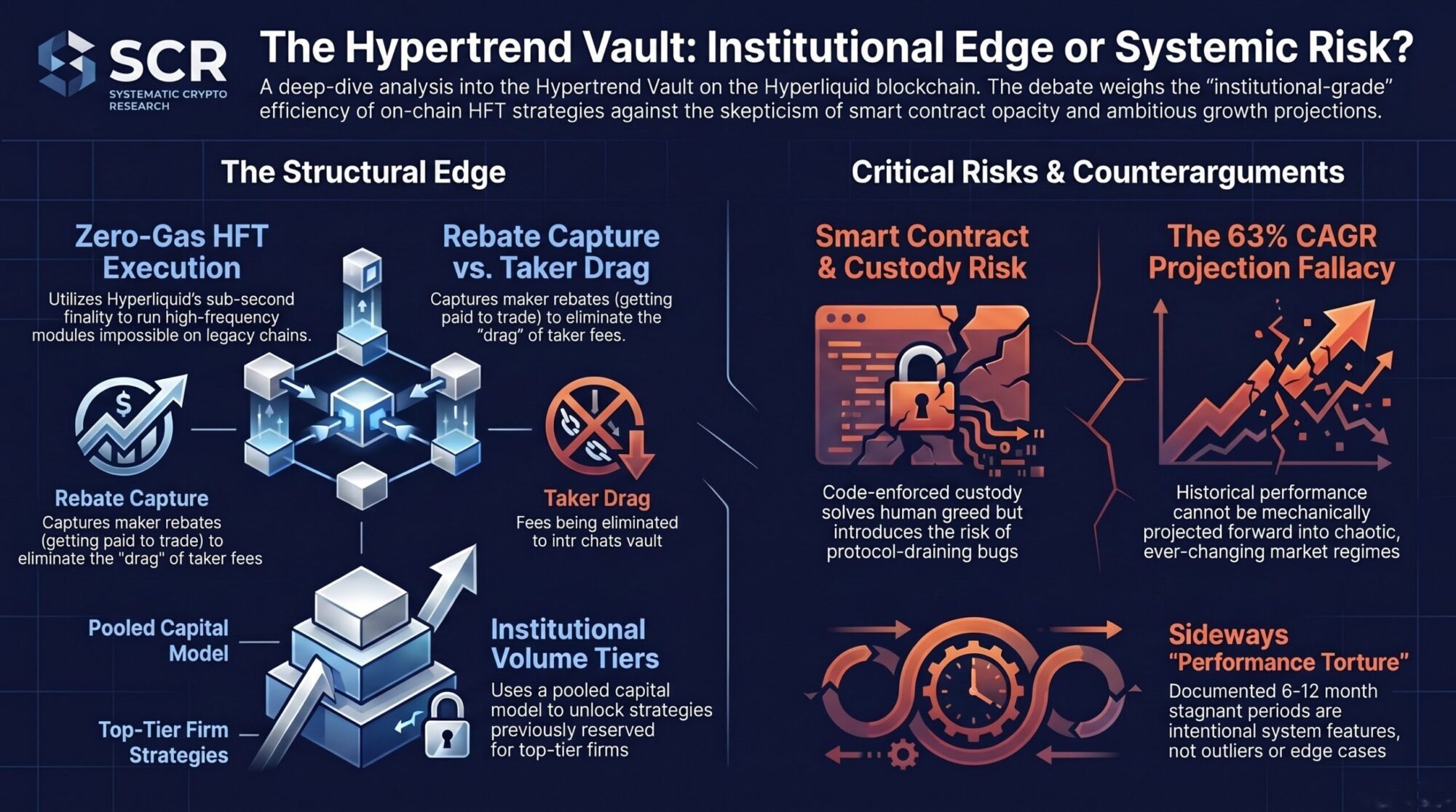
Host: I appreciate that framework, though I suspect we’ll find this ecosystem is a lot more resilient than you think. Let’s get into it. I’ll start with my position. Look, the HyperTrend Vault isn’t just another crypto wallet. It’s to use their own pretty vivid phrase, it’s the bastard child of trend following and HFT, high frequency trading, brought to life on-chain. For years, the old FINREV model was limited by API connections. All these individual accounts, latency issues, API errors, just drag. By moving to an on-chain vault on Hyperliquid and partnering with Dark Forest Technology, it’s now a pooled capital model, and that unlocks strategies that are, well, mathematically impossible for one person alone. We’re talking about maker rebates, literally getting paid to trade, and funding rate arbitrage. All with sub-second finality. This is institutional precision. My thesis is that this finally gives retail investors the kind of edge that was, you know, previously only for firms like Jane Street.
Expert: That is a very compelling pitch. I’ll give you that. But let me tell you why I’m pumping the brakes. Institutional precision looks fantastic on a slide deck. But in complex systems, whether it’s a coral reef or a blockchain, the law of unintended consequences is king. My core argument is that we’re introducing layers of opacity. We’re facing that classic crypto Hotel California problem. You can check your money in, but can you ever really leave? I’m deeply sceptical of the projections. A 63% CAGR is a massive, massive number. And we’re putting all our faith in a pretty new layer 1 blockchain, Hyperliquid, instead of something battle tested like Ethereum. So, my thesis is simple. This transition just adds layers of smart contract risk and token complexity. You’ve got TLP, you’ve got Trend tokens that might just obscure the simple goal of preserving wealth.
Host: I mean, the mantra is “research first, hype never,” but an airdrop point system that feels like it’s getting dangerously close to hype.
Expert: I see why you’d think that, and we should definitely dig into that distinction between hype and incentive design. But let’s move to the core debate. I want to start with the strategy itself because that’s the engine here. You mentioned complexity, but let’s actually look under the hood. The source material calls the strategy a blended soup of over 50 assets. It’s not just simple trend following. If it were, I might actually agree with you on the fragility point, but this is combining mean reversion, cross-sectional momentum, and carry trades.
Host: Blended soup is a charming metaphor, but let’s be specific. In ecology, that’s a generalist strategy, and generalists do well until the environment changes dramatically. You just threw out a few terms. Mean reversion, cross-sectional momentum. What are we actually buying here?
Expert: Okay, let’s break it down. Cross-sectional momentum is it’s basically taking advantage of the lag in the market. In crypto, Bitcoin almost always moves first. It breaks a key level. The altcoins, your Ethereum, your Solana, they often take a few seconds or even minutes to react. The algorithm sees the Bitcoin move and instantly gets into those lagging assets to ride the wave.
Host: So, it’s drafting like a cyclist behind a truck.
Expert: Exactly. It’s pure physics. Then you have mean reversion. Think of it like a rubber band. If an asset’s price stretches way too far from its average too fast, the algorithm shorts it, betting it’ll snap back. And finally, you have carry trades, which are about harvesting funding rates.
Host: Okay, hold on. Carry trades. This is often where the hidden risk is in these products. You’re basically just betting that the cost of borrowing stays stable, right?
Expert: Not exactly. In crypto perpetuals, there’s a funding rate. When everyone’s bullish and levered long, the longs have to pay the shorts. The vault takes the short side of that. It stays market neutral and just collects those payments. It’s not betting on price. It’s betting on market greed. It’s collecting fees from impatient speculators.
Host: So, you’re the casino. You’re not playing the game. You’re just taking the rake.
Expert: Precisely. And this all leads to the performance data. The projections are based on that classic hockey stick curve. Even in what the research calls a conservative scenario, think choppy sideways markets. The model projects a $10,000 deposit growing to about $53,000 over 5 years. That’s a 5.4x. And if you look at the likely scenario based on the historical 63% CAGR, that same 10 grand becomes $115,000. These aren’t just fantasy numbers. They’re extrapolated from the 4,815% returns FINREV has generated since 2019. The math is there.
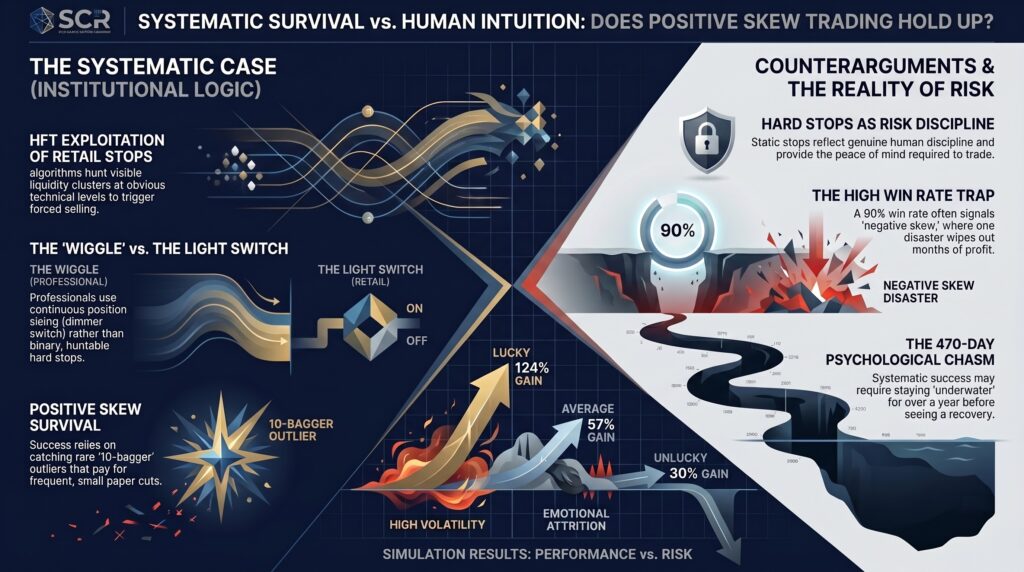
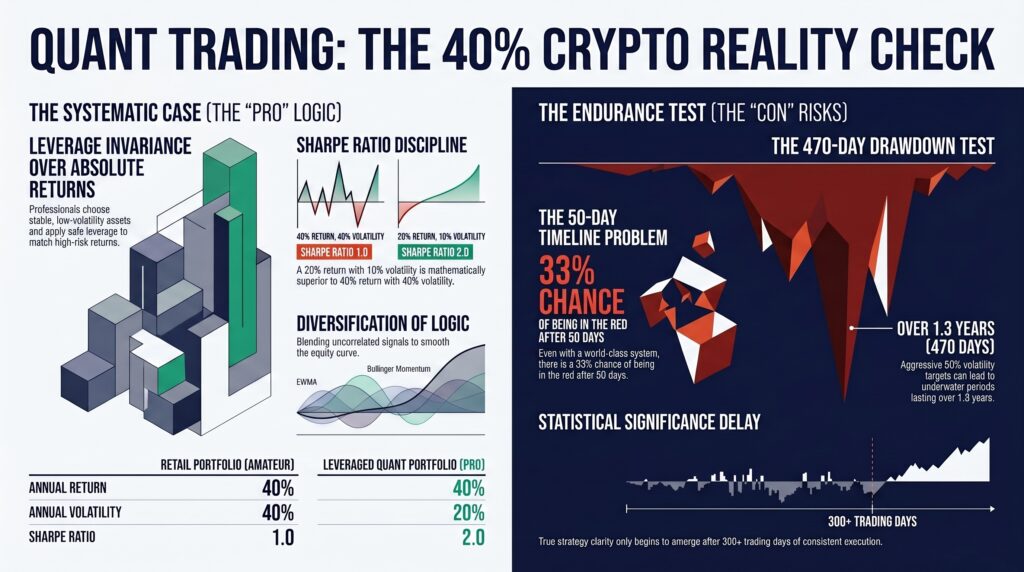
Host: I’m sorry. I have to pull the emergency brake there. 10,000 into 115,000 in five years. That’s a growth rate that beats Warren Buffett, that beats Jim Simons. It beats almost every hedge fund in history. You can’t just extrapolate past performance into the future like that. You’re citing the likely scenario, but markets are chaotic systems. In nature, a population booms until it hits a limit and then it crashes. What happens when the market regime changes? What about the drawdowns? The research itself says to expect 10 to 20% drawdowns.
Expert: That is a fair point, and to be clear, the research is upfront about this. It states very clearly that there will be periods of 6 to 12 months of sideways grinding performance. The source material literally calls it torture for impatient investors. But this is where the research first mindset is so important. This is not a short-term flip. It demands a 5 to 10 year horizon. The resilience comes from that blend of strategies. So when trend following is getting chopped to pieces, the HFT modules are farming maker rebates, and the carry trades are still harvesting funding. It’s designed to survive the famine to thrive in the feast.
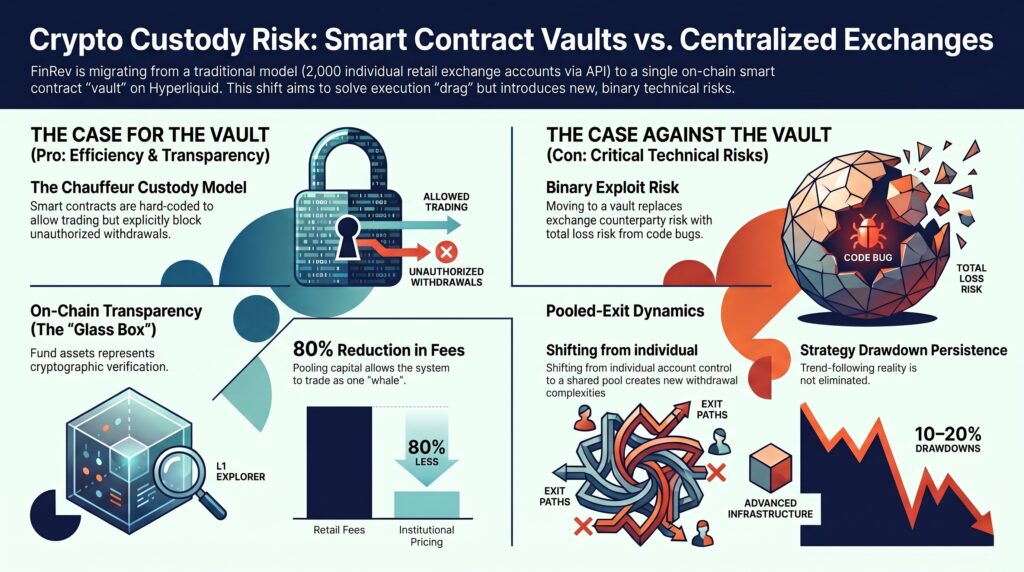
Host: Surviving the famine is one thing, but looking at a dashboard in the red for 8 months straight, most retail investors are going to panic and sell at the absolute bottom of that window. But let’s pivot to the mechanics of that survival. You mentioned the pooled capital model. This brings me to custody and security. I mean, in crypto, “not your keys, not your coins” is the first thing you learn, usually the hard way. By depositing into this vault, I am, for all intents and purposes, handing my keys to a smart contract. I’m giving up direct control. It feels like we’re just rebuilding a bank on the blockchain.
Expert: That’s a valid fear, but I’d argue the architecture is fundamentally different from a bank or, say, an FTX. This uses a smart contract custody model. Think of it like a bank vault with two completely separate keys. Key number one is the user’s key. Only you, or the wallet that deposited, can sign a transaction to withdraw funds. The code literally can’t send your funds to anyone else.
Host: And the second key?
Expert: The second key belongs to the contract itself. That key has the authority to execute trades, swap USDC for Bitcoin, open a hedge, but it has zero authority to transfer ownership of the capital.
Host: So in theory, the algorithm can lose my money through bad trades. It can go to zero. But the CEO can’t just run off to the Bahamas with it.
Expert: Exactly. It completely mitigates counterparty risk, the risk of human greed. It replaces that with code-enforced rules.
Host: However, and this is a huge however, code has bugs. We’ve seen hundreds of millions drained from DeFi protocols because of a single misplaced semicolon. The source material admits this. You solve centralised risk, but you introduce smart contract bug risk. You’re just trading a human thief for a digital one.
Expert: That’s true, and it’s a risk you have to acknowledge. There’s no such thing as risk-free yield, but the system is built on the battle tested Ethereum virtual machine standard, and the code goes through multiple independent audits. Plus, and this is key, it’s all transparent on-chain. You can see the holdings in real time. You couldn’t do that with FTX. That was a black box. This is a glass vault.
Host: Fair enough. It’s a trade-off. Okay, let’s talk about what’s actually in this glass vault because the terminology is becoming a bit of an alphabet soup. We’ve got USDC, TLP and now Trend tokens.
Expert: Yeah, precision is important here. Let’s break it down.
Host: Please do. Because from the outside, it looks like a convoluted way to just print money and juice the returns. Why do we need two different tokens?
Expert: Well, it’s actually a pretty standard structure in sophisticated DeFi. The ERC-4626 standard. First, you have TLP, tokenized liquidity provider tokens. Think of this as your receipt. You deposit $10,000, you get $10,000 worth of TLP. As the vault trades and the underlying assets grow, the value of your TLP grows with it. It’s your ownership certificate.
Host: Okay. So, TLP is my share of the fund. That’s simple enough.
Expert: Exactly. Then you have the Trend token. Now, this is equity in the protocol itself. It’s what’s being distributed through that point system ending in March. Holding Trend is like owning a piece of the vault’s business.
Host: And what’s the value in owning the business? I mean, usually governance tokens are just useless voting rights, right?
Expert: But here the value is yield. This is what they call the flywheel. The vault charges a 20% performance fee on profits. That fee doesn’t go to the developers. It gets paid out to people who stake their Trend tokens. So if the vault makes a million in profit, $200,000 is distributed to Trend stakers in USDC.
Host: That is actually a significant distinction. Most DeFi protocols pay you yield in their own inflationary token. They just print more to pay you for holding it, and the price goes to zero. It’s a Ponzi. You’re saying this yield is in real USDC from actual trading profits.
Expert: Correct. It’s a real yield model. And that’s why the point system is so aggressive right now. A depositor with say 25K could earn hundreds of thousands of Trend tokens in this six-month window. It’s all about aligning incentives. The users who provide the capital become the owners who profit from the fees.
Host: I have to concede that it is a much stronger economic model than 99% of what’s out there. If the trading works, and that is a big if, then the token has real intrinsic value. But let’s talk about where this trading happens. The move to Hyperliquid.
Expert: Yes, that shift to the Hyperliquid layer 1 is the whole technological unlock.
Host: But why leave the relative safety of Ethereum? Hyperliquid is new. It feels like moving a bank from Wall Street to a tent in the desert just because the rent is cheaper.
Expert: It comes down to physics, speed, and cost. Hyperliquid offers something like 20 times the speed of Solana with sub-second finality. But the real key is zero gas fees for trading. On Ethereum, high-frequency trading is just impossible. The gas fees would eat every cent of profit. On Hyperliquid, the vault can run those HFT modules. It can place thousands of limit orders to capture the spread and generate maker rebates.
Host: We touched on this, but explain maker rebates like I’m five. How do you get paid to trade?
Expert: Okay, imagine a toll road. Normally, you pay a toll to drive on it, right? That’s a taker fee. But the road needs cars on it to look busy. So, the operator says, “Hey, if you just park your car here and let someone else buy it from you, we’ll pay you.” You’re a maker. You are making the market.
Host: And because Hyperliquid is so fast, the algorithm can park and unpark that car thousands of times a minute.
Expert: Exactly. It captures tiny fractions of a cent thousands of times a day. It creates an income stream that’s completely separate from whether the market is going up or down.
Host: So, you’re just scalping the market noise.
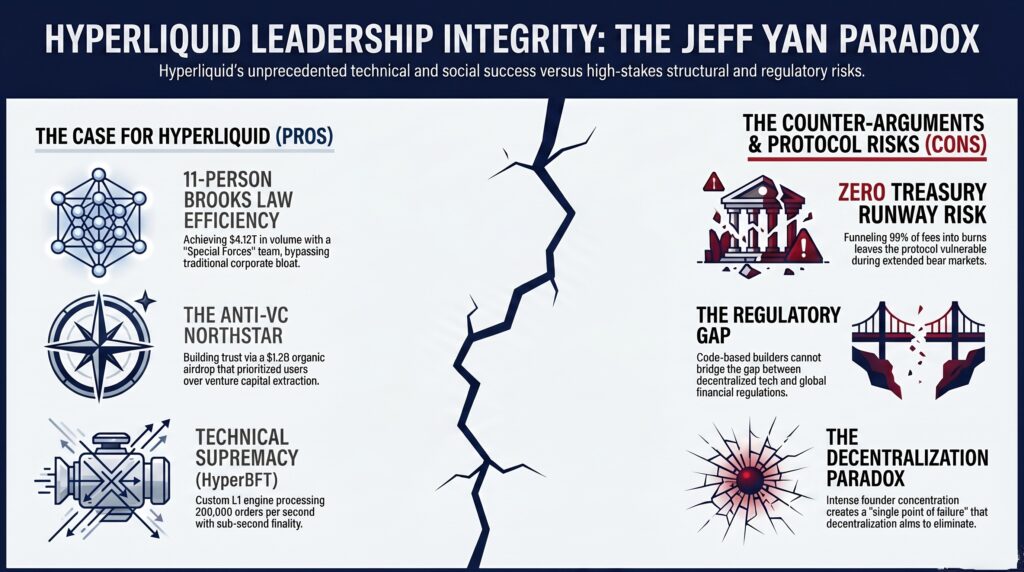
Expert: Yes. And that’s only possible on a chain built for this. I mean, the Hyperliquid team comes from Jane Street. They’re HFT natives, and the volume speaks for itself. Over 35 billion in cumulative volume. It’s new, sure, but it’s purpose-built.
Host: I hear you on the technical specs, but as an ecologist, I worry about invasive species. A new chain is a new environment. We don’t know what predators or you know exploits exist there yet. Ethereum is like an old-growth forest. It’s robust. Hyperliquid feels more like a fast-growing plantation. If that chain halts or if the bridge gets hacked, all that speed means nothing.
Expert: It’s a fair analogy, but it ignores the need for evolution. If you want to race in Formula 1, you don’t drive on a cobblestone road. You need a racetrack. Hyperliquid is the track. The risk of the venue is real, but that’s the price you pay for that level of performance.
Host: Let’s circle back to the user experience, the “research first, hype never” mantra. The source material really emphasizes that this is for people who can handle volatility. Specifically, it mentions the conservative, likely, and optimistic scenarios. And I do want to touch on the optimistic one. If we see a true mania phase bull run, the model suggests 100 plus percent APY is possible. That $10,000 deposit could grow to $320,000 in 5 years.
Expert: And that is exactly where my alarm bells start ringing. 320,000 from 10. That sounds like Lambo talk. That sounds like late night infomercials.
Host: It would be if it weren’t backed by the mechanics of compounding in a high volatility environment. It’s a projection, not a promise. But I agree, and the team agrees that users should be focusing on the conservative baseline to manage their expectations.
Expert: I think that’s the responsible take. The source material is brutally honest. If you can’t psychologically handle 6 to 12 months of sideways performance, this strategy will torture you and that honesty is refreshing. Most crypto projects promise only forever. This one admits there will be pain.
Host: Intellectual honesty is part of the brand. Vince, the researcher, puts his own capital in. He calls it skin in the game. He’s putting a significant portion of his own portfolio in the vault.
Expert: And that surprisingly is one of the most persuasive things for me. Not the Sharpe ratios, not the zero gas fees, it’s the fact that the people who built it are eating their own cooking.
Host: It changes the entire incentive structure. If the ship sinks, the captain’s going down with it.
Expert: We’re getting close to the end of our time. I have to say, while I still have my skepticism about the newness of the chain, the complexity of the contracts, the logic does hold together better than I first thought. So, where do you land on it?
Host: I’m willing to concede that the institutional precision does create a real advantage. The focus on long-term compounding and the refusal to promise overnight riches align with the mature philosophy. I’m still very cautious about those sideways periods. I think I’m willing to learn more specifically about how to accumulate those points before the March TGE, but I’d be going in with eyes wide open, treating it less like a savings account and more like a venture capital bet.
Expert: That’s a balanced view. From my side, I see this as a systematic wealth engine. It’s not a slot machine. The combination of TLP growth, the Trend airdrop, and the USDC staking yield. It creates a multi-layered compounding effect that’s well hard to ignore. It’s the application of physics to finance.
Host: Just remember, even the best engineered ships can sink if the ocean decides to turn on them.
Expert: True, but I’d rather be on the ship with the best navigation system. As we sign off, just remember that core principle. Research first, hype never. The data is out there. The chain is public.
Host: Indeed. Don’t take our word for it. The debate continues in the data. Go verify everything on-chain. Thank you for listening to the debate.
📖 Read the Full Article: The HyperTrend Vault Launch: Your Practical Guide to Institutional-Grade Wealth Building
Key Takeaways
- Pooled Capital Unlocks Institutional Strategies – Vault architecture enables maker rebates, funding rate arbitrage, and coordinated HFT execution that’s mathematically impossible for individual retail accounts.
- Smart Contract Custody Changes the Risk Profile – Two-key architecture separates trade execution authority from capital transfer authority, eliminating counterparty risk while introducing smart contract bug risk.
- Token Economics Create Real Yield – TLP tokens represent vault ownership while Trend tokens earn 20% of trading profits distributed in USDC, not inflationary protocol tokens.
- Hyperliquid Enables Zero-Gas HFT – Sub-second finality and zero trading fees make high-frequency strategies viable that would be cost-prohibitive on Ethereum.
- Transparency is Non-Negotiable – All holdings, trades, and balances are verifiable on-chain in real-time, replacing trust-based systems with code-enforced rules.
- Conservative Expectations Matter – Despite 63% CAGR projections, the system is designed for 5–10 year horizons with expected 6–12 month sideways periods that “torture” impatient investors.
🎯 Explore the Vault Infrastructure
The architectural shift from API-connected bots to on-chain vaults represents the evolution of professional crypto trading infrastructure.
Next Step: Watch the introduction video to understand:
- How smart contract custody actually protects your capital
- The technical mechanics of maker rebates and funding arbitrage
- On-chain verification and transparency features
All holdings and trades are verifiable in real-time on Hyperliquid. This is transparent, code-based finance—not trust-based promises.
Continue Learning
Related Deep Dives:
- The Math Behind Hedge Fund Returns: Understanding Sharpe Ratios and Risk-Adjusted Performance
- Smart Contract Custody vs. Exchange Custody: Post-FTX Security Models
- Cross-Sectional Momentum Explained: How Algorithms Exploit Market Lag
Resources Mentioned
- HyperTrend Vault – On-chain pooled capital trading system on Hyperliquid
- Dark Forest Technology – HFT execution partner for order routing
- Hyperliquid – Layer 1 blockchain purpose-built for derivatives trading (35B+ volume)
- TLP Tokens – ERC-4626 vault share certificates representing ownership
- Trend Token – Protocol equity token earning 20% performance fee distribution
- FINREV – Legacy system with 4,815% returns since 2019, migrating to vault architecture
- Jane Street – Origin of Hyperliquid founding team (HFT background)
About This Podcast
This debate explores the technical and philosophical implications of bringing institutional-grade high-frequency trading to retail investors through vault architecture. For traders evaluating the shift from centralised exchange API bots to on-chain pooled capital systems, understanding both the advantages and the risks is critical.
Related Articles:
- Why a Proven Crypto Trading System is Rebuilding on Hyperliquid Vault Infrastructure
- Understanding Real Yield: How Trading Profits Fund Token Economics
- The Hotel California Problem: Liquidity and Exit Mechanisms in DeFi Vaults
Transcript generated from Notebook LM podcast discussion. Edited for clarity and formatted for web publication.