
HYPE and the Institutional Influx: What’s Actually Happening Right Now
Why Hyperliquid’s Native Token Just Hit an All-Time High — And What the Smart Money Knows That the Market Is Only Starting to Price In
On May 21st, 2026, HYPE broke above $62 — a fresh all-time high, up more than 20% in a single trading day, while Bitcoin barely moved. It was the best single-day performance of any top-100 cryptocurrency on the planet, by a wide margin.
If you’ve been following Hyperliquid through this site, none of this should feel surprising. If you’re arriving here fresh, you’re probably asking the right question: is this a momentum trade, or is something structural shifting?
The honest answer is both — and separating the signal from the noise is exactly what this piece is for.
SCR has been tracking Hyperliquid since before most of the market paid attention. The analytical case for Hyperliquid’s infrastructure was already compelling at $4 billion market cap. At the current levels, the question has evolved: the infrastructure argument is largely settled. What’s being priced now is something larger — the possibility that Hyperliquid becomes the primary on-chain rail for institutional capital as the regulatory architecture of digital finance gets rebuilt around it.
That’s a significant claim. Let’s look at the evidence for it.
🎧 Listen to the Podcast
Prefer audio? This article is also available as a structured debate podcast — two voices examining the institutional influx thesis from opposite positions.
Duration: 21 minutes
▶ Listen on Spotify | 📄 Read the Transcript and Counterargument Analysis
Table of Contents
The Regulatory Unlock: The GENIUS Act and What It Actually Means for On-Chain Capital
To understand what’s moving HYPE, you need to understand what just changed in the regulatory environment — because the price action is, in part, the market beginning to price in a structural shift that hasn’t fully arrived yet.
The GENIUS Act — the Guiding and Establishing National Innovation for U.S. Stablecoins Act — passed through the U.S. Senate in May 2026 after clearing a 66-34 procedural vote. It establishes, for the first time, a coherent federal framework for U.S. dollar-backed stablecoins. This is not a minor regulatory tweak. This is the legal scaffolding that allows legacy financial institutions to deploy capital directly onto public blockchains without operating in a regulatory grey zone.
For the past five years, institutional money has been standing at the edge of the on-chain market, looking in. Compliance officers could not sign off. Legal frameworks were absent. The institutional appetite existed — the infrastructure to act on it, compliantly, did not. The GENIUS Act changes that equation materially.
Compounding this is the World Liberty Financial (WLF) banking registration play — WLF’s push for a national trust bank charter and the development of its compliant USD1 stablecoin represent the execution layer of this new era. Traditional finance is no longer merely studying crypto. It is building on it.
The GENIUS Act codifies a uniform federal framework for U.S. dollar-backed stablecoins, giving legacy financial institutions the legal authority to deploy capital on public blockchains. It is widely regarded as the most significant U.S. crypto legislation since the Bitcoin ETF approvals of 2024. Compliance timelines extend to 2027, meaning the full capital deployment cycle is still ahead of us. For institutional compliance officers who could not previously sign off on on-chain deployments, this framework resolves the legal ambiguity that has held institutional capital at arm’s length from decentralised infrastructure for years. Authority refs: Senate Banking Committee records, May 2026 | Consensys policy analysis, May 2026 | Bloomberg Law — Stablecoin Framework Coverage
The question for any investor tracking this development is the same: when that wall of institutional capital starts moving on-chain, where does it route?
It routes to wherever it can be deployed most efficiently. And efficiency in this context means sub-second transaction finality, deep organic liquidity, fully on-chain order books, and infrastructure that doesn’t break under institutional-grade volume. Legacy networks were not built for this. Hyperliquid was — years before the regulatory environment made it relevant.
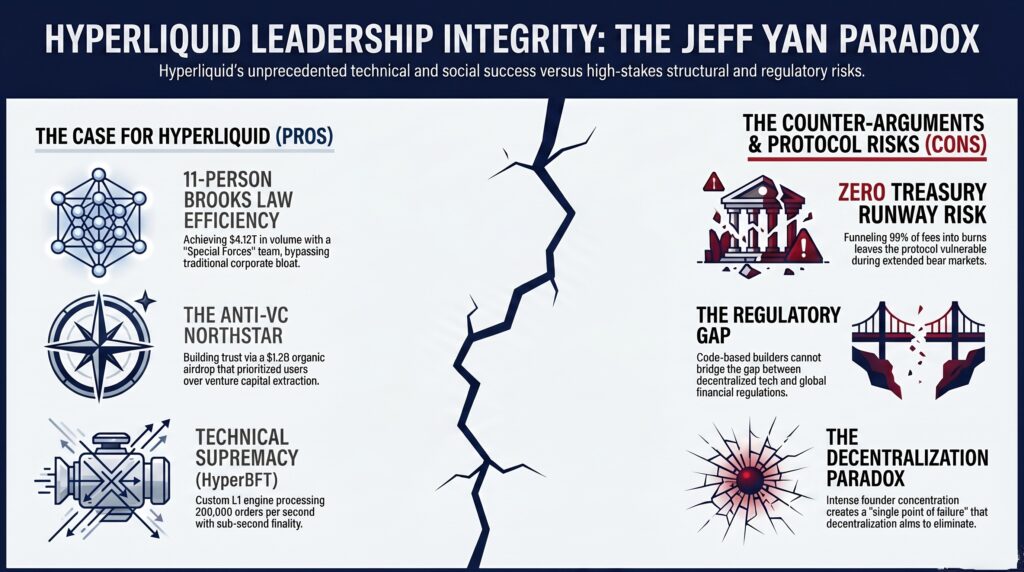
The leadership culture and architectural decisions that made this possible are covered in full in our Jeff Yan analysis.
The Infrastructure That Was Already There
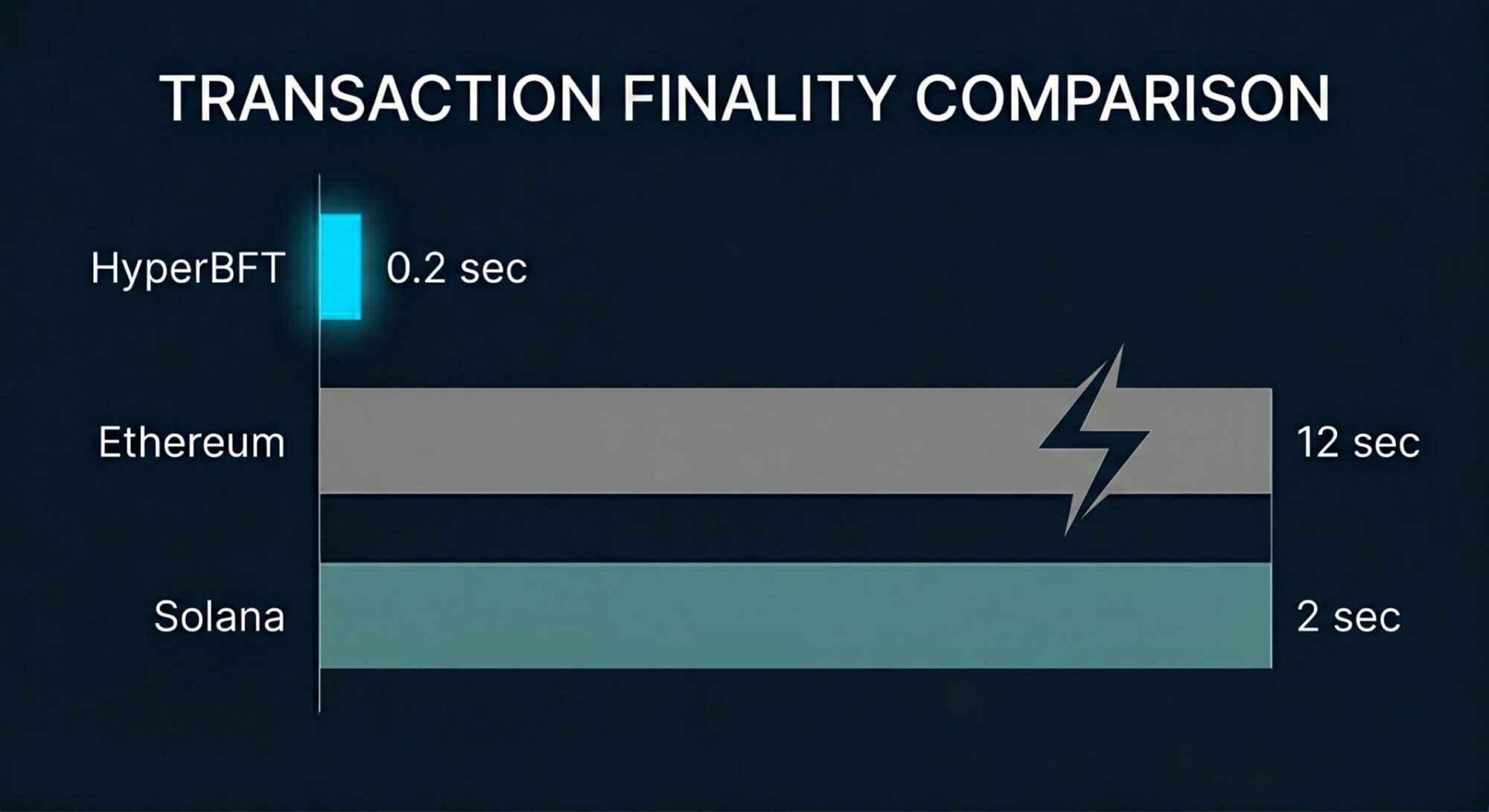
For readers new to Hyperliquid, a brief orientation — because the technology underpinning the current price move matters.
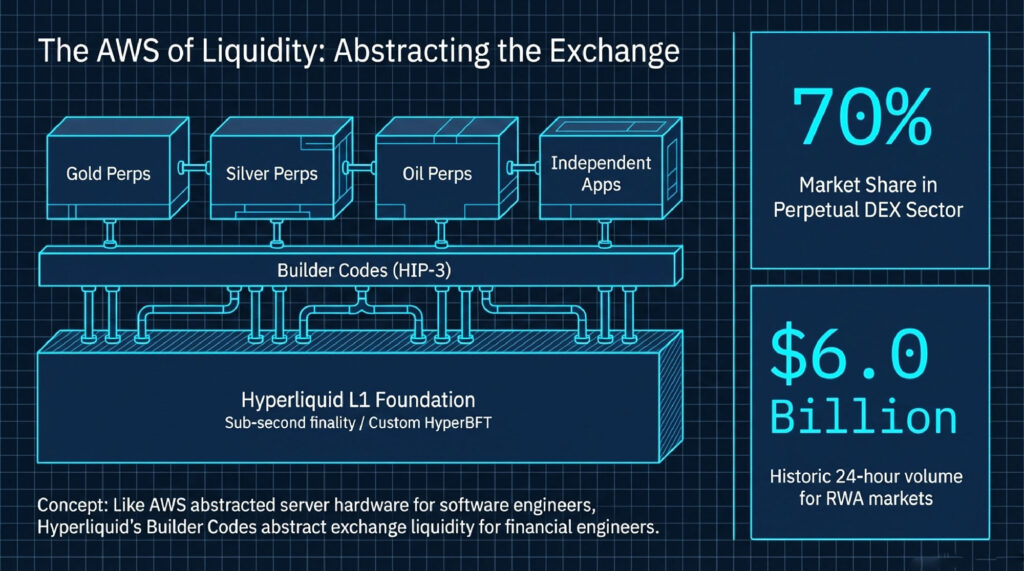
Hyperliquid is a specialised Layer-1 blockchain built entirely from scratch as a financial trading engine, not a general-purpose chain with a DEX bolted on. Its custom consensus mechanism, HyperBFT, achieves 0.2-second deterministic transaction finality while processing 100,000 to 200,000 operations per second — an order of magnitude beyond the New York Stock Exchange’s throughput, on a fully decentralised chain. It runs a fully transparent, on-chain order book: the execution quality of a centralised exchange with the self-custody and transparency of a decentralised one.
The full technical architecture is documented in our Technical Deep Dive. The point here is narrower: this infrastructure was not built in response to the GENIUS Act. It was already there.
One of Solana’s most vocal long-time builders put it publicly this month: Solana’s original pitch was to be a “light-speed NASDAQ.” After years of trying, no Solana DEX matched that vision. Hyperliquid, in his view, is the product Solana was always meant to enable. When the loudest believers in a competing project start switching sides, it’s worth noting.
An on-chain order book records every trade, every position, and every liquidation permanently and publicly on the blockchain — visible to anyone, verifiable by anyone, in real time. A centralised exchange’s order book lives on private servers. Users must trust the operator to report positions accurately. The FTX collapse was not caused by a technical failure. It was caused by an operator misrepresenting what was happening on those private servers. A fully on-chain order book makes that specific category of fraud structurally impossible — because there are no private servers to misrepresent. For institutional investors operating under post-FTX compliance mandates, this transparency is not a feature preference. It is a risk management requirement. Authority refs: FTX bankruptcy proceedings, Southern District of New York, 2022–2024 | CFTC — “Regulatory Priorities for Digital Asset Transparency,” 2025 | BIS Working Paper No. 1168 — “DeFi transparency and systemic risk in digital asset markets,” 2024
I’ve been watching this story unfold for two years. I was trading actively in the perps market when Scott Phillips — whose background you can read about in full in Inside the FINREV Team — launched a video seminar for FINREV members entitled “Hype: The 10 Million Dollar Trade.” It was a game-changer. Scott had gotten deeply interested in Hyperliquid’s development and laid out a future in that video that is literally rolling out in front of us today.
What set this story apart from every other “coin of the future” narrative was the leadership. Scott had struck up a conversation with Jeff Yan — then the unknown CEO of Hyperliquid — who approached him simply as an active trader and asked: “How’s it going? How can we make the trading platform better for you?” That was the moment Scott saw there was something genuinely different happening at Hyperliquid. The FTX horror feels far away now. In 2026, the future looks bigger than it did even then.
Scott’s Call: The Stealth Bull Market Nobody Is Watching
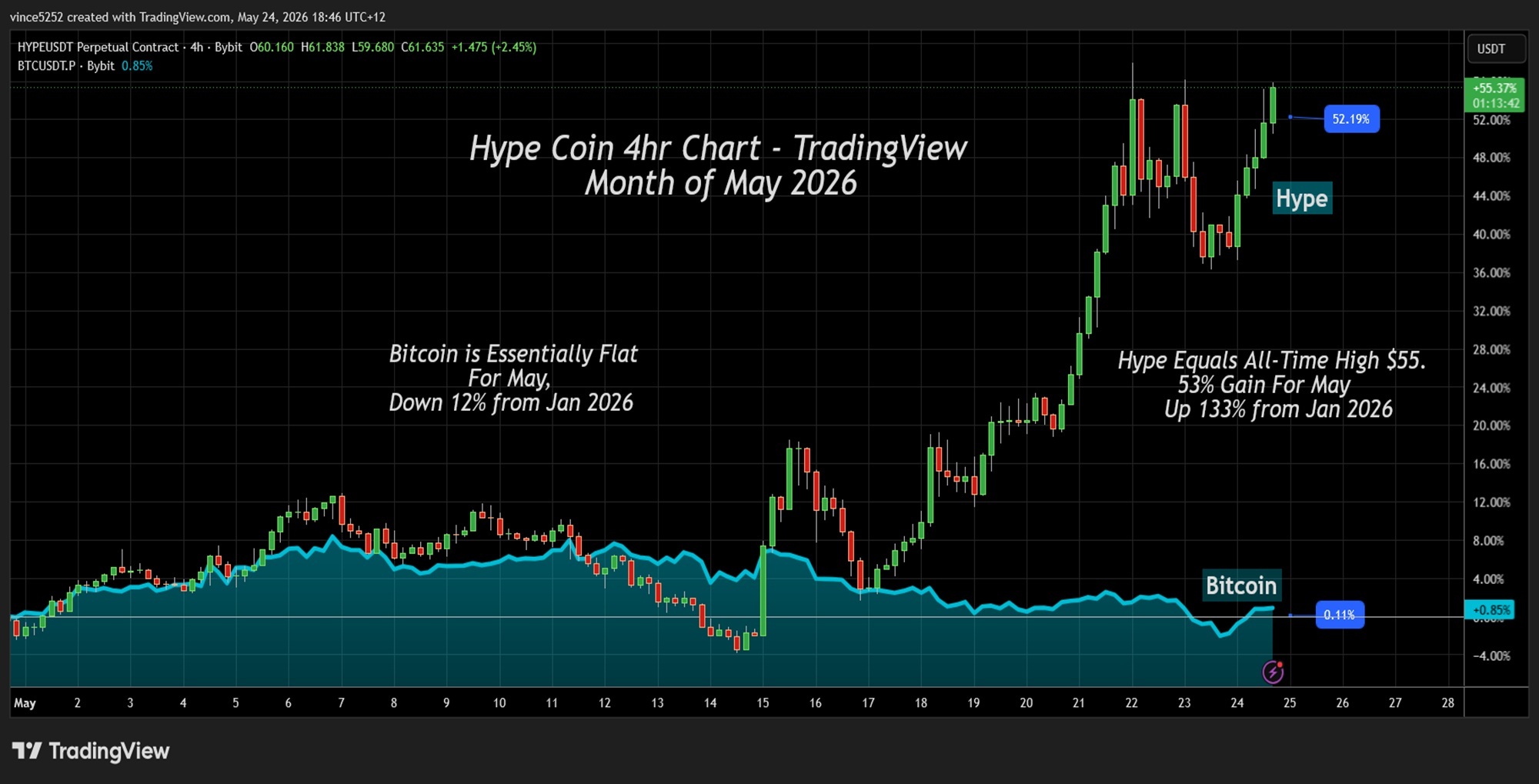
Scott Phillips doesn’t do stealth. His communication style is direct to the point of being confrontational, and it’s one of the reasons SCR covers his work — because authentic conviction stated without polish is more useful signal than carefully managed institutional communication.
Earlier this month, Scott sent a note to FINREV and HyperTrend members that is worth understanding in full context. The core of it:
“A new bull market doesn’t announce itself with fanfare. It announces itself with boredom. The market is boring, the influencers are capitulating, the true believers are turning on each other — and yet the price is going up. HYPE is within reach of recapturing its all-time highs. Nothing is more bullish than all-time highs.”
And the line serious traders should file away: the coins that will be the big movers of this bull market move first. HYPE right now is that coin leading out. Scott has demonstrated this pattern time and again — identify the early mover before the crowd arrives, hold conviction through the noise, and let the market catch up. That note was written before HYPE broke $62. By any reading, it was a timely call.
The more interesting part of Scott’s position is not the call itself — it’s the posture behind it. Scott is a systematic trader. His methodology is built around algorithmic execution and disciplined position management. He does not “set and forget.” That’s not how systematic trading works.
Except with HYPE. Scott has stated publicly that HYPE represents approximately half his personal crypto portfolio, held as a fundamental conviction play. He has bought lows and held through significant drawdowns — and come out the other side. For a systematic trader of his background to hold a position through a move from $58 to $21 and back through $62 without blinking tells you something important about the conviction level behind the thesis. That is not a trade. That is a fundamental belief about where the protocol goes from here.
It also tells you something important about the risk — which we’ll return to.
What’s Actually Moving the Price Right Now
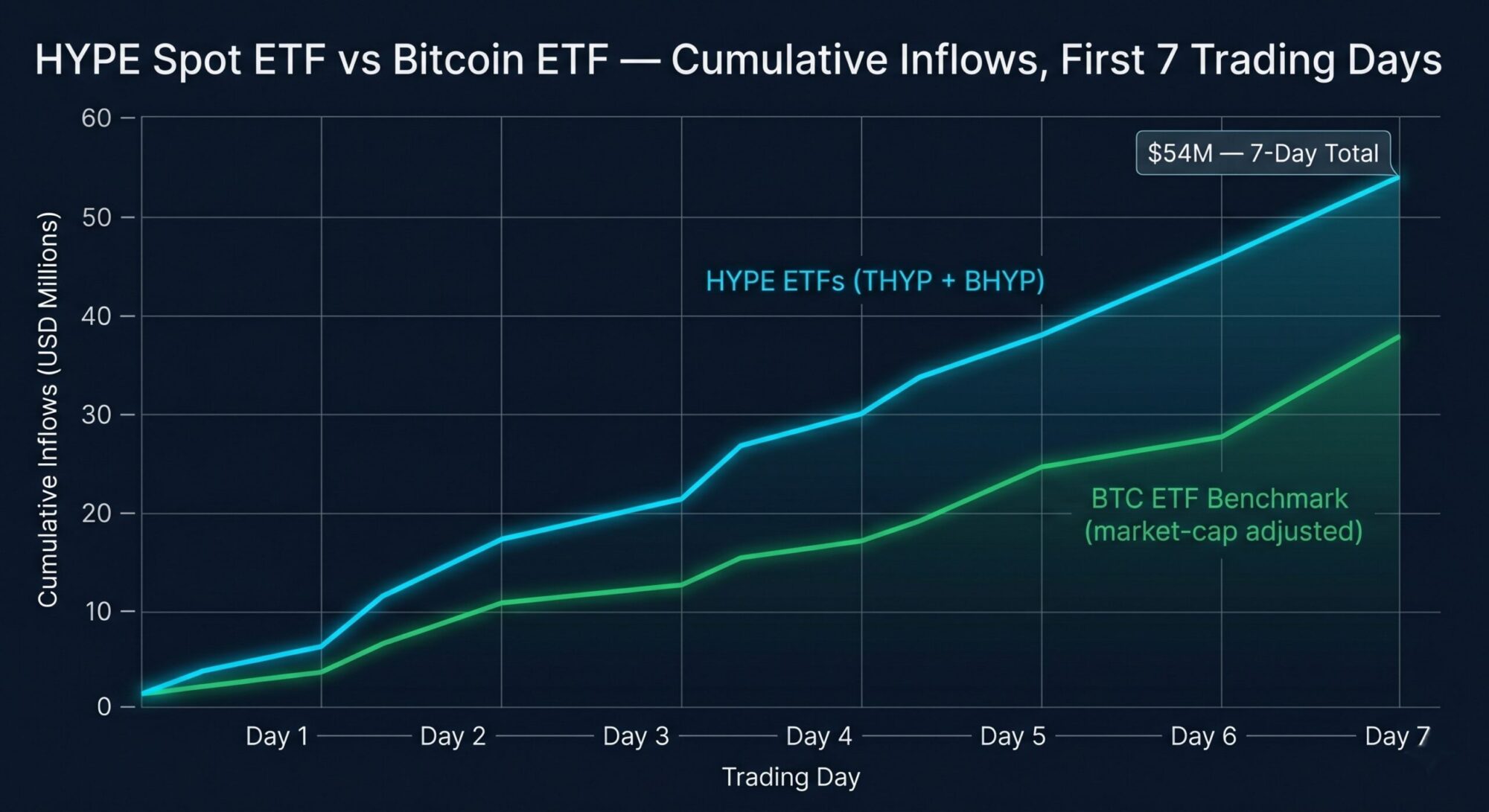
The May 21 move was not driven by speculation alone. The data behind it is specific and verifiable.
Spot HYPE ETFs launched on U.S. markets earlier in May — the 21Shares Hyperliquid ETF (THYP) and Bitwise’s BHYP. In their first seven trading days, the two ETFs combined attracted approximately $54 million in cumulative inflows, with a single-day record of $25.5 million on May 21st alone. THYP led with $16.7 million and BHYP added $8.8 million on that day.
The pace matters. Presto Research noted that on a market-cap-adjusted basis, institutional capital was entering HYPE ETFs faster in the early days than it entered Bitcoin ETFs at the equivalent stage. Whether that pace sustains is a different question — but the opening signal is meaningful.
Grayscale-linked wallet accumulation is running in parallel. Lookonchain flagged that wallets linked to Grayscale purchased approximately 115,700 HYPE — around $7 million — within a single hour on May 21st. Over the preceding week, the same cluster accumulated more than 682,000 HYPE, valued at approximately $41.6 million. Grayscale had also filed for its own spot Hyperliquid ETF earlier in the year.
Bitwise is going further still. The asset manager announced it plans to use 10% of management fees from BHYP to acquire HYPE for its own balance sheet — and stake it. An institutional asset manager using a public product to build a long-term staked position in the underlying asset is a structural signal about conviction, not a trading decision.
| ETF | Ticker | Day 1 Inflows | 7-Day Cumulative |
|---|---|---|---|
| 21Shares Hyperliquid ETF | THYP | $1.2M | ~$37M |
| Bitwise Hyperliquid ETF | BHYP | — | ~$17M |
| Combined | — | — | ~$54M |
The broader Hyperliquid numbers provide the fundamental foundation. Q1 2026 generated $215 million in gross revenue. The protocol bought back 4.9 million HYPE tokens during the quarter. Total Value Locked sits at $1.69 billion. HYPE climbed roughly 44% during a quarter the Hyperliquid Research Collective described as one of the worst for crypto markets since 2018 — a quarter in which Bitcoin dropped 26% and the total crypto market cap shed over $900 billion.
Hyperliquid went up while the market bled. That is not a coincidence.
The HYPE Tokenomic Engine: Doing What Bitcoin Always Promised
The full deflationary model is covered in detail in Beyond the “Magic Bean” Trap — HYPE Tokenomics, and further context in The Jeff Yan Paradox. What’s worth stating here is the angle specific to this moment.
Bitcoin’s original thesis was radical and simple: create lasting, appreciating value by fixing supply and making the network more useful over time. Inflation couldn’t eat it. No central authority could dilute it. Community participation was rewarded by the asset itself becoming scarcer and more valuable as adoption grew. It was a genuinely new idea about how value could be stored and grown.
The gap between that thesis and Bitcoin’s execution has always been that Bitcoin’s utility is largely passive — you hold it, you secure the network, and you wait. The protocol doesn’t generate revenue. There’s no flywheel beyond scarcity plus adoption.
Hyperliquid is executing the Bitcoin thesis with an engine underneath it. HYPE has a hard cap of 1 billion tokens. Between 93% and 97% of all protocol revenue — generated from real trading activity — is used to buy HYPE from the open market and burn it permanently. In Q1 2026, that was 4.9 million tokens removed from existence. As institutional volume grows, revenue grows. As revenue grows, daily burns grow. The community is rewarded for participation not through token emissions that dilute everyone, but through a protocol that actively removes supply as it scales.
Hyperliquid has nailed the Bitcoin thesis exactly — at scale, in real time, with an engine generating the fuel.
Bitcoin’s original value proposition was built on fixed supply plus growing utility: as adoption expanded, scarcity would drive appreciation, rewarding long-term participants. The gap in Bitcoin’s model is that the network generates no protocol revenue — the scarcity mechanism depends entirely on demand growing faster than new supply. Hyperliquid adds the missing engine: between 93–97% of all protocol trading revenue is used to permanently buy and burn HYPE tokens. This creates a compounding scarcity loop — more institutional volume generates more protocol revenue, which funds larger daily buybacks, which tightens circulating supply at exactly the moment global demand is growing. It is the Bitcoin thesis with a revenue flywheel underneath it. The community is rewarded through scarcity mechanics, not inflationary token emissions.
Cross-reference: Full HYPE tokenomics model → A5 | Leadership philosophy behind the community-first model → A8
Authority refs: Hyperliquid Labs — Protocol Revenue Distribution Documentation | CoinStats AI Fundamental Analysis — Hyperliquid, May 2026 | Messari Research — “Deflationary Token Mechanics in High-Volume DeFi Protocols,” 2025
The HLP Vault: Becoming the House
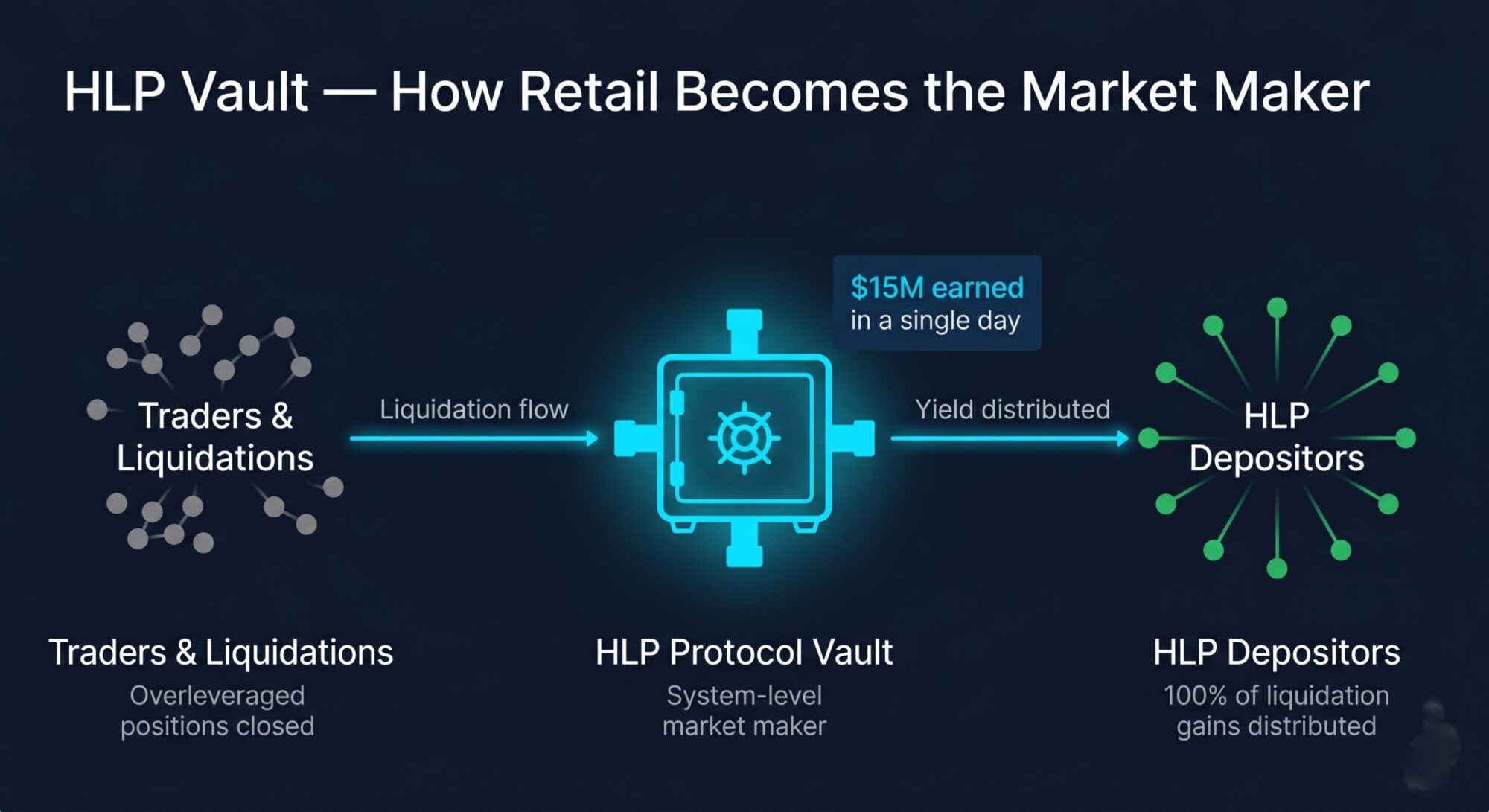
One of Hyperliquid’s more underappreciated structural innovations is the Hyperliquidity Provider (HLP) vault — a protocol-native market-making mechanism that allows participants to sit on the profitable side of the exchange’s liquidation table.
In a standard centralised exchange, when a highly leveraged trader gets liquidated, the exchange captures the premium. That profit flows to the institution, not to users. HLP flips this model. The vault acts as the protocol’s system-level market maker and liquidation backstop — and when it profits from liquidations, those profits flow to depositors.
The most vivid illustration: a single $700 million liquidation event generated $15 million in a single day for HLP depositors. Not a projected yield. A real cash event that hit accounts in one trading session. The vault has been generating yields in the 50%+ per year range during active market cycles, climbing past 100% APY during periods of elevated volatility.
In traditional finance, market-making is the exclusive domain of privileged institutions — investment banks, prop trading desks, and exchange operators who capture the bid-ask spread and liquidation premium from every trade. Retail participants are always on the other side of that equation. Hyperliquid’s HLP vault changes the structure: it is a fully community-owned, protocol-native liquidity pool that performs the market-making function at the exchange level. Depositors earn from bid-ask spreads, funding rates, and liquidation premiums — the same revenue streams that accrue to market makers on centralised exchanges. Unlike centralised exchanges where liquidation profits are retained by the platform, HLP distributes 100% of these gains to depositors. The vault is embedded directly into Hyperliquid’s HyperCore engine, not deployed as a third-party smart contract, making it a native economic actor within the protocol itself.
Risk note: HLP vault performance is directly tied to trading volume and liquidation frequency. Yields compress significantly in low-volatility periods. The vault carries smart contract execution risk and a 4-day withdrawal lock-up. Depositors should treat this as an active-risk yield instrument, not a passive savings product.
Authority refs: KuCoin Market Research — “Hyperliquid HLP Vault: Turning Whale Losses into Liquidity Yield,” February 2026 | Zealynx Security Glossary — “Hyperliquidity Provider,” January 2026 | Hyperliquid Official Protocol Documentation — hyperliquid.gitbook.io
I want to offer a personal view on how I’m getting involved in Hyperliquid — not as advice, but as one way to think through the opportunity. Risk is a slippery animal full of surprises, even for experienced investors. How I see it will be different from how you see it by definition.
I have a long-standing interest in the FINREV trend-following system, which is evolving into the HyperTrend Vault. I understand it thoroughly — the people who built it, how it’s managed, and why it holds up as a solid long-term strategy. Alongside that, HYPE has ticked all the boxes for me for two years. My admiration for what Jeff Yan is building — which is its own story, covered in The Jeff Yan Paradox — is a significant part of that conviction.
My current approach is to split risk capital equally between trading HYPE and the HLP vault. The vault, for me, is a perfect complement to the trading. The moments that challenge active trading most are the sudden liquidity drops caused by over-leveraging in these markets. At precisely that moment — when trading could struggle — the HLP vault is still generating returns from liquidations in both market directions. The two positions hedge each other structurally, not just in theory.
How Serious Investors Are Thinking About Participation
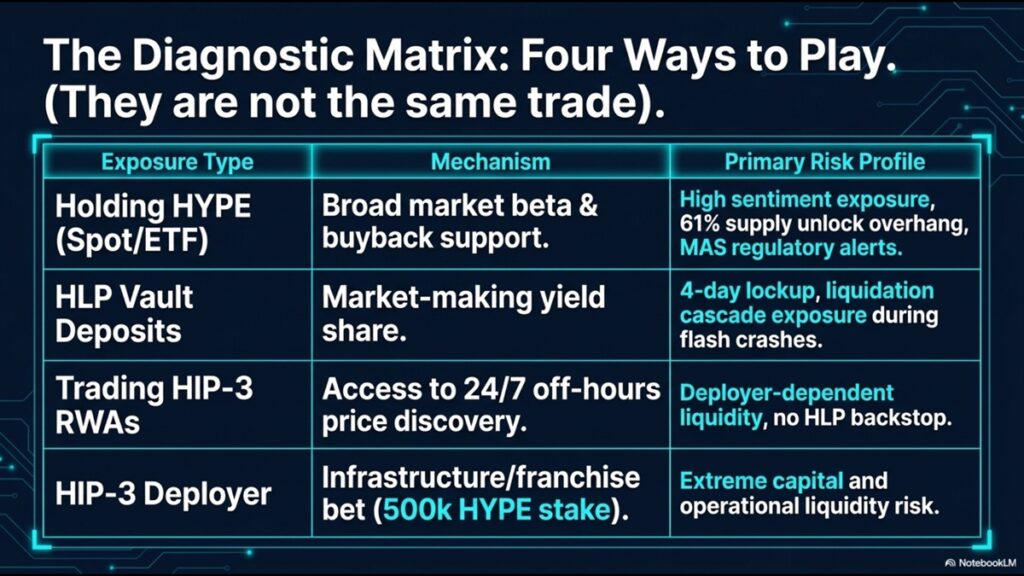
The HYPE opportunity in May 2026 is not a single instrument. It’s a set of distinct approaches with different risk profiles, time horizons, and yield mechanisms. Conflating them is one of the fastest ways to get position sizing wrong.
Pure price exposure — holding HYPE spot. The case is straightforward: if the institutional influx thesis plays out over 2026 and 2027, HYPE’s fixed supply, aggressive buyback, and structural role as the gas token of an increasingly institutional-grade infrastructure chain should drive significant price appreciation. The risk is equally straightforward. HYPE fell roughly 64% from its September 2025 peak to its January 2026 low — even within a thesis that Scott and others considered fully intact throughout.
A reasonable question: how does a market leader with infrastructure this strong fall 64%? Two answers. The first is simply welcome to crypto — new markets are structurally more volatile than mature ones. The second is more specific: Hyperliquid weathered several significant attacks during this period, with large traders attempting to game its liquidity system. These events triggered genuine liquidity stress and sharp drawdowns. In each case, price rebounded sharply once the market could see that Hyperliquid’s systems had controlled the situation. The infrastructure held. The price reflected that — eventually.
If you cannot hold through that drawdown psychologically or financially, the position size is wrong regardless of your conviction on the thesis.
HLP vault yield. An active-risk income strategy. You are not holding HYPE for price appreciation — you are providing liquidity and capturing a share of fees and liquidation revenue. The yield is real and can be significant. The risk is volume-dependent and carries the standard smart contract considerations for any on-chain liquidity position. The mechanics of smart contract custody risk are covered in full in Why a Proven Crypto Trading System is Rebuilding on Hyperliquid.
HYPE staking. Staking participates in protocol reward mechanisms and contributes to network security. Circle and Coinbase have each committed to staking 500,000 HYPE — institutional validation of the staking mechanism as a long-term holding strategy. The Grayscale-linked wallets that accumulated $41.6 million in HYPE also staked the majority of it ($51 million reported as staked), signalling long-term conviction rather than short-term trading intent.
The honest framework for any of these approaches is the same one Scott himself operates by: understand what you are trying to do, size accordingly, and know in advance what drawdown level would tell you the thesis has broken — versus what’s simply the market being violent within a thesis that remains intact.
Scott made peace with that distinction. He made more than a million dollars doing so. But he would also be the first to tell you that his approach to holding HYPE is not how he typically trades — and that it worked precisely because he understood what he was doing from the beginning, sized correctly, and did not waver when the market tested him hard.
That’s the lesson. Not that you should replicate the position. That you should understand the instrument before you size it.
What Hyperliquid Built While the Market Looked Away
The price action of May 2026 does not exist in isolation. It is the market beginning to price years of sustained, disciplined execution.
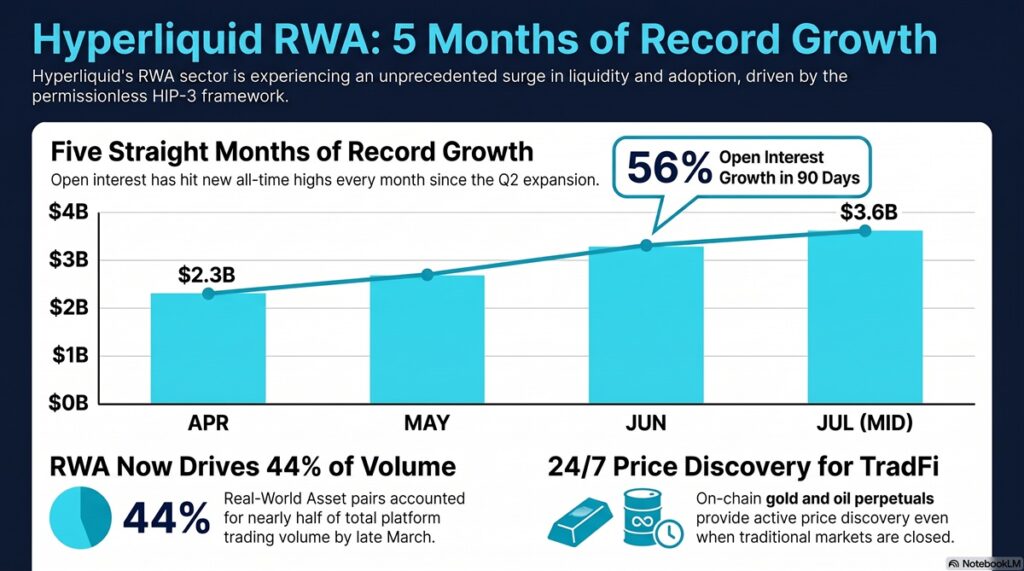
Q1 2026 was — by any measure — a brutal quarter for crypto markets. During it, Hyperliquid expanded into real-world assets through HIP-3 perpetuals covering silver, crude oil, and equity indices, with deployer volumes nearly tripling by March. It launched prediction markets (HIP-4) — binary outcome contracts settling across the same unified margin account as perps and spot, the foundation for on-chain options, insurance products, and structured instruments that didn’t exist on-chain before. It made the deliberate decision to sunset its own USD stablecoin (USDH) when the market clearly preferred USDC — USDH never crossed $100 million in supply, while USDC on Hyperliquid now sits at $5 billion, double the prior year. They killed their own product because the market preferred something else. The list of companies with the discipline to do that is very short.
S&P Dow Jones licensed an official benchmark to trade on the platform. Ripple Prime added institutional support. The first and second spot HYPE ETFs launched.
The leadership culture making this execution possible — the 11-person team philosophy, Jeff Yan’s anti-VC founder model, the decision-making framework behind the USDH sunset — is covered in full in The Jeff Yan Paradox. The point here is simply this: what’s being priced in May 2026 is not speculation about what Hyperliquid might become. It is the market finally catching up to what Hyperliquid already built.
Where This Leaves Us — A Framework, Not a Prediction
The most useful thing any analyst can offer in a moment like this is not a price target. It is a framework for thinking clearly when the market is moving fast and conviction is expensive to maintain.
Two things can be simultaneously true. The GENIUS Act represents a genuine structural demand-side catalyst for on-chain infrastructure — one that is still largely ahead of us, given 2027 compliance timelines. Hyperliquid has built infrastructure objectively positioned to benefit from that catalyst, and its tokenomics are structurally designed to amplify the benefit to holders. And: markets price anticipated futures aggressively, sometimes well ahead of the fundamentals, and assets that have already moved 20% in a day carry their own set of risks regardless of the underlying thesis.
The macro environment has not been tamed. The bond market is in revolt. The Fed remains in a corner. And here’s the uncomfortable truth that belongs in any honest analysis right now: the S&P 500 could plummet at any moment given the game of economic chicken playing out at the macro scale. What happens to crypto markets in that scenario? It gets ugly — real ugly. These glacial downward momentum moves in equities turn fast in digital assets. Macro risk in our world is not a footnote. It is a first-order consideration.
None of that disappears because HYPE hit a new high. Serious investors in this space should be carrying both an umbrella and sunglasses — positioned for both outcomes, not betting the farm on either.
What changes with the current move is not the fundamental thesis. The fundamental thesis for Hyperliquid has been intact for SCR readers since Article 1. What changes is the institutional validation layer. When Grayscale-linked wallets accumulate $41 million in a week, when ETF inflows outpace Bitcoin’s equivalent launch on a market-cap-adjusted basis, when institutional market makers begin staking positions rather than trading them — the signal shifts from “this might become important” to “this is being treated as important by people with serious capital allocation mandates.”
That’s a meaningful change. It’s not a guarantee. But it is signal.
🎧 Listen to the Debate Podcast
Two voices examine the institutional influx thesis from opposite positions — the structural bull case vs the specific risk arguments retail investors need to understand before sizing a position.
▶ Listen on Spotify | 📄 Read the Transcript and Counterargument Analysis
What You Can Do Next
Explore Hyperliquid Directly
If you want to explore Hyperliquid as a trading platform, the HLP vault, or spot HYPE exposure, you can access the platform through our affiliate link. By signing up through our link, you’ll receive a 4% discount on trading fees — and you’ll directly support SCR’s ability to continue producing independent research and analysis to help you navigate these markets. Your use of our links is genuinely the most direct way to sustain this work, and we appreciate it more than we can say.
▶ Access Hyperliquid — 4% Fee Discount via SCR
Explore the HyperTrend Opportunity
Scott Phillips’ systematic trading system — HyperTrend — is built on Hyperliquid infrastructure and represents one of the most direct ways for investors to access the platform’s performance edge through institutional-grade algorithmic execution and the approaching migration to a Hyperliquid Vault.
Watch the HyperTrend Intro Video
Additional Research Resources
- Hyperliquid Infrastructure Deep Dive — Full technical architecture: HyperBFT, HyperCore, HyperEVM, HIP-3
- Inside the FINREV Team — Scott Phillips background, trading methodology, and credibility case
- HYPE Tokenomics — Beyond the Magic Bean Trap — Full deflationary model, fixed supply, buyback-and-burn mechanics
- Why Hyperliquid Leadership Matters — Jeff Yan, the 11-person team philosophy, and the culture behind the execution
- Podcast: The Institutional Influx Debate — Full transcript and counterargument analysis
Disclosure and Risk Warning
Vince at Systematiccryptoresearch.com holds positions in HYPE and has financial interest in the Hyperliquid ecosystem. SCR covers Hyperliquid and the HyperTrend system because they represent the primary subject of this research blog’s analytical mandate — not because SCR is paid to promote them.
This article is research and analysis, not financial advice. Cryptocurrency markets are highly volatile. HYPE dropped approximately 64% from its September 2025 high to its January 2026 low within a longer bullish thesis — this kind of drawdown is a feature of the asset class, not an anomaly. Past performance of any metric cited in this article — including ETF inflows, HLP vault yields, and protocol revenue — does not guarantee future results.
HLP vault participation involves smart contract risk. Vault yields are dependent on trading volume and liquidation activity and will compress during low-volatility market conditions. A 4-day withdrawal lock-up applies. Readers considering HLP participation should understand the full risk profile before deploying capital.
The GENIUS Act’s full regulatory impact is subject to implementation timelines and may not deliver the capital flows described here on the timeline the market is currently pricing. Regulatory frameworks can change.
Macro conditions — including equity market instability, Federal Reserve policy, and bond market stress — can and do affect cryptocurrency markets rapidly and severely. Position sizing should reflect your personal risk tolerance, not conviction alone.
Conduct your own due diligence. Size positions according to your own risk tolerance. Never invest more than you can afford to lose.
Image credits: Hero infographic and Images 1, 3, 4 generated with Gemini AI. Image 2: TradingView.com — HYPE/USDT vs BTC/USDT comparative chart, used for editorial research purposes. ETF data: The Block, May 2026. On-chain data: Lookonchain, May 2026.