Is the Institutional Influx into HYPE a sign of the future – the Debate
This podcast debate transcript accompanies the pillar article on HYPE’s all-time high and the institutional influx into Hyperliquid. The episode examines the counterarguments swirling around the 2026 HYPE coin opportunity and the article’s structural case doesn’t fully resolve: whether the GENIUS Act regulatory unlock genuinely benefits retail participants, or transfers systemic tail risk onto depositors least equipped to carry it — and whether Hyperliquid’s infrastructure advantage is durable or vulnerable to the macro guillotine hanging over all digital assets.
“For the full case on the GENIUS Act, ETF inflow data, HLP vault mechanics, and a framework for participation — read the pillar article this debate was built around.”
🎧 Listen to the Article 09 Podcast on Spotify
📖 Read the Full Article 09: HYPE and the Institutional Influx: What’s Actually Happening Right Now
Podcast Episode: 09 — The Institutional Influx Debate
Duration: ~21 minutes
Published: May 2026
Topic: A structured debate on whether Hyperliquid’s surge to all-time highs represents verified institutional validation of a superior infrastructure — or a transfer of systemic risk onto retail participants who are poorly equipped to carry it.
📻 About This Podcast
This podcast was generated using Google’s NotebookLM from the research in the accompanying article. The conversational debate format explores the HYPE institutional influx thesis from both sides — examining the structural bull case and the specific risk arguments in detail — which can help clarify complex ideas that might be dense in written form.
This is a supplementary tool. The article contains the full technical analysis and primary sources. The podcast is for those who prefer audio learning or want to hear the counterarguments explored through structured debate.
📖 Read the Full Article: HYPE and the Institutional Influx: What’s Actually Happening Right Now
⚡ What This Debate Revealed That the Article Didn’t Cover
The pillar article makes a compelling structural case for Hyperliquid as the institutional rail for on-chain finance. The debate surfaced four specific challenges that the article does not fully resolve — these are the questions a serious investor should pressure-test before accepting the thesis:
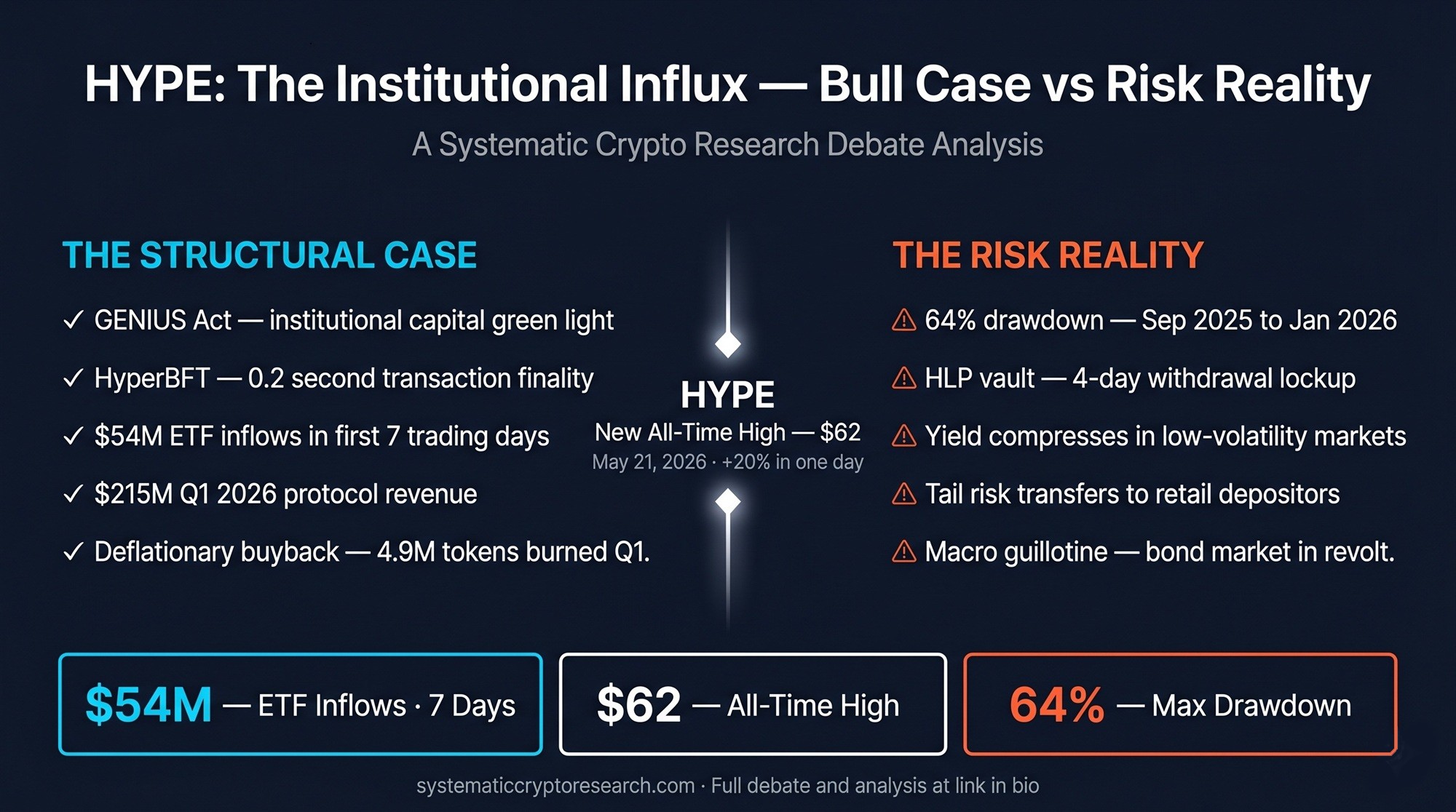
- Tail risk transfers to retail HLP depositors. When retail deposits provide liquidity to the HLP vault, they are acting as the ultimate backstop for institutional leverage. The 4-day withdrawal lockup means that in a flash crash — precisely when you most need to exit — you cannot. Institutions have treasury capital to weather a 64% drawdown. Retail HLP depositors may not.
- Yield is a weather report, not a fixed product. The 50–100% APY figures are real — but they require sustained high volatility and liquidation activity. In a low-volatility sideways market, those yields compress to near nothing. The protocol generates no guaranteed return. It generates a share of whatever trading activity produces.
- The macro guillotine doesn’t care about tokenomics. The bond market is in revolt. The Fed is cornered. When hedge funds face margin calls on traditional assets, they liquidate their most liquid, highest-risk positions first. Crypto gets sold regardless of how good the underlying infrastructure is. Decoupling in a bull phase is very different from decoupling in a liquidity crisis.
- The coral reef attracts apex predators. The same institutional capital that validates the thesis also brings sophisticated players who will actively attempt to game liquidity systems. The 64% drawdown between September 2025 and January 2026 was not random volatility — it included deliberate attacks on Hyperliquid’s liquidity mechanisms by large traders. Retail traders who bought the top were crushed regardless of whether the infrastructure held.
🧠 SCR Analysis: Where the Debate Lands
The counterarguments above are real and the SCR analysis does not dismiss them. What they miss is the structural context that makes this moment different from every previous “institutional crypto” narrative.
The HLP vault’s tail risk is real — but it is disclosed, on-chain, and visible to every participant in real time. The FTX collapse was not a failure of blockchain technology. It was a failure of private servers hiding leveraged liabilities. Sam Bankman-Fried hid the leverage where nobody could see it. Hyperliquid’s on-chain order book records every trade, every open position, and every liquidation publicly. That specific category of fraud is structurally impossible on a fully transparent public ledger.
The macro risk is undeniable — but Hyperliquid’s infrastructure actively feeds on volatility rather than being destroyed by it. The same liquidation cascade that wipes out overleveraged positions generates the HLP vault’s highest single-day returns. Q1 2026 — one of the worst quarters for crypto markets since 2018 — produced $215M in protocol revenue and a 44% HYPE price gain. The infrastructure survived its stress tests. The price reflected that, eventually.
The debate’s most important moment is the closing summary. After 21 minutes of rigorous pushback on both sides, neither voice claims certainty. Both agree: look at the mechanics, not the marketing. Understand what you are actually taking on before you size the position. That is the SCR position exactly.
The institutional validation layer has shifted — Grayscale accumulating $41.6M in a week, ETF inflows outpacing Bitcoin’s equivalent launch on a market-cap-adjusted basis, Bitwise staking its own balance sheet. That is signal. It is not a guarantee. Both things are true simultaneously — and understanding both is what separates systematic analysis from either hype or fear.
📋 Episode Chapters
00:00 — Opening: The $700M liquidation event and the $15M retail payout
01:45 — The GENIUS Act: Legal scaffolding for institutional on-chain capital
04:10 — HyperBFT: Deterministic finality, front-running elimination, and why speed is structural
06:30 — The coral reef and the apex predators: What institutional influx means for retail
08:15 — ETF inflows, Grayscale accumulation, and the institutional validation data
10:20 — The HLP vault: Becoming the house — and the fine print retail needs to read
13:45 — The Bitcoin thesis executed: Deflationary flywheel, USDH sunset, and institutional discipline
16:00 — The macro guillotine: Bond market revolt, Fed corner, and liquidity crisis transmission
18:30 — FTX vs on-chain transparency: Why the order book is the ultimate risk management tool
20:00 — Final positions: Where both sides land and what retail needs to understand
Full Transcript
Host 1: Welcome to the debate. Imagine watching a $700 million cascading liquidation event violently wipe out the market.
Host 2: Normally that’s the part of the story where everyday traders completely lose their shirts.
Host 1: And a privileged Wall Street market maker quietly pockets the spread. But what if instead of getting crushed, everyday users — retail depositors — actually pocketed $15 million in cash in a single day.
Host 2: It sounds like some utopian financial fantasy, but that actually happened.
Host 1: It did. And it sits right at the centre of a massive structural shift we need to unpack today. On May 21st, 2026, Hyperliquid’s native token HYPE completely decoupled from the rest of the market — breaking above its all-time high of $62, surging over 20% in a single trading day, while Bitcoin was completely flat. Today we are drawing from the recent analysis published by Systematic Crypto Research — SCR — who have been tracking the underlying mechanics driving this exact price action.
Host 2: The crux of the matter — the real tension we have to resolve — is what that price action actually represents for the people putting their capital on the line.
Host 1: The central question: is Hyperliquid’s surge the result of a fundamentally superior institutional-grade trading system that forward-looking pro traders should be embracing —
Host 2: — or does this massive influx of institutional capital actually mask severe structural and macroeconomic risks that everyday retail investors are completely underestimating? I look at the empirical data, the tokenomics, and the underlying tech, and I argue that Hyperliquid is the ultimate verified institutional rail for the future of on-chain finance.
Host 1: And I look at this through the lens of a deeply sceptical retail investor. The throughput of the technology is undeniably impressive. But system stress under institutional volume, smart contract vulnerabilities, and the looming macroeconomic guillotine — these risks are being disproportionately shouldered by everyday traders, not the institutions.
Host 2: Let’s get into the structural catalysts. To understand what is moving HYPE, we have to look at the regulatory unlock. The GENIUS Act — the Guiding and Establishing National Innovation for US Stablecoins Act — passed the Senate in May 2026. This is the legal scaffolding that finally allows legacy financial institutions to deploy capital directly onto public blockchains using US dollar-backed stablecoins. For years, compliance officers at major asset managers couldn’t sign off on this without operating in a legal grey zone.
Host 1: Sure, the GENIUS Act is huge. But legal permission to enter a market doesn’t automatically mean the destination is safe for the retail traders already swimming there.
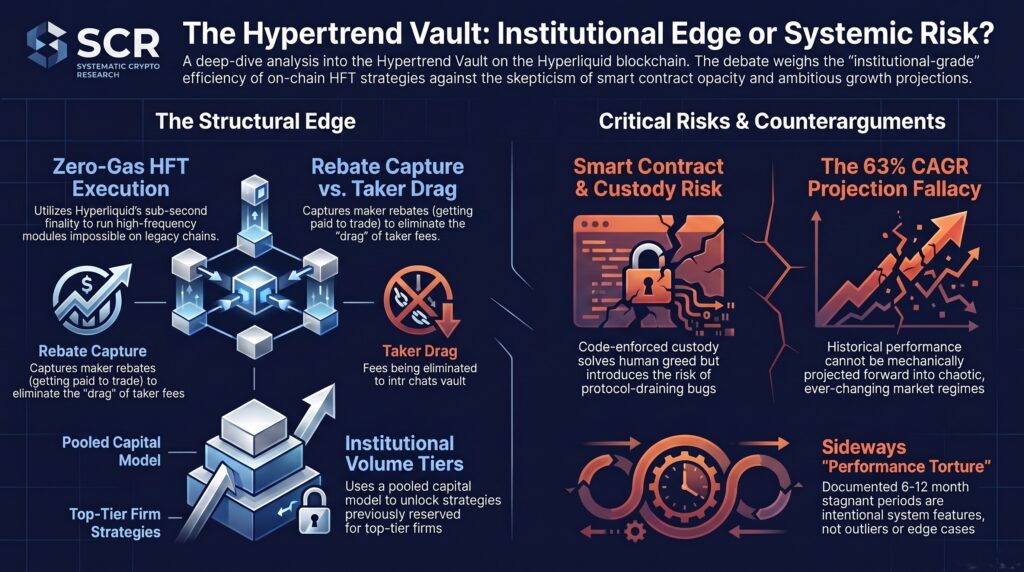
Host 2: You have to look at the destination itself. Hyperliquid isn’t just another decentralised exchange. They didn’t build on top of Ethereum or Solana. They built a specialised Layer-1 blockchain from scratch with a custom consensus mechanism called HyperBFT.
Host 1: Break down what HyperBFT actually does in practice.
Host 2: It achieves 0.2-second deterministic finality. On older blockchains, transactions sit in a waiting room — a mempool — where predatory bots can see your trade, jump ahead of you, and give you a worse price. That’s the classic front-running problem. Deterministic finality means there is no waiting room. The trade is settled instantly and irreversibly in a fifth of a second. They are hitting 100,000 to 200,000 transactions per second — an order of magnitude beyond the legacy infrastructure of the New York Stock Exchange.
Host 1: Think of Hyperliquid’s infrastructure like a highly evolved, massively efficient coral reef — built quietly, perfectly adapted to process high-frequency flow. Now that the regulatory waters are open, it is naturally attracting the ocean’s largest apex predators: institutional money.
Host 2: Let’s follow that marine ecology logic to its actual conclusion. What happens in a marine ecosystem when the apex predators arrive? The smaller fish — the retail traders — are the ones that get eaten. Especially when the environment gets stressed. Between September 2025 and January 2026, HYPE suffered a brutal 64% drawdown.
Host 1: Why did that happen? Because large traders were actively attempting to game the liquidity system. They spoofed the order books, created synthetic volatility, and shook out the weak hands. The infrastructure survived. It didn’t halt trading, it didn’t collapse. It passed the stress test.
Host 2: If you were a retail trader who bought the top, you were completely crushed regardless of whether the protocol held.
Host 1: That drawdown was violent, yes. But the critical takeaway is that because it survived that stress test, we are now seeing unprecedented institutional validation. Spot HYPE ETFs — THYP from 21Shares and BHYP from Bitwise — saw $54 million in cumulative inflows in just their first 7 days. Grayscale-linked wallets accumulated $41.6 million in a single week and staked the majority of it. Bitwise is committing 10% of ETF management fees to continuously buy and stake HYPE. These are serious structural asset managers building long-term positions.
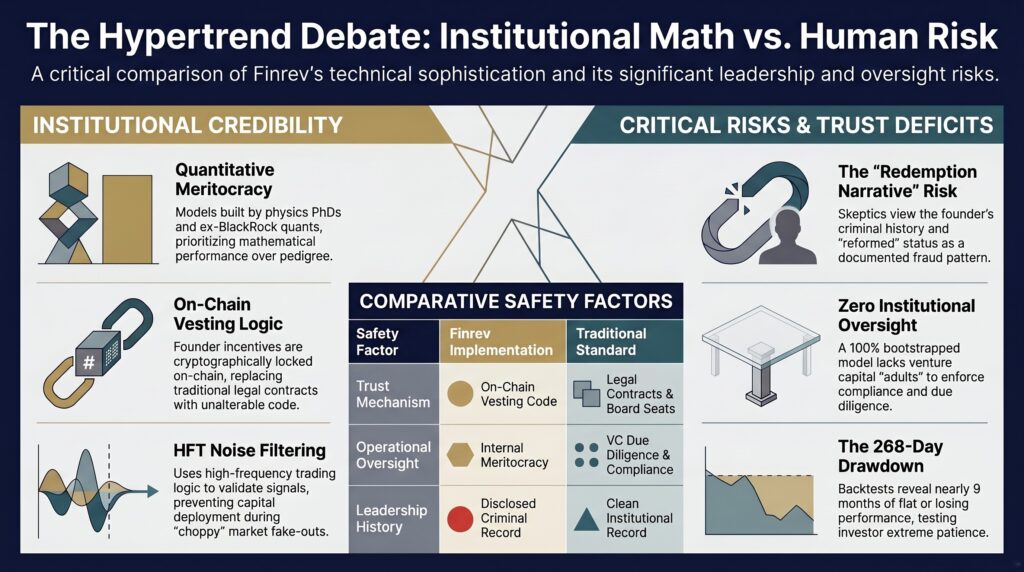
Host 2: You’re framing this institutional adoption as democratisation. It is not that simple. What massive institutional staking creates is a heavily tiered risk system. Institutions like Grayscale and Bitwise have the treasury capital to weather a 64% drop. The retail systematic trader — someone like Scott Phillips, highlighted in the SCR research, who holds approximately half his portfolio in HYPE — is enduring gut-wrenching volatility to get there. The institutions aren’t sharing the risk. They are insulating themselves from it.
Host 1: Retail is not locked out of institutional-grade yield. The protocol gives retail the exact tools to participate.
Host 2: You’re talking about the HLP vault.
Host 1: Specifically the Hyperliquidity Provider — HLP — vault. This is the aha moment of this entire ecosystem. It literally turns retail users into the house. In traditional finance, when a retail trader gets overleveraged and liquidated, someone has to take the other side of that trade. It’s usually a massive market maker like Citadel or Virtu. They absorb the liquidated assets at a discount, capture the spread, and keep the profit. Retail is always on the losing side of that equation. The HLP vault is a protocol-native market maker. When you deposit capital into HLP, your funds are used to facilitate those liquidations and capture those exact spreads. The protocol distributes 100% of those liquidation gains directly to the depositors. That is how a single $700 million liquidation event generated $15 million in cash in a single day for everyday HLP depositors. During active market cycles, we’re seeing APYs pushing 50 to 100%. Retail pulling up a chair and taking Citadel’s seat at the table.
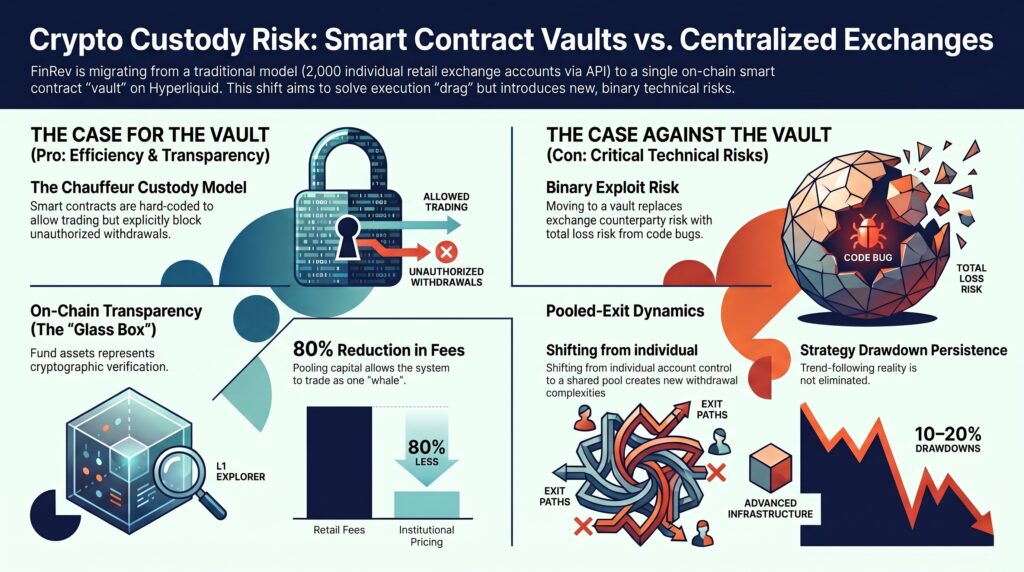
Host 2: Did you actually read the fine print on that vault? You’re pitching this like it’s a high-yield savings account. It is absolutely not. The HLP vault is an active-risk yield instrument. The yield is entirely reliant on high trading volume and extreme volatility. When the market goes sideways and volatility dries up, those yields compress to almost nothing. There is a mandatory 4-day withdrawal lockup — 4 days in crypto is an eternity. It is the equivalent of seeing a category 5 hurricane approaching and the bank telling you the vault is on a time delay. You simply cannot get your money out. And there is the ever-present smart contract execution risk. The HLP vault acts as the system-level market maker and liquidation backstop. If the system breaks under the stress of institutional-grade volume, the depositors are holding the bag. The retail liquidity providers are acting as the ultimate backstop for institutional leverage. It is a massive transfer of tail risk onto the people who can least afford it.
Host 1: The active risk is real, and the SCR analysis makes it clear that participants need to size their positions according to their personal risk tolerance. But you are ignoring the broader structural tokenomics. This isn’t a legacy protocol printing infinite tokens to pay artificial yield. Hyperliquid is executing the original Bitcoin scarcity thesis — but with an actual revenue-generating engine underneath it. Hard cap of 1 billion tokens. The protocol takes between 93% and 97% of all revenue generated from real trading fees and uses it to buy HYPE on the open market and burn it permanently. Just in Q1 2026, Hyperliquid burned 4.9 million tokens from $215 million in gross revenue. As institutional adoption scales, the supply shrinks precisely when demand is peaking.
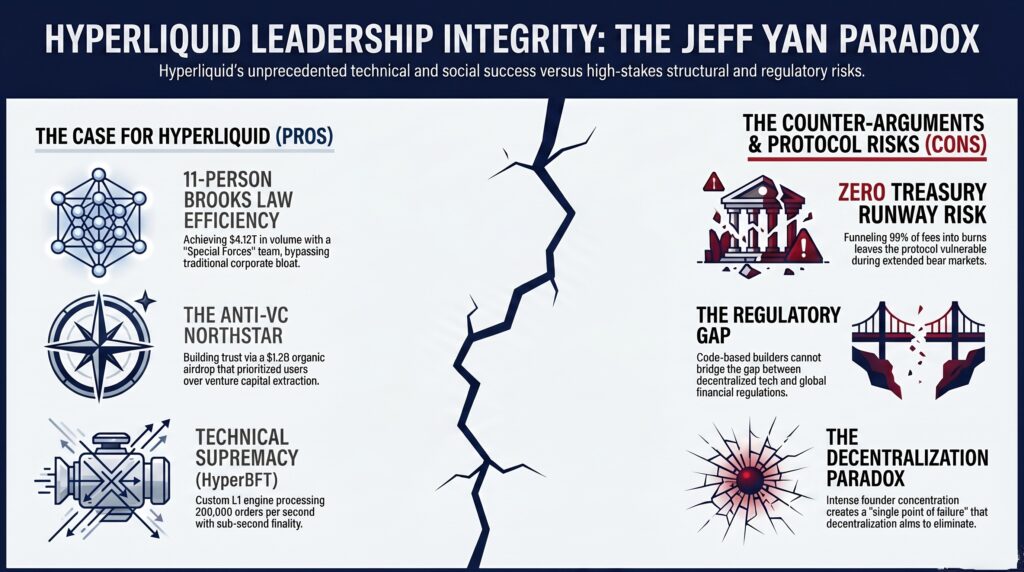
Host 2: The mathematics of the burn are sound. And look at what they did with their own stablecoin, USDH. They sunset it completely when it couldn’t organically cross $100 million in supply. The market clearly preferred USDC, which now has a $5 billion supply on their platform. They killed their own product to optimise the ecosystem. That is rare institutional maturity in an industry built on ego.
Host 1: Jeff Yan and the team show remarkable discipline. Full credit for that. But here is where the macro guillotine drops on this entire bullish narrative. The bond market is in a state of revolt. Inflation is cornering the Fed. We are looking at a scenario where the S&P 500 could plummet at any moment due to this game of economic chicken at the sovereign level.
Host 2: Crypto has shown signs of decoupling — look at the May 21st price action.
Host 1: Decoupling during a bull phase is very different from decoupling during a liquidity crisis. When the bond market breaks and the cost of capital spikes, hedge funds get margin calls on their traditional assets. What do they do? They liquidate their most liquid, highest-risk assets first, just to raise cash. Crypto gets sold off violently. No matter how good the tokenomics are, a highly leveraged digital asset ecosystem will be absolutely crushed by a sudden withdrawal of global macro liquidity.
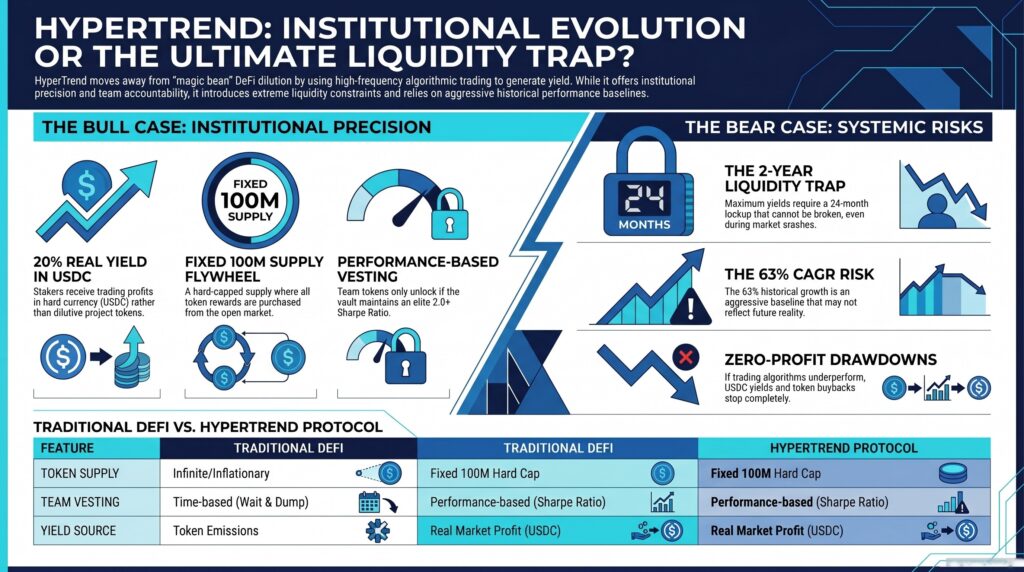
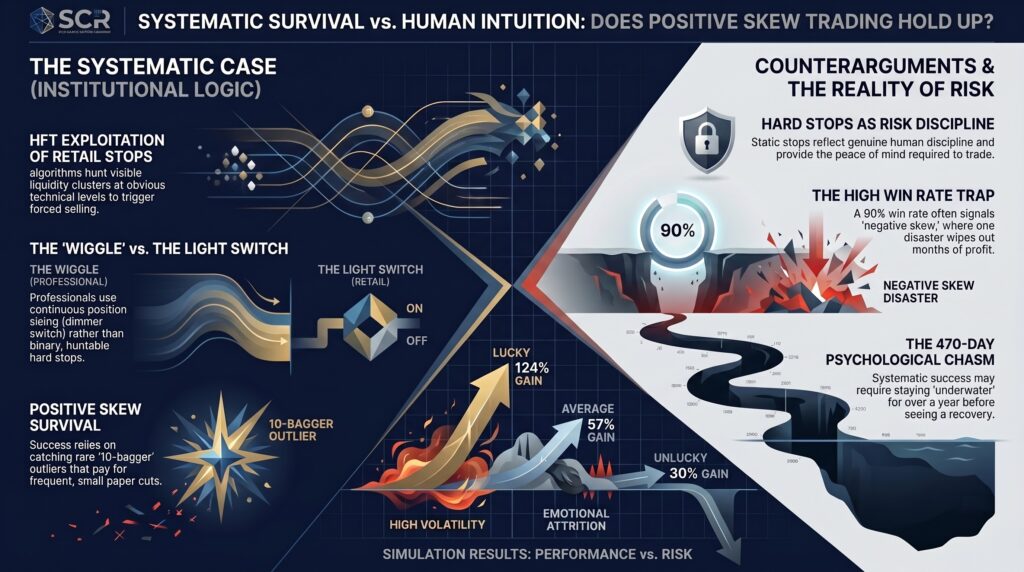
Host 2: The macro picture is definitely fraught. But the SCR material explicitly points to rigorous algorithmic trend-following systems. Scott Phillips’ FINREV methodology, and Hyperliquid’s integration of similar approaches with the approaching HyperTrend Vault, are specifically designed to manage drawdowns. These algorithmic systems don’t care if the market is going up or down. They execute mathematically — specifically designed to hedge against sudden macro liquidity drops.
Host 1: And the HLP vault continues to capture liquidation spreads in a downward crash just as efficiently as in a blowoff top. The system actively feeds on that volatility.
Host 2: My core concern remains that the everyday retail user seduced by 50% APY and the token burn narrative does not have the sophisticated algorithmic hedging that a professional like Scott Phillips uses. They are nakedly exposed to the storm.
Host 1: And that is exactly why the transparency of a decentralised on-chain order book is the ultimate defence mechanism. The FTX collapse was not a failure of blockchain technology. It was a failure of centralised private servers and hidden liabilities. Sam Bankman-Fried hid the leverage where nobody could see it. Hyperliquid’s on-chain order book records every single trade, every open position, and every liquidation publicly in real time. For institutional investors operating under strict post-FTX compliance mandates, this isn’t just a feature. It is a hard risk-management requirement.
Host 2: Everyone — including the retail user — can see exactly where leverage is piling up. You cannot hide a toxic balance sheet on a fully transparent public ledger. You can see the iceberg before you hit it. Transparency is vital. It prevents fraud. But transparency does not prevent panic. Knowing exactly how fast the ship is sinking doesn’t stop it from sinking when macro liquidity simply evaporates. That said — seeing the true state of the market and verifying the data yourself is infinitely better than trusting a centralised exchange operator in the Bahamas.
Host 1: To summarise my position: the underlying technology — particularly the deterministic finality of HyperBFT — is undeniably impressive. The data-driven tokenomics, the execution of the deflationary buy-and-burn flywheel, and the verified volume of ETF adoption are genuinely compelling. But the catastrophic macro risks, combined with the smart contract dangers and the 4-day lockups that retail liquidity providers are taking on, simply cannot be ignored. If you are a retail trader, you are swimming with apex predators. You need to size your risk accordingly — because when the water gets choppy, the institutions have life rafts. You don’t.
Host 2: And to summarise my perspective: Hyperliquid represents the verified structural future of on-chain finance. The regulatory clarity provided by the GENIUS Act has opened the floodgates for legacy capital, and Hyperliquid is the only infrastructure capable of handling that throughput without breaking. With an ungameable on-chain order book, a deflationary engine that actively rewards participants from real protocol revenue, and the true democratisation of market-making yields through the HLP vault, this institutional influx is fundamentally justified. The infrastructure has survived brutal stress tests, and the smart money is clearly recognising that fact.
Host 1: Whether you are bullish on the institutional influx or sceptical of the systemic risks, you have to apply rigorous observation. Look at the mechanics, not just the marketing.
Host 2: You don’t just jump into the ocean because the water looks nice from the beach. You study the currents, you understand the ecosystem’s stress points, and you know exactly what kind of predators are swimming in the water with you. Look past the hype to understand your own capital preservation limits and your personal risk tolerance.
Host 1: There is much more depth in the SCR material, especially regarding the specific algorithmic trading strategies designed to navigate these very waters. Explore the Systematic Crypto Research analysis further and form your own conclusions on how this massive structural shift will play out. The data is all there on-chain for you to verify.
📘 Key Concept: Tail Risk Transfer in DeFi Liquidity Provision
Tail risk transfer occurs when the potential losses from extreme, low-probability market events are shifted from one class of market participant to another — typically from leveraged traders onto liquidity providers. In DeFi protocols with automated market-making vaults, retail liquidity providers collectively act as the system-level backstop: when large liquidation cascades occur, the vault absorbs the positions and captures the spread, but also assumes the risk of catastrophic protocol stress or smart contract failure during those extreme events.
In the HLP vault context, this means retail depositors are performing the same risk-absorbing function as institutional market makers like Citadel or Virtu — but without the same treasury capital buffers, risk management infrastructure, or ability to exit instantaneously during stress events. The 4-day withdrawal lockup codifies this asymmetry: the protocol needs the capital to remain stable during the very events that create the highest tail risk.
References: Brunnermeier & Pedersen (2009) — market liquidity and funding liquidity interaction under stress, Journal of Finance | Roncalli (2020) — liquidity risk and tail risk in systematic strategies | BIS Working Paper No. 1069 — “DeFi risks and the decentralisation illusion,” Bank for International Settlements, 2022
If You Want to Go Further
If you are interested in how systematic algorithmic trading strategies are designed to navigate exactly these conditions — and how the approaching HyperTrend Vault applies those principles on Hyperliquid infrastructure — start with the HyperTrend introduction video.
Watch the HyperTrend Intro Video
Resources Mentioned
- Hyperliquid Protocol — $215M Q1 2026 revenue, $1.69B TVL, 44% HYPE price gain in Q1 2026, 100% uptime, zero gas fees for trading
- HyperBFT Engine — Custom Layer 1 consensus mechanism, 100,000–200,000 orders per second, 0.2-second deterministic finality, fully on-chain order book
- GENIUS Act — Guiding and Establishing National Innovation for US Stablecoins Act, passed US Senate May 2026, establishes federal framework for institutional on-chain capital deployment
- HYPE ETF Launch — THYP (21Shares) and BHYP (Bitwise) — $54M combined inflows in first 7 trading days, May 2026
- HLP Vault — Protocol-native market-making vault, 50–100% APY during active cycles, 4-day withdrawal lockup, $15M distributed to depositors in single $700M liquidation event
- HYPE Deflationary Model — 1 billion hard cap, 93–97% protocol revenue used for open-market buyback and permanent burn, 4.9M tokens burned Q1 2026
About This Episode
This debate explores whether Hyperliquid’s surge to all-time highs represents verified institutional validation of a genuinely superior infrastructure — or the beginning of a risk transfer onto retail participants who are poorly positioned to carry it. For anyone navigating the on-chain finance landscape — whether as an investor, a trader, or someone trying to understand where the industry is heading — the tension between institutional influx and retail risk is the defining question of this moment.
Related Articles
- HYPE and the Institutional Influx: What’s Actually Happening Right Now
- Why Leadership is the Ultimate Indicator of Protocol Success
- Why a Proven Crypto Trading System is Rebuilding on Hyperliquid
- Beyond the Magic Bean Trap — HYPE Tokenomics
- Hyperliquid Technical Deep Dive
Transcript generated from NotebookLM podcast discussion. Edited for clarity and length. Formatted for web publication by Systematic Crypto Research.