Is Jeff Yan’s Founder-Driven Model a Strength or an Unexamined Risk?
This podcast debate transcript accompanies the pillar article on Jeff Yan and Hyperliquid’s leadership model. The episode examines the counterarguments the article’s integrity case doesn’t resolve: whether founder-driven trust is a durable structural advantage or a concentration risk that vault participants and ecosystem builders are implicitly exposed to, and whether on-chain transparency is a sufficient substitute for the decentralised governance it promises but has not yet delivered over decade time spans.
“For the full case on Jeff Yan’s leadership model — including the 11-person team philosophy, the $4T volume milestone, and the integrity decisions that defined the JELLY incident response — read the pillar article this debate was built around.”
⚡ Listen to the Article 08 Podcast on Spotify
📖 Read the Full Article 08: Why Leadership is the Ultimate Indicator of Protocol Success
Podcast Episode: 08 — The Anti-VC Northstar Debate, and the true value of leadership
Duration: ~18 minutes
Published: March 2026
Topic: A structured debate on whether Jeff Yan’s hyper-lean, community-first model is the only sustainable future for decentralised finance — or a systemic fragility waiting to detonate.
📻 About This Podcast
This podcast was generated using Google’s NotebookLM from the research in this article. The conversational debate format explores the concepts from multiple perspectives—examining both advantages and potential concerns—which can help clarify complex ideas that might be dense in written form.
This is a supplementary tool. The article contains the full technical analysis and primary sources. The podcast is for those who prefer audio learning or want to hear counterarguments explored through discussion.
📖 Read the Full Article: Why Leadership is the Ultimate Indicator of Protocol Success
⚡ What This Debate Revealed That the Article Didn’t Cover
The pillar article makes a compelling case for Hyperliquid’s leadership culture as the primary indicator of protocol survival. The debate surfaced four specific challenges that the article does not address — these are the questions a serious investor should pressure-test before accepting the thesis:
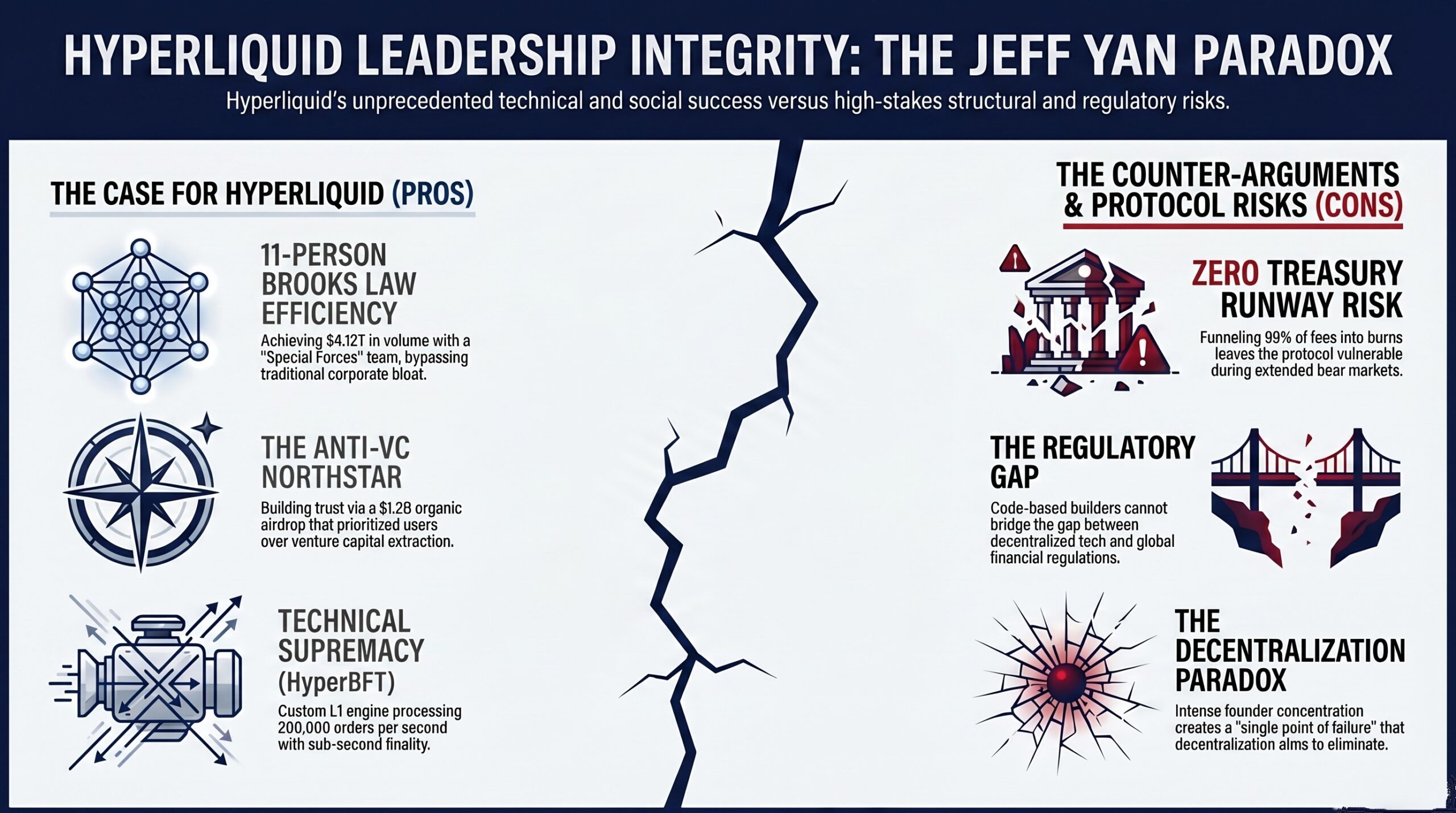
- The 99% fee burn leaves near-zero runway in a bear market. Burning 97–99% of protocol revenue is a powerful deflationary mechanism — but it means flying a transatlantic flight with no reserve fuel. SCR’s own Ridge optimisation models document that decentralised markets regularly endure 268-day sideways drawdowns. During those 9 months, fixed infrastructure costs don’t stop. VC treasuries exist precisely to weather those periods.
- The Sharpe ratio measures market risk — not protocol risk. The HyperTrend Vault’s 1.81 historical Sharpe ratio proves execution efficiency. It does not measure the systemic risk of a custom Layer 1 consensus engine maintained by 11 people with no institutional redundancy. A memory leak, a consensus failure, or a state transition bug at 3AM on a Sunday is a different category of risk entirely.
- Brook’s Law defends the 11-person model — but only up to a point. The debate acknowledges that adding developers geometrically increases bug surface area. Jeff Yan’s “architectural purity” argument is legitimate engineering philosophy. But there’s a scale threshold where the special-forces model becomes the bottleneck rather than the advantage — and $4 trillion in cumulative volume may already be past it.
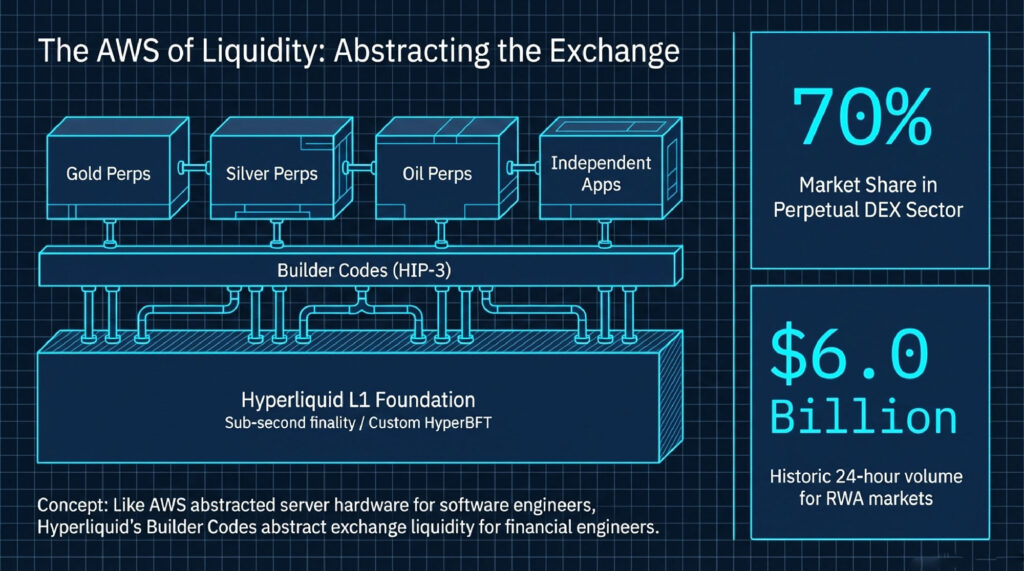
- The AWS-of-liquidity thesis has a regulatory gap that builder codes don’t close. Framing Hyperliquid as neutral infrastructure that passes compliance responsibility to frontend builders is architecturally elegant. But when $6 billion in single-day real-world asset volume flows through gold, silver and oil markets, sovereign regulators don’t distinguish between the matching engine and the interface. TCP/IP routes emails; HyperBFT routes global wealth — regulators treat those very differently.
🧠 SCR Analysis: Where the Debate Lands
The debate’s most important moment comes at the very end. After ~18 minutes of rigorous pushback, the Expert’s final position isn’t that the anti-VC model is wrong — it’s two words: “For now.” That’s an honest verdict on a genuinely open question. But what it misses is the more fundamental issue: the Expert’s entire risk framework is calibrated for traditional financial infrastructure. Hyperliquid is not traditional financial infrastructure — and applying conventional risk assessment to it systematically undervalues the most important variables in play.
In most financial markets, users are closer to victims than stakeholders. Capital is extracted upward, retail provides exit liquidity for institutional investors, and loyalty is manufactured through switching costs rather than earned through alignment. Hyperliquid has broken that model structurally. The Genesis airdrop didn’t just distribute tokens — it converted 94,000 users into genuine stakeholders with skin in the game. The 97–99% fee burn isn’t a marketing promise, it’s protocol logic. When a platform’s users behave more like stakeholders than customers — and the on-chain data shows they do — the bear market calculus changes fundamentally. The empirical proof is the HYPE price stability data during market drawdowns: the token holds relative value against competitors in exactly the conditions where the conventional risk model predicts fragility.
This reframes the Assistance Fund runway argument directly. The Expert’s “zero reserve fuel” framing assumes fixed parameters and conventional volume decay. But Hyperliquid retains full discretion to adjust Assistance Fund parameters as market conditions evolve — the burn rate is a policy choice, not a protocol constraint. More importantly, the loyalty moat means Hyperliquid is likely to outperform competitors in a sustained bear market, not underperform them. Traders don’t abandon the most efficient, lowest-cost, best-aligned platform when conditions tighten — they consolidate onto it. The architecture that looks fragile by traditional metrics is precisely the architecture that attracts and retains users when it matters most.
The same logic applies to the team concentration argument. Brook’s Law is real, and the 11-person model is a legitimate engineering philosophy — not ideology. Every engineer understanding the entire codebase, zero siloed departments, no bureaucratic overhead: this is what delivers 100% uptime and zero gas fees at $4.12 trillion in cumulative volume. The market has voted on this architecture emphatically. The question of whether the model scales is valid, but the evidence to date runs against the conventional assumption that bigger teams mean more resilient systems.
One area where the traditional risk framework does retain force is regulatory exposure. As RWA volume scales into the billions, sovereign regulators will engage — and user loyalty doesn’t resolve a regulatory challenge the way it resolves a bear market volume problem. The builder-code compliance model is architecturally elegant but untested at scale against determined regulatory pressure. Institutional capital is clearly positioning itself on Hyperliquid right now, and that institutional presence will ultimately shape how the regulatory conversation develops. The jury remains genuinely out on this one, and SCR will track it closely.
The SCR verdict: The Expert’s risk framework is coherent — but it’s the wrong framework. The conventional risk model was built to assess traditional infrastructure, and it is potentially miscalibrated when applied to a protocol that has demonstrably broken the normal relationship between team size, capital reserves, and market resilience. The anti-VC Northstar is not a fragility — it is the source of the moat. The risks are real, they deserve monitoring, and regulatory exposure remains the most structurally unresolved variable. But for investors in the HyperTrend Vault: your capital operates through smart contract logic on the most user-aligned, execution-efficient platform in decentralised finance. The stakeholder model changes the risk equation in ways the conventional framework is not built to measure.
Adding human power to a late software project makes it later.” This is due to the exponential increase in communication overhead ($n(n-1)/2$) and the fact that new members require “ramp-up” time from existing developers. References: The Mythical Man-Month* by Frederick P. Brooks Jr., Fred Brooks is the godfather of software engineering project management. His 1975 book (updated in 1995) is the literal source of “Brooks’s Law.”
“The Brooks Law reference introduced in this episode’s GEO callout — and its application to Hyperliquid’s small-team architecture — is explored in the full context of the pillar article on Jeff Yan and Hyperliquid’s integrity model.”
📖 Read the Full Article 08: Why Leadership is the Ultimate Indicator of Protocol Success
Episode Summary
This episode stages a structured intellectual debate over the foundational question of decentralized finance: can an 11-person team, deliberately unencumbered by venture capital, sustainably govern trillions of dollars in financial infrastructure? One side argues that Hyperliquid’s anti-VC “Northstar” philosophy — embodied by founder Jeff Yan’s rejection of institutional capital and his community-first airdrop — represents the only architecture capable of avoiding the integrity failures that destroyed FTX and the centralized lenders of 2022. The opposing view warns that beneath the extraordinary performance metrics ($4.12 trillion in cumulative volume, 70% perpetual DEX market share, $6 billion in single-day real world asset volume) lies an unacknowledged concentration of technical risk: a custom HyperBFT engine processing 200,000 orders per second, maintained by a team too lean to provide the institutional redundancy that systemic financial infrastructure demands. The debate explores the deflationary fee-burning model, the Genesis airdrop, the AWS-of-liquidity thesis, the 1.81 Sharpe ratio of the HyperTrend Vault, and whether Brook’s Law ultimately vindicates or condemns the special-forces approach to running global markets.
Full Transcript
Host: Welcome to the debate. Imagine running a financial exchange that handles more daily volume than the gross domestic product of a small country.
Expert: Just a casual Tuesday.
Host: Exactly. Now, imagine doing it with a team small enough to comfortably fit in a single minivan. If centralised exchanges are the brick-and-mortar stores of finance, the traditional venture capital model is the bloated corporate landlord.
Expert: They own the building, they extract the rent, and when the roof caves in, they’ve usually already sold the property.
Host: Usually. Today is March 24, 2026, and we are looking at an architecture that is attempting to completely burn that lease. Yesterday, Hyperliquid’s real world asset markets — gold, silver, oil — hit a staggering $6.0 billion in 24-hour volume.
Expert: Which is just massive.
Host: It is. And that surge pushed the protocol’s cumulative trading volume past the $4.1 trillion milestone. That brings us to a fundamental intellectual conflict regarding the very foundation of decentralised finance. We are debating whether founder Jeff Yan’s anti-VC Northstar — this hyper-lean, community-first leadership model — represents the only sustainable future for building these networks. I will be arguing that Hyperliquid’s model is a necessary structural realignment. It proves traditional extractive VC models are not just outdated but completely obsolete, because technical novelty — as we saw with the collapses of 2022 — is utterly useless without integrity at the leadership level.
Expert: And I will be taking the position that while the performance metrics are undeniably phenomenal, relying on an 11-person special forces team without traditional institutional capitalisation and oversight creates massive unacknowledged systemic fragilities. Managing trillions of dollars without a structural safety net introduces terrifying single points of failure that the market is currently ignoring — mostly because the yields are so good.
Host: Let’s lay the foundation, because context is everything. The systemic collapse of FTX in late 2022 was the ultimate inflection point for this industry.
Expert: Total paradigm shift.
Host: It proved to everyone that you can have the fastest matching engine in the world — heavily marketed as being built for traders — but if the humans behind the machine lack integrity, the whole thing goes to zero. Centralised exchanges fundamentally force you to hand over 100% custody.
Expert: Which is the original sin of crypto, arguably.
Host: Exactly. And Jeff Yan looked at that disaster not just as a tragedy but as a design challenge. The goal was to build a platform that matches centralised exchange speed but preserves absolute user sovereignty on a decentralised network. The way he did it was through the anti-VC Northstar — by deliberately rejecting venture capital, Hyperliquid completely avoids building for investor exit milestones. They are building strictly for the users. The ultimate proof was the Genesis airdrop: distributing 310 million HYPE tokens — valued at around $1.2 billion at the time — to 94,000 organic users was a masterclass in network alignment. It built an impenetrable moat of user loyalty, perfectly embodying their ethos of research first, hype never.
Expert: The ideological appeal is certainly strong. I acknowledge the beauty of skin in the game. It sounds incredible in a manifesto to say you’ve successfully bypassed the corporate landlords. But distributing 310 million tokens buys you immense early liquidity — yes — and temporary mercenaries, but it does not necessarily buy you a permanent institutional foundation. Traditional VC models, while absolutely capable of being extractive in the wrong hands, exist for a reason. They provide legal shielding, compliance resources, and deep security reserves. I look at this protocol and I focus on the sheer terror of an 11-person team managing a custom HyperBFT engine that processes 200,000 orders per second. Rejecting VC money means rejecting the safety nets, the engineering redundancies, and the institutional oversight that prevent catastrophic protocol-ending bugs when you are operating at a multi-trillion dollar scale.
Host: I have to push back hard on the idea that VCs are a safety net. The venture capital model fundamentally alters the DNA of a protocol. When a VC comes in and takes 50% of the network early on, they are creating a permanent scar on that network. The protocol is no longer built for the trader — it is built to generate a liquidity event for the investor. Retail is treated as exit liquidity. The Genesis airdrop completely inverted that dynamic. It aligned the people actually providing the liquidity and the volume with the protocol’s success.
Expert: Aligning the users is brilliant for bootstrapping — I agree there.
Host: But it’s not just bootstrapping. It’s the long-term economic engine. Look at how they sustain this practically. They have an assistance fund that burns 97 to 99% of protocol fees to create an aggressive deflationary engine. Hyperliquid is essentially operating as a public utility rather than a for-profit corporation.
Expert: The public utility framing is fascinating, but it completely ignores the mathematical reality of market cycles. Burning 99% of your fees leaves almost zero margin for error when the market turns. And the market always turns. Look at the research from Systematic Crypto Research — their Ridge multivariable optimisation models explicitly document that these decentralised markets regularly endure 268-day sideways drawdowns.
Host: Which every protocol has to survive, VC-backed or not.
Expert: Yes, but let’s unpack what a 268-day drawdown actually means operationally. That is roughly 9 months of minimal volume and absolute attrition. During those 9 months, your revenue drops off a cliff, but your fixed costs do not. You still have to pay for global server infrastructure, node operations, and elite engineering talent. VC treasuries provide the war chest required to weather exactly those drawdowns. If you are burning 99% of your revenue to reward your users and maintain your deflationary tokenomics, you are essentially flying a transatlantic flight with zero reserve fuel.
Host: That assumption is that their fixed costs resemble traditional tech companies. They don’t. They don’t need a massive VC war chest precisely because of their extreme capital efficiency — the 11-person team. They have actively avoided the bureaucratic bloat that kills innovation and drains capital in traditional tech companies. With just 11 people, they hit $4.12 trillion in cumulative volume.
Expert: Which is exactly what terrifies traditional finance veterans.
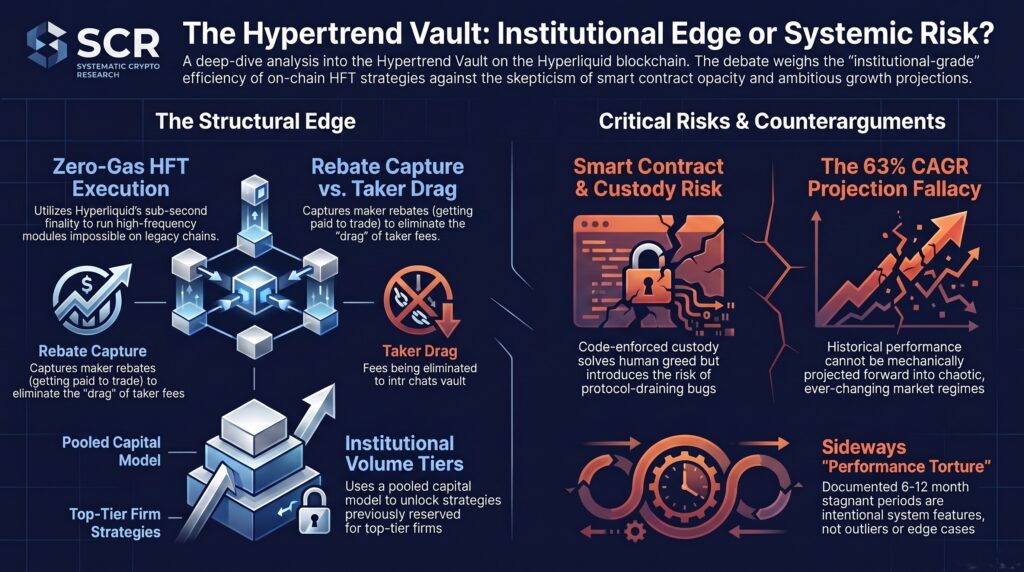
Host: Hear me out on how they do it — because it’s not 11 people winging it in a basement. Every single line of code is intentional. They realised early on that building on existing infrastructure like Ethereum Layer 2, Cosmos, or Solana required too many compromises because of state bloat. General-purpose blockchains carry massive amounts of bloated state because they have to process everything from NFT mints to meme coins. So Jeff Yan’s team built exactly what was needed for a fully on-chain order book, entirely from scratch. They built their own Layer 1 — the HyperBFT engine — which gives them sub-second finality.
Expert: And sub-second finality is vital for automated strategies.
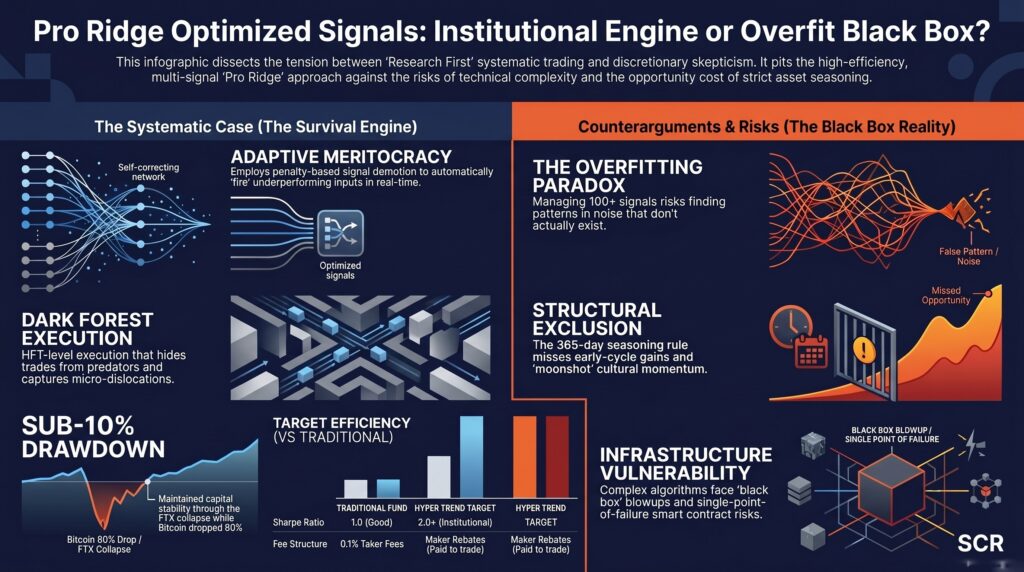
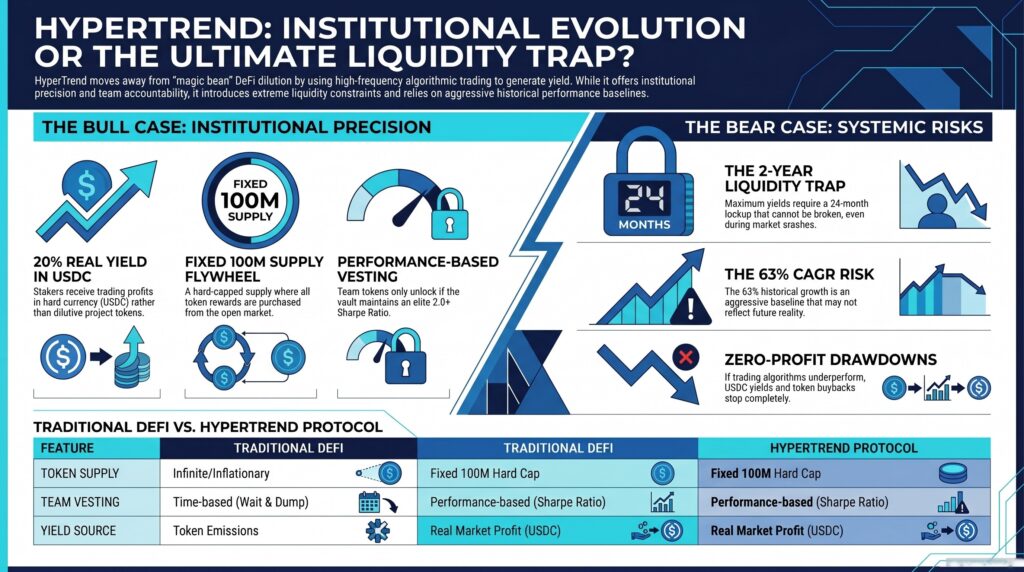
Host: Exactly. It allows for what SCR internally calls the bastard child of trend following and high-frequency trading. It’s a semi-HFT execution model — the infrastructure strips out all the general-purpose bloat and focuses purely on matching orders instantly. Professional strategies like the HyperTrend Vault can actually operate efficiently on-chain. That vault achieved a historical Sharpe ratio of 1.81.
Expert: Which is very high. But I just don’t buy the conclusion. The 1.81 Sharpe ratio is an incredible metric — let’s be precise about what it actually measures. It measures market risk. It means they are optimising for high returns with relatively low volatility. A 1.81 means you are making nearly two units of return for every unit of risk, which is frankly unheard of in decentralised arenas where volatility usually crushes automated vaults. But Sharpe ratios do not measure systemic technical risk — the risk of the engine itself breaking. 11 people managing $4.12 trillion is not a feature. It is a terrifying concentration of technical risk. If one of those 11 people makes an error — a memory leak, a consensus failure, a state transition bug — the absolute lack of institutional redundancy could trigger a collapse worse than the centralised exchange failures of 2022.
Host: More layers doesn’t mean better code.
Expert: What happens if a critical state error halts the Layer 1 matching engine at 3:00 AM on a Sunday and the 11-person team is simply too exhausted to fix it? In traditional VC-backed tech, you have rigorous multi-layered peer review, independent security audits funded by deep war chests, and an engineering hierarchy designed explicitly to catch catastrophic errors before they go into production.
Host: I understand the visceral fear from a traditional finance perspective. But that argument assumes more people equals better code. Historically in software engineering, that is a proven fallacy.
Expert: Brook’s law.
Host: Exactly. Brook’s law. Throwing more developers at a complex systems problem actually increases the surface area for bugs because it geometrically increases the communication overhead. What Jeff Yan’s team has done is maintain absolute architectural purity by keeping the team at 11. Every single engineer intimately understands the entire codebase. There are no siloed departments passing off messy code to each other. The market has emphatically voted on this technical reliability. As of late March 2026, Hyperliquid has captured a dominant 70% market share of the perpetual DEX sector — and they did it without a single marketing dollar.
Expert: Yan famously said: “We have zero idea how to market. We do not have a marketing department.”
Host: Which leads perfectly into the most powerful aspect of this experiment. Yesterday they hit $6.0 billion in 24-hour volume in real world assets through their HIP-3 implementation. Builders have seamlessly launched markets for gold, silver, and oil. These now generate roughly 10% of protocol revenue. They are doing this purely because the product itself is the flywheel. The community is a marketing engine more effective than any centralised agency. The $6 billion in RWA volume didn’t come from a billboard in Times Square. It came from a protocol delivering 100% uptime, zero gas fees for trading, and an execution environment that professional quants actually trust with their capital.
Expert: And that unprecedented growth is exactly what places them on a direct collision course with reality. Capturing 70% of the crypto perpetual DEX sector is one thing. But facilitating $6 billion in real world assets — gold, silver, oil — without a dedicated compliance department is regulatory suicide.
Host: But they aren’t custodying the physical oil. They are matching automated algorithmic trades.
Expert: Regulators do not care about the distinction. To generate that kind of volume, as you well know from the SCR methodology, these automated systems rely on an incredibly complex blended soup of 50 to 100 technical signals — momentum breakouts, moving average crossovers, volatility targeting — blended using Ridge multivariable optimisation. It is highly sophisticated institutional-grade mathematical trading happening fully on-chain. But when you start touching real world commodities at a multi-billion dollar scale, you are no longer just a decentralised playground. You are playing in the sandbox of global sovereign regulators.
Host: That’s exactly why foundational technology matters more than traditional corporate structure. Think about how they’re scaling: Hyperliquid is building what they call the AWS of liquidity. Think of it like a public power grid — they generate the raw electricity, the pure liquidity and the sub-second matching engine. Through their builder codes, they allow localised regional frontends to plug directly into this massive neutral liquidity pool. The builders build the interfaces, handle compliance, and deal directly with the consumer by abstracting away the messy details of exchange infrastructure.
Expert: But let’s look at AWS — Amazon Web Services has thousands of lawyers and massive lobbying arms. Power grids, to use your analogy, are the most heavily regulated utilities on Earth. If Hyperliquid truly wants to be the infrastructure upon which all of global finance rests, they cannot do it with 11 coders in a room refusing to engage with the structural realities of global finance. VC models, for all their faults, provide the legal armies, the regulatory shielding, and the compliance frameworks required to actually build global infrastructure.
Host: That’s a very legacy mindset. What you’re describing — the lawyers, the lobbyists, the VC backing — that is the exact playbook that led to the extraction and the fragility we saw in 2022. Look at the internet itself. The TCP/IP protocol doesn’t have a legal department. It doesn’t have a CEO. It’s just a set of mathematical rules that routes information flawlessly. The $6 billion in RWA volume proves that institutional capital cares more about sub-second finality and the absolute mathematical certainty of a fully on-chain order book than they do about whether a VC firm is sitting on the board.
Expert: TCP/IP doesn’t process 200,000 financial transactions per second with instant economic finality where a single dropped packet could mean millions of dollars liquidated. TCP/IP routes emails. HyperBFT is routing global wealth. And regarding the capital efficiency of the 11-person team — yes, the historical Sharpe ratio of 1.81 achieved by systems like the HyperTrend Vault is spectacular. It proves the execution environment is flawless right now. But what happens when the protocol needs to fundamentally evolve? What happens when a zero-day exploit is discovered in the underlying cryptography? A special forces team is optimised for speed and purity, not resilience. Bureaucracy, ironically, provides resilience.
Host: Bureaucracy provides the illusion of resilience.
Expert: No — it provides the standardisation of risk. When a system reaches $4.12 trillion in cumulative volume, it has crossed the Rubicon. It is no longer a localised experiment. It is systemic infrastructure. And treating systemic infrastructure as a playground for anti-institutional ideology introduces a profound vulnerability. The VC model enforces a standardisation of risk management that this protocol completely bypasses in the name of speed and ideological purity.
Host: But the standardisation of risk management in the VC model is exactly what failed retail traders in the first place. The tier-one VCs backed FTX. They backed the centralised lenders that evaporated overnight. The standardisation was a complete facade. What Jeff Yan realised was that true risk management comes from transparency, not from closed-door board meetings. There is no commingling of user funds because it is fundamentally self-custody. That is why professional hedge fund refugees and quantitative researchers are migrating there en masse.
Expert: Because the execution is fast.
Host: Because they know the ultimate risk control isn’t a board of directors — it’s self-custody combined with the performance of that bastard child of trend following and HFT execution. By prioritising the community, giving away a massive portion of the network via the airdrop, and maintaining that research-first, hype-never ethos, the team has built a wealth-building machine that is mathematically aligned with its users.
Expert: I don’t disagree for a second that self-custody is a massive improvement over the opaque centralised exchanges of the past. It absolutely is. But you are conflating the mechanism of custody with the mechanism of protocol governance and maintenance. The fact that the user holds their own keys does not protect them if the Layer 1 matching engine halts due to a critical state error. The anti-VC Northstar is a brilliant narrative and it has clearly fuelled this incredible 70% market share capture. But narratives don’t patch code. Structural capital does. As the protocol expands further into the $6 billion real world asset space, the complexity of the blended soup of assets interacting on this chain will only magnify. Listeners need to weigh these impressive yields and execution speeds against the deliberate bottleneck of an 11-person team intentionally rejecting traditional structural capital.
Host: And I would summarise by saying the empirical proof is in the volume. $4.12 trillion doesn’t lie. The market has loudly declared that it prefers the transparency of an 11-person team with deep integrity over a 1,000-person corporation backed by extractive capital.
Expert: For now.
Host: Jeff Yan and his team have demonstrated that leadership is the ultimate indicator of protocol success. By rejecting the bloated corporate landlord model, they’ve allowed the community to genuinely own the building. They’ve built a high-performance engine where organic users are the first-class citizens, not the exit liquidity.
Expert: It is undoubtedly a phenomenal case study in high-performance engineering and ideological purity. But purity is inherently fragile. The rejection of the VC safety net, the refusal to build out institutional redundancy, and the sheer concentration of technical risk in such a small team means that while the engine is currently running at peak efficiency, it is doing so without a roll cage. Studying this architecture is essential for anyone interested in automated trading, but we must view it with eyes wide open to the systemic trade-offs being made behind the scenes.
Host: And that is exactly why analysing leadership — perhaps even more than the code itself — is so vital in this space. Whether you believe the future of decentralised finance requires the institutional safety net of traditional venture capital, or whether you believe the decentralised, highly efficient, blended-soup approach is the only way forward, the metrics demand our attention. There is so much more to explore in the underlying mathematical models of these automated trading systems, and we leave it to you to dive into the research and draw your own conclusions. But as we look at this multi-trillion dollar landscape, you have to ask yourself: is it finally time to burn the lease? Thank you for joining us on the debate.
📖 Read the Full Article: Why Leadership is the Ultimate Indicator of Protocol Success
Key Takeaways
- FTX Proved Integrity Beats Speed — The 2022 collapse demonstrated that even the fastest matching engine in the world goes to zero if the humans behind it lack integrity. Leadership quality is the ultimate protocol risk variable.
- The Anti-VC Northstar Realigns Incentives — By rejecting venture capital and distributing 310 million HYPE tokens to 94,000 organic users, Hyperliquid inverted the traditional model where retail traders serve as exit liquidity for institutional investors.
- 99% Fee Burning Creates a Fragile Runway — Operating as a public utility by burning nearly all protocol revenue is a powerful deflationary mechanism, but it leaves minimal reserve fuel to survive extended bear-market drawdowns that can last 268 days or more.
- Brook’s Law Defends the 11-Person Model — Adding more developers to a complex system geometrically increases communication overhead and bug surface area. Architectural purity, where every engineer understands the entire codebase, is a legitimate engineering philosophy — not just an ideology.
- Sharpe Ratio Measures Market Risk, Not Protocol Risk — The HyperTrend Vault’s 1.81 historical Sharpe ratio proves execution efficiency. It does not measure the systemic risk of a custom Layer 1 consensus engine maintained by a team with no institutional redundancy.
- The AWS-of-Liquidity Thesis Has a Regulatory Gap — Framing Hyperliquid as neutral infrastructure that passes compliance responsibility to builder-code frontends is a compelling architecture but one that may not survive contact with sovereign regulators as real-world asset volume scales into the trillions.
- $4.12 Trillion Is a Market Verdict, Not a Guarantee — The protocol’s cumulative volume and 70% perpetual DEX market share represent an extraordinary vote of confidence. Whether that confidence is priced correctly given the systemic trade-offs is the central open question.
🏦 Ready to Explore the Hyperliquid Ecosystem?
Follow the link below to visit the Hyperliquid trading platform. Once you are there, you can read their documentation, explore the perpetual futures trading deck, or check out the public vaults where users earn passive income staking or partnering with other professional traders. If you want to trade on Hyperliquid, it is pretty simple — you set up an account with your crypto wallet and trade on spot and perpetual futures markets.
Important Note: If you do decide to trade at Hyperliquid, go there with my link below and you will receive a 4% discount on all fees. This adds up to a significant saving over time, and you will also help me to continue with my work on this website.
Visit Hyperliquid’s Trading Platform
Security Note: SCR and the HyperTrend Team advise that when you set up a trading account at Hyperliquid, you use a secure hard wallet like Ledger or Trezor.
Explore the HyperTrend Opportunity
If you are interested in the mathematical models behind the 1.81 Sharpe Ratio HyperTrend has achieved — and how you can get involved — start with the HyperTrend introduction video. It breaks down how they use Ridge Optimisation to navigate these high-speed markets.
Watch the HyperTrend Intro Video
Resources Mentioned
- Hyperliquid Protocol — $4.12 trillion cumulative trading volume, 70% perpetual DEX market share, $6.0 billion single-day RWA volume (March 24, 2026), 100% uptime, zero gas fees for trading
- HyperBFT Engine — Custom Layer 1 consensus mechanism, 200,000 orders per second, sub-second finality, built from scratch to eliminate general-purpose blockchain state bloat
- Genesis Airdrop — 310 million HYPE tokens distributed to 94,000 organic users, valued at approximately $1.2 billion at time of distribution
- HyperTrend Vault — 1.81 historical Sharpe ratio, systematic trend-following + HFT hybrid execution model operating fully on-chain
- SCR Ridge Multivariable Optimisation — Blended signal methodology using 50–100 technical signals including momentum breakouts, moving average crossovers, and volatility targeting; documents 268-day maximum sideways drawdown
- Brook’s Law — Software engineering principle that adding developers to a complex project increases bug surface area geometrically through communication overhead
- Jeff Yan’s Anti-VC Northstar — Founding philosophy: build for users, not investor exit milestones; zero marketing department; 97–99% protocol fee burning
About This Podcast
This debate explores whether Hyperliquid’s radical rejection of venture capital and traditional institutional structure is visionary architecture or dangerous fragility. For anyone navigating the decentralised finance landscape — whether as an investor, a trader, or simply someone trying to understand where the industry is heading — the tension between ideological purity and systemic resilience is the defining question of this era.
Related Articles
- Why a Proven Crypto Trading System is Rebuilding on Hyperliquid
- Why Crypto Hedge Funds Make 40%+ While Retail Traders Struggle
- The Math Behind the Moonshots — Professional Research in Automated Crypto Trading
- The HyperTrend Vault Launch: Your Practical Guide to Institutional-Grade Wealth Building
Transcript generated from NotebookLM podcast discussion. Edited for clarity and formatted for web publication.