Table of Contents
🎧 Audio Discussion Available
An AI-generated podcast explores this article’s concepts through conversational debate format—useful for audio learners or those wanting to hear multiple perspectives.
Duration: 16 minutes
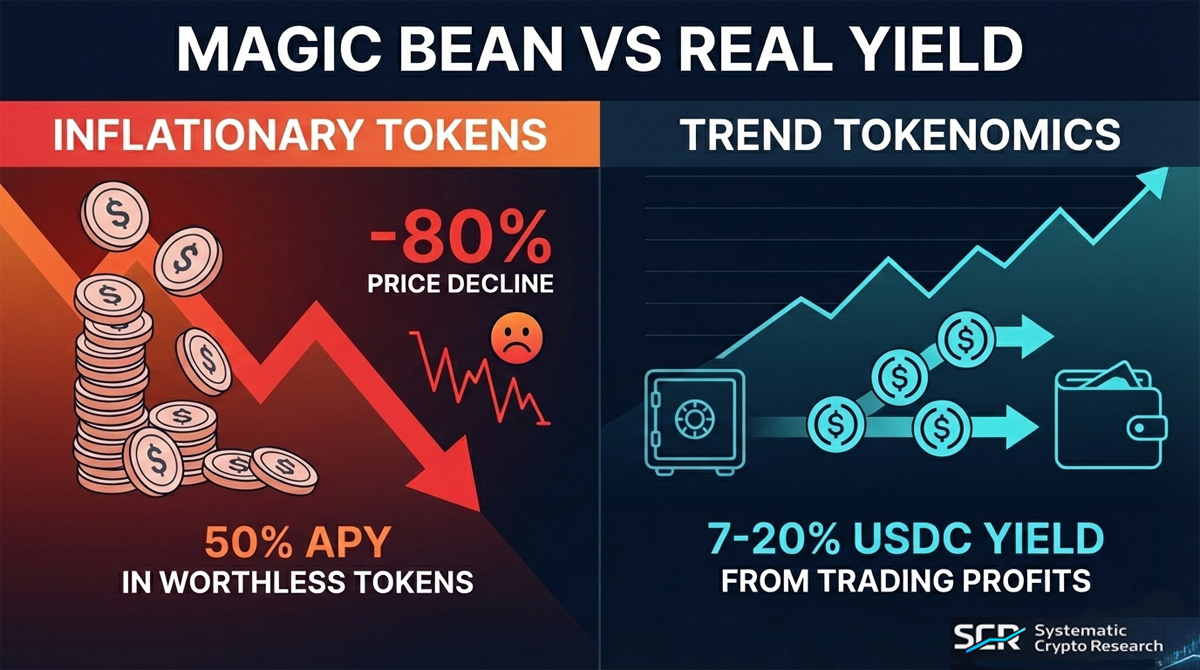
If you’ve explored DeFi yield farming, you’ve probably encountered what Scott Phillips calls “magic beans”—tokens that promise high yields by paying you in more of the same token. The math seems compelling at first: stake your BEAN tokens, earn 50% APY in more BEAN tokens. But then reality hits. As the protocol mints new tokens to pay rewards, sell pressure overwhelms demand, the price crashes, and your “50% yield” becomes worthless faster than you can unstake.
“Magic Beans” = DeFi protocols that pay staking rewards in their own inflationary token. The math looks attractive (50%+ APY), but as the protocol mints new tokens to pay rewards, sell pressure overwhelms demand and the price crashes—turning your “50% yield” into losses faster than you can exit.
Real examples: Even successful protocols like AAVE and Morpho face this dynamic. They generate real lending revenue, but token rewards are paid in inflationary tokens that most holders immediately sell, creating constant downward price pressure regardless of protocol success.
Even successful protocols like AAVE and Morpho face this dynamic. They generate real revenue from lending, but their token holders receive rewards in inflationary tokens that most immediately sell, creating constant downward price pressure regardless of protocol success.
For the last three years, I’ve been researching Finrev, an automated crypto trading platform, looking for a systematic approach to wealth building that doesn’t rely on hoping someone else buys your inflated tokens. That research has led me to the upcoming Trend coin launch—a token designed from the ground up to solve the fundamental problem plaguing DeFi economics: how do you generate real, sustainable passive income without destroying your principal through inflation?
The HyperTrend Vault goes public in just weeks. The Trend Coin Tokenomics will be revealed as the Trend token generation event approaches in the second half of 2026. This isn’t vaporware or speculative tokenomics. This is a proven trading system (3+ years of documented performance) transitioning to a vault architecture that enables something most crypto projects can’t deliver: passive income paid in hard currency, not inflationary promises.
The Engine: Why the HyperTrend Vault Matters
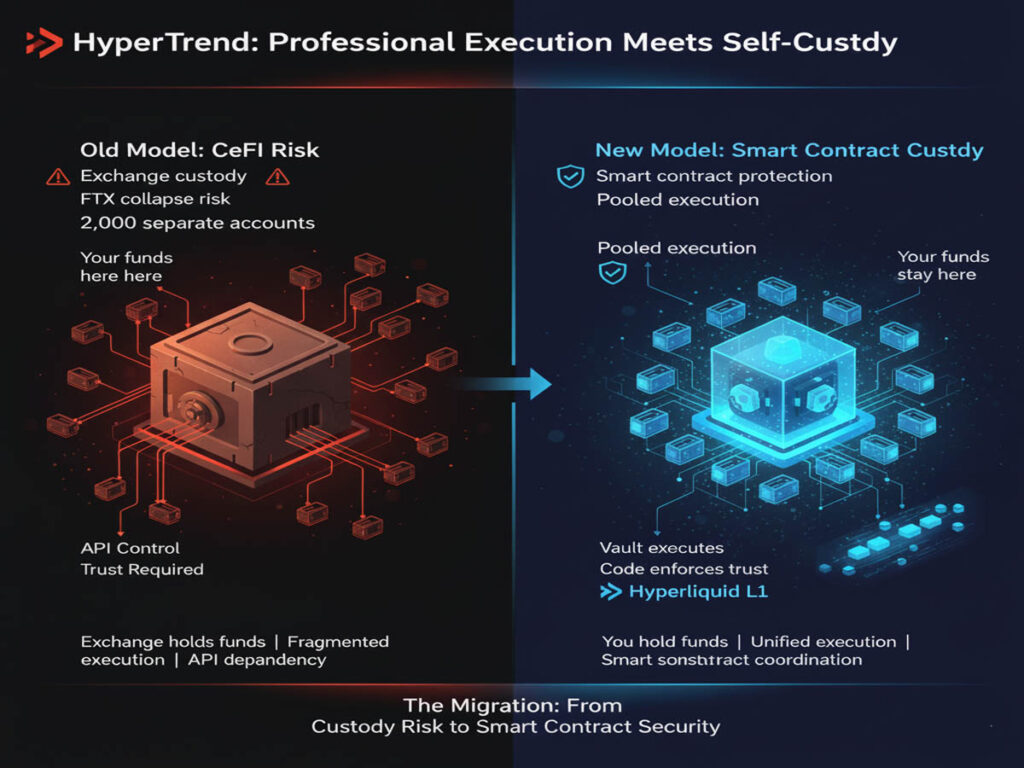
Before we discuss the token economics, we need to understand what generates the value. The HyperTrend Vault represents Finrev’s proven trading strategies rebuilt on Hyperliquid’s blockchain infrastructure, pooling capital into a single smart contract instead of managing thousands of individual accounts. This unlocks institutional-grade execution, VIP trading fee tiers, and high-frequency trading capabilities impossible with fragmented retail accounts.
The HyperTrend Team targets vault returns of 35-100% annually, depending on market conditions and leverage selection. Over the past three years, Finrev achieved a 63% compound annual growth rate across bull, bear, and choppy markets.
Critical qualifier: Information shared here on HyperTrend Vault and the Trend coin from the draft HyperTrend whitepaper is subject to change until the whitepaper is publicly released. Please also remember that past performance doesn’t guarantee future results. HyperTrend integrates new trading modules with proven strategies, and markets evolve constantly. What we can verify: three years of auditable performance, a team with institutional quant backgrounds, and on-chain transparency that lets you verify every trade in real-time.
For the full technical breakdown of how the vault actually works—signal development, execution architecture, risk management—see Why a Proven Crypto Trading System is Rebuilding on Hyperliquid. And for a deeper dive into the upcoming vault launch details, see HyperTrend Vault Launch Guide
Trend Coin Tokenomics: Three Mechanisms That Break the “Magic Bean” Cycle
The Trend coin was engineered specifically to create what the team calls “number-go-up tokenomics”—sustainable price appreciation driven by real revenue, not ponzi mechanics. Here’s how it works:
Mechanism 1: Real Payouts in USDC (Not Tokens)
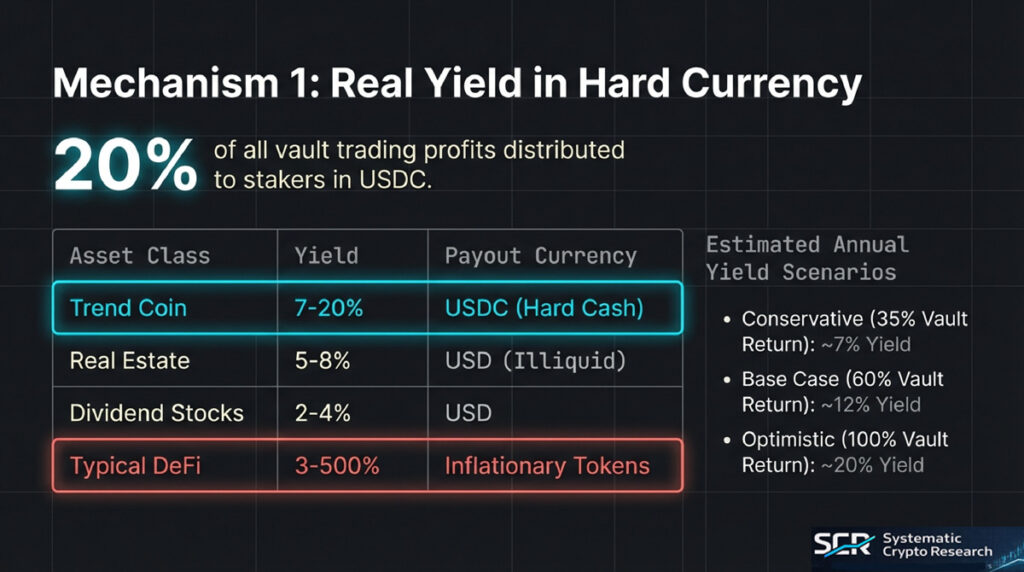
Trend token holders who stake their tokens receive 20% of all vault trading profits—forever. But unlike every “magic bean” protocol, these rewards are not paid in Trend tokens. They’re paid in USDC, the regulated, audited stablecoin.
This changes everything. You can generate passive income in hard currency that you can spend, reinvest, or hold without ever touching your principal Trend token position. No inflation. No sell pressure. Just direct profit-sharing from actual trading revenue.
How realistic are the yields? Let’s run the math based on the team’s targets and historical performance:
- Conservative scenario (35% vault return): Stakers receive ~7% USDC yield annually
- Base case (60% vault return): Stakers receive ~12% USDC yield annually
- Optimistic scenario (100% vault return): Stakers receive ~20% USDC yield annually
Compare this to:
- AAVE/Morpho staking: 3-5% in inflationary tokens
- Stock dividends: 2-4% in USD
- Real estate rental yield: 5-8% (illiquid, requires management)
- Bitcoin: 0% (store of value, no cash flow)
The risk qualification: These projections assume the vault achieves its performance targets in favorable market conditions. Crypto markets are volatile. Drawdown periods exist—the whitepaper mentions maximum drawdowns around 20%. There will be months where the vault goes sideways or declines. Trend-following systems endure long periods of low returns while waiting for major trend moves. If you can’t psychologically handle 6-12 month stretches of flat performance, this isn’t for you.
Mechanism 2: Fixed Supply + Deflationary Buyback Pressure
There will only ever be 100 million Trend tokens. The smart contract forbids creating more—mirroring Bitcoin’s scarcity model.
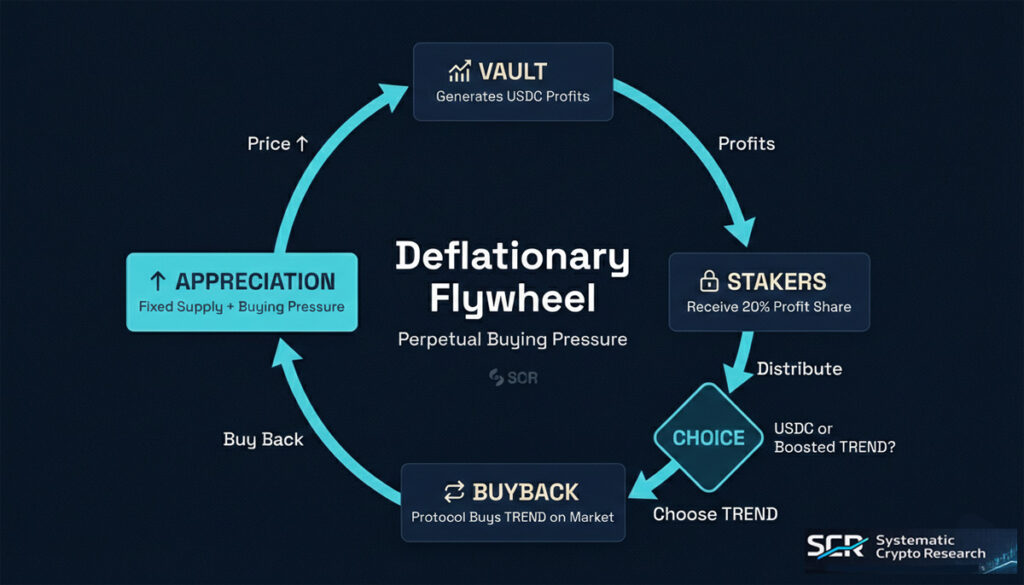
But here’s where it gets interesting: When stakers claim their 20% profit share, they can choose between receiving USDC or receiving boosted rewards in Trend tokens. If they choose the Trend token option, the protocol must go to the open market and buy Trend tokens to satisfy those reward obligations.
This creates a perpetual buying pressure flywheel:
- Vault generates USDC profits from trading
- 20% goes to stakers
- Stakers who choose Trend rewards (for higher yield) force protocol buybacks
- Buybacks + fixed supply = sustained price appreciation
- Higher token price + cash flow = more attractive to hold long-term
Fixed supply (100M tokens) + buyback pressure = price appreciation engine
How it works: When stakers choose “boosted rewards in Trend tokens” instead of USDC, the protocol must buy Trend tokens on the open market to pay them. This creates perpetual buy pressure with zero new token inflation.
The flywheel: Vault profits → 20% to stakers → Stakers choose Trend rewards for higher yield → Protocol buybacks → Rising price + cash flow → More attractive to hold long-term → Repeat.
What breaks this: Only works if the vault consistently generates profits. Extended market downturns weaken buyback pressure and could cause token price decline even if long-term vault performance remains positive.
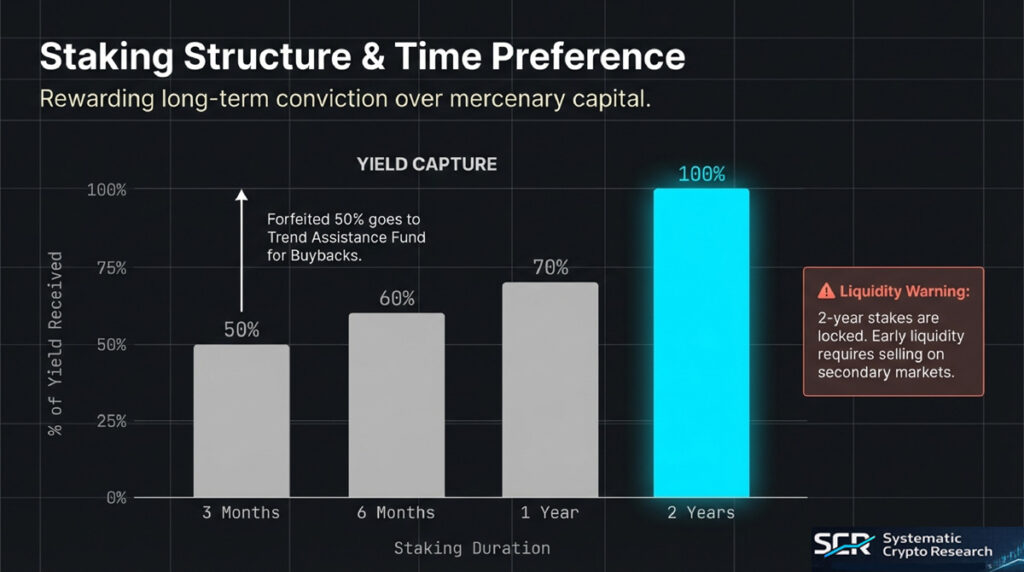
Additionally, stakers who choose shorter lock-up periods (3 months, 6 months) receive reduced yield percentages. The excess yield goes to the Trend Assistance Fund, which the protocol uses to opportunistically buy Trend tokens during market dips, providing additional price support.
The risk factor: This only works if the vault consistently generates profits to fund buybacks. If market conditions turn unfavourable for extended periods, buyback pressure weakens. The token price could decline even if the underlying vault maintains positive long-term performance. You’re exposed to both vault performance risk and token market sentiment.
Before committing capital, ask yourself:
- Can you handle 6-12 month periods where the vault goes flat or slightly negative?
- Can you lock tokens for 2 years to maximize yield (100% vs 50% for 3-month stake)?
- Can you tolerate 20% drawdowns without panic-selling?
- Do you understand this is 5-10 year wealth building, not get-rich-quick?
If you answered “no” to any of these: This token isn’t for you, regardless of how sound the tokenomics are. Psychological sustainability > Mathematical elegance.
The trade-off: Accept volatility + lock-ups in exchange for USDC passive income that doesn’t inflate away your principal.
Mechanism 3: Team Incentives Locked to Performance
This is perhaps the most important trust-building element: the team allocated themselves 25% of the total token supply, but the vast majority only vests if they deliver exceptional results.
10% of team supply: Vault Performance Vesting
- Only unlocks during rolling six-month periods where the vault maintains a post-fee Sharpe ratio above 2.0
- If performance drops below this elite threshold, vesting stops
- This matches the risk-adjusted returns of the world’s top hedge funds
5% of team supply: TVL Milestone Vesting
- 1% unlocks at each Total Value Locked milestone: $100M, $200M, $300M, $400M, $500M
- Team only gets wealthy if they attract and retain user capital at scale
10% of team supply: Standard 6-month cliff + 2-year vest
- For team members without direct trading responsibilities
- Industry-standard structure
Claim: Team receives 25% of token supply, but 15% only unlocks if they deliver exceptional results
Vesting structure:
- 10% of supply: Only vests during 6-month periods with Sharpe ratio >2.0 (matches top hedge funds globally)
- 5% of supply: Unlocks at TVL milestones ($100M, $200M, $300M, $400M, $500M)
- 10% of supply: Standard 6-month cliff + 2-year vest
Verification: All vesting enforced by smart contracts, verifiable on-chain at launch. Team cannot dump and run—they only get paid if you profit first.
Context: Compare to typical crypto projects where VCs/insiders get massive discounts then dump on retail. HyperTrend took zero VC funding—entirely community-bootstrapped.
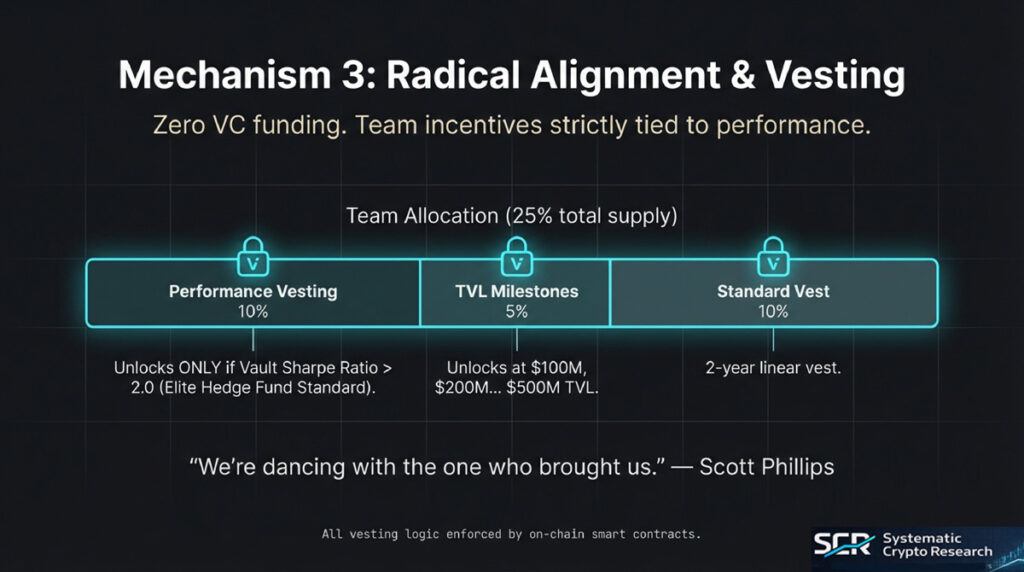
What this means: The team’s wealth is directly tied to delivering the performance they’re promising. They can’t dump tokens and run. They only get paid if they make you money first. Scott Phillips has been vocal about this: “We’re dancing with the one who brought us”—meaning the community that bootstrapped this technology gets rewarded before the team does.
Compare this to typical crypto projects where VCs and insiders get tokens at massive discounts, then dump on retail investors at launch. HyperTrend took zero VC funding. It was entirely community-bootstrapped, and the tokenomics reflect that alignment.
The transparency factor: All vesting schedules are enforced by smart contracts and verifiable on-chain. When the token launches, you’ll be able to track exactly when team tokens unlock and whether performance targets are being met. This isn’t trust-based—it’s cryptographically verifiable.
Trend Coin Tokenomics Airdrop: 32% for Community, Zero for VCs
The token distribution further reinforces this philosophy:
- 32% Airdrop: Exclusively for the community that built this
- 43% Staking Rewards: Decade-long emissions schedule
- 25% Team: Performance-locked vesting as described above
- 0% VC allocation: No private sales, no discounted insider deals
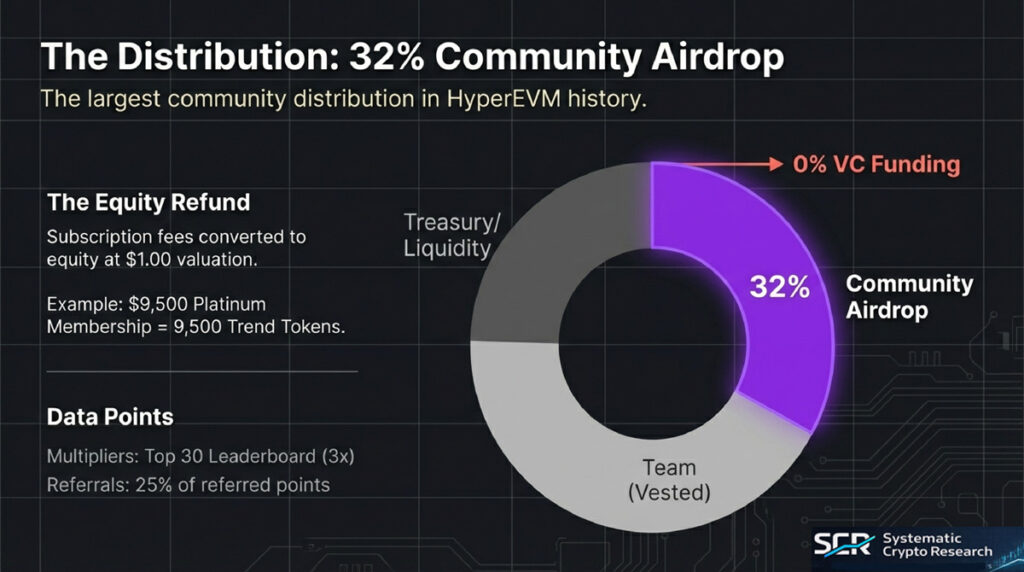
That 32% community allocation represents the largest proportional airdrop I’ve encountered in legitimate institutional-grade projects. And it’s not being diluted by VC presales or insider allocations.
The airdrop system rewards four types of participation:
- Vault deposits (largest weight)
- Early participation bonus
- Referral network effects (you receive 25% of your referrals’ points)
- Leaderboard positioning (top participants receive multiplied rewards)
Sharpe Ratio = Risk-adjusted returns metric. For Trend coin, it determines when 10% of team tokens unlock.
The threshold: Team vesting only activates during 6-month periods where vault maintains Sharpe ratio >2.0 (post-fee).
Why 2.0 matters: This matches elite hedge funds like Renaissance Technologies (~2.5 Sharpe). A 1.0 Sharpe beats 95% of all hedge funds globally. The team must deliver top-tier performance to unlock their tokens.
For existing Finrev subscribers, the team has committed to full subscription refunds in token equity. If you paid $9,500 for a Platinum membership, you’ll receive $9,500 worth of Trend tokens at launch valuation. Your subscription fee wasn’t rent—it was an equity investment.
The Real Risk: What Could Break This?
I’m not here to shill. I’m documenting a research process. So let’s examine failure scenarios with the same rigour we applied to the upside case.
Market Structure Risk:
- Crypto trend-following works until it doesn’t
- Black swan events can wipe out months of gains in hours
- Correlation breakdowns during extreme volatility
- Hyperliquid platform risk (though decentralized, still has infrastructure dependency)
Token Economic Risk:
- Buyback pressure requires sustained profitability
- If the vault underperforms for 12+ months, the token price could collapse regardless of long-term potential
- Staking lock-ups create liquidity constraints—you can’t exit during drawdowns
- Market depth for the Trend token is unknown at launch
Team Execution Risk:
- Transitioning from Finrev to HyperTrend involves technical complexity
- Scaling to larger capital ($100M+ TVL targets) may impact performance
- Team retention and motivation over a multi-year timeline
This is not financial advice. I’m a researcher documenting my own capital allocation decisions, not a financial advisor telling you what to do. Crypto trading and token investment involve substantial risk of loss. Never invest money you cannot afford to lose entirely. Do your own research. Verify everything on-chain.
Bottom Line: A Systematic Bet on Institutional Execution
Most people in crypto are looking for the next 100x token or memecoin lottery ticket. I’m interested in something less exciting but potentially more reliable: systematic wealth building through institutional-grade execution delivered via transparent, community-owned infrastructure.
Trend coin isn’t a magic bean. It’s an attempt to solve the fundamental economic problem of DeFi – sustainable value accrual without inflationary destruction – by tying token value directly to real trading profits and enforcing team accountability through performance-based vesting.
Will it work? The vault trading core engine Finrev has a proven track record. The tokenomics are sound on paper. The team has institutional pedigrees and skin in the game. But markets are unpredictable, and new systems carry execution risk.
What I can say with confidence: this represents the most thoughtfully designed attempt at sustainable passive income in crypto that I’ve encountered. If you value clear data, honest discussion of risk, and alignment of incentives over hype and promises, the HyperTrend ecosystem deserves serious evaluation.
For Existing Finrev Members: Your Equity Refund
The team has been explicit about rewarding the community that bootstrapped this technology. As Scott Phillips puts it: “We’re dancing with the one who brought us.”
The current airdrop plan includes a full subscription refund in token equity. Every dollar you’ve paid for your Finrev subscription—whether $6,500 for Gold or $9,500 for Platinum membership—is slated to be returned to you in Trend tokens at the valuation of the Trend token.
Think about what this means: If you paid $9,500 for a Platinum membership, you receive $9,500 worth of Trend tokens following the launch. Those tokens immediately begin:
- Accruing USDC yields from vault profits (potentially 7-20% annually based on vault performance)
- Benefiting from deflationary buyback pressure as other stakers choose Trend rewards
- Building long-term value as the ecosystem scales and attracts institutional participation
In effect, your subscription fee—which gave you access to the trading system—now converts to equity ownership in the protocol itself. You didn’t just rent the service; you’re becoming a stakeholder in its future success.
But the value accrual doesn’t stop with the token airdrop. Early vault depositors and active community participants are positioning themselves for substantial benefits as the ecosystem matures:
- Referral network effects: 25% of referred users’ airdrop points create compounding value for community builders
- Leaderboard positioning: Top participants receive multiplied rewards (up to 3x) that accelerate token accumulation
- Staking multipliers: Longer lock-ups (2 years) receive 100% of yield vs. 50% for 3-month stakes—a 2x advantage that compounds over time
- Future governance influence: As the protocol evolves and opens to institutional fund managers (Phase 3), early token holders may influence strategic decisions
- Ecosystem expansion benefits: The Fair Launch Investor Program and future product launches could create additional value accrual mechanisms for existing stakeholders
The team’s vision extends beyond a single vault. They’re building infrastructure for on-chain institutional finance—and positioning early community members to benefit from that entire ecosystem as it scales.
This post may contain affiliate links
What To Do Next
If you’re evaluating Finrev/HyperTrend:
- Click here to watch the special introduction video with Scott to learn more about HyperTrend, Finrev, and the process of becoming a member.
- Once you have watched the “Introduction video,” you will be invited to book a call to talk to one of the onboarding coaches, who are all actual traders.
- Understand this is a 5-10 year wealth-building journey, not a get-rich-quick scheme.
- Final qualification: These are current plans based on team commitments and draft whitepaper specifications. Final mechanics will be formalized at the token generation event. Token values fluctuate; benefits depend on vault performance and market conditions. This is long-term wealth building, not guaranteed returns.
Want to understand the mathematics behind the performance targets? See Article 2: Why Crypto Hedge Funds Make 40%+ While Retail Traders Struggle for the full breakdown of Sharpe ratios, volatility targeting, and Kelly Criterion position sizing.
Want to know who’s actually building this? Read Article 3: Inside the Finrev Team to meet the BlackRock quant, the professional traders, and the 40-person “trader army” behind the algorithm.
Want the technical details on how signals are developed? Check out Article 4: The Math Behind the Moonshots for the Ridge multivariable optimization methodology and signal weighting process.
📄 Full Podcast Transcript: Real USDC Yield From High-Frequency Algorithms
Questions or feedback? Reach me at contact@systematiccryptoresearch.com or via the contact form on this site. I’m interested in your perspective and happy to discuss any aspect of this research.
Disclosure: This article discusses Finrev and HyperTrend systems. The author may have positions in the mentioned assets. This is educational content, not financial advice. Crypto trading involves substantial risk of loss. Past performance doesn’t guarantee future results. Team backgrounds and credentials don’t guarantee trading system performance. Do your own research and verify all claims independently.