Inside the Finrev Team: The Hedge Fund Refugees and Ex-Convicts Building HyperTrend
This post may contain affiliate links
Table of Contents
🎧 Audio Discussion Available
An AI-generated podcast explores this article’s concepts through conversational debate format—useful for audio learners or those wanting to hear multiple perspectives.
You have six figures in crypto. You’ve outgrown the retail trading bots with their cutesy interfaces and “easy setup!” promises. You don’t need a tutorial on what an API is. It is time to consider professional crypto trading systems.
You need professional-grade execution, institutional-level risk management, and performance that actually matters.
But you don’t have $5 million for a hedge fund minimum. You’re not an accredited investor with the right connections. You’re stuck in the gap between retail toys and institutional access.
So where do serious retail investors actually go?
The answer: Systems built by people who’ve managed institutional capital, survived their own catastrophic losses, and have more skin in the game than you do.
This is the story of the team building HyperTrend on the industry leading DEX platform Hyperliquid — and why their backgrounds matter more than their marketing.
Scott Phillips: The Redemption Arc Nobody Talks About
Most crypto influencers sell you the highlight reel. Scott Phillips leads with the lowlight reel.
From his own words:
“I spent most of my life as a complete scumbag junkie and criminal. I got clean in prison 11 years ago, and decided I wanted to be a professional trader.”
This isn’t buried in fine print. It’s front and center in his YouTube channel description. Why start with this?
Because someone who’s been to the bottom and clawed their way back has something most crypto traders don’t: perspective on what it actually takes to survive.
The Education: Learning from Legends
After getting clean, Scott didn’t watch YouTube tutorials or buy a $97 trading course. He sought out the legends:
Van Tharp: Market Wizard, position sizing expert
Ed Seykota: The original trend following billionaire
Linda Raschke: Professional trader with 35+ years of experience
Al Brooks: Price action specialist
Ivan Krastins: Systematic trading developer
These aren’t names you know from crypto Twitter. These are people who’ve traded for decades, survived multiple market cycles, and built legitimate wealth through systematic approaches.
The result: Scott developed trading systems with an edge. Not magic, not secrets—just mathematics applied consistently.
✓ VERIFIED CLAIM: Learning from Trading Legends
Scott Phillips trained with:
Van Tharp: Market Wizard, position sizing expert, Source: Trade Your Way to Financial Freedom by Van K. Tharp (2nd Edition, 2006)
Ed Seykota: Original trend following billionaire (featured in Market Wizards)
Linda Raschke: 35+ years professional trading experience
Al Brooks: Price action specialist
Ivan Krastins: Systematic trading developer
Why this matters: These aren’t crypto Twitter influencers. These are traders with decades of documented performance across multiple market cycles who built legitimate wealth through systematic approaches.
Context: Most crypto “educators” learned from YouTube. Scott learned from people who traded successfully for 30-40 years.
The Track Record: Wins and Brutal Losses
The wins:
Bitcoin at $4.21: Bought 1,000 Bitcoin when most people had never heard of it
$3 million in two trades: Lesser-known markets, 2024
The losses:
Sold Bitcoin at $21: Had 1,000 Bitcoin, sold at $21 when it dropped from $33. Kept only 9.
“I sure did lose a lot of money for a few years” before developing systems with edge
Multiple painful lessons that shaped his risk management approach
Why this matters: Most trading “educators” don’t actually trade. Scott trades—and tells you about the losses with the same energy as the wins.
⚡ PROFESSIONAL INSIGHT: Why Scott Shares the Losses
The wins: Bitcoin at $4.21, $40k→$770k, $5k→$1.3M memecoin account
The losses: Sold 1,000 Bitcoin at $21 (kept only 9), “lost a lot of money for a few years” before developing systems with edge
Why this matters: Most trading “educators” don’t actually trade with real capital. Scott trades—and tells you about the losses with the same energy as the wins.
The credibility test: Anyone can cherry-pick winners. Only someone with real track record and psychological maturity shares catastrophic mistakes publicly.
The Mission: Paying It Forward – Build a Professional Crypto Trading System Accessible To All
From his channel description:
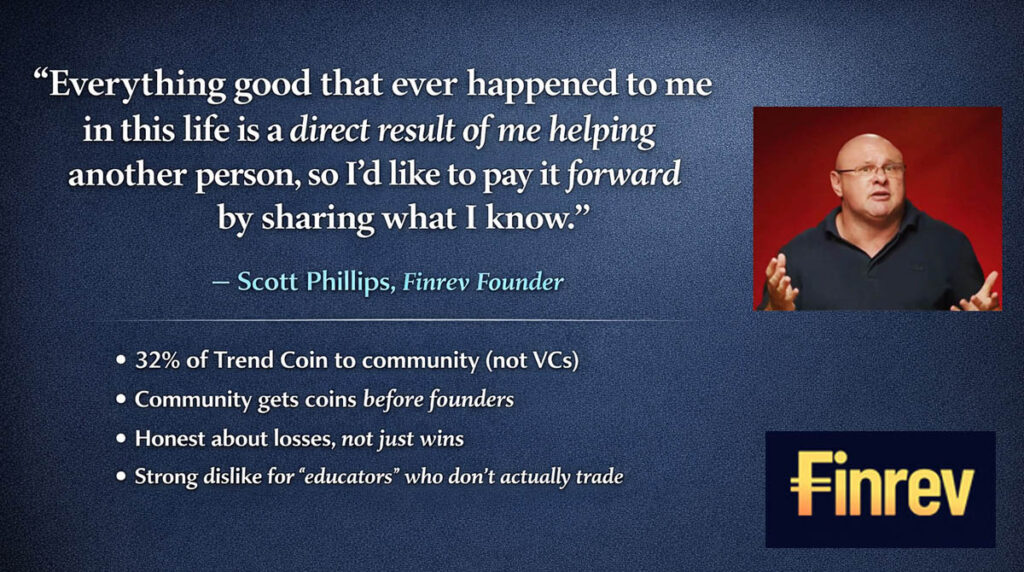
“Everything good that ever happened to me in this life is a direct result of me helping another person, so I’d like to pay it forward by sharing what I know.”
Why HyperTrend is different: Scott’s ‘pay it forward’ philosophy drives community-first token distribution and honest communication about both wins and losses
This isn’t marketing fluff. It’s the operating philosophy behind:
32% of Trend coin allocated to the community (not sold to VCs)
White-glove onboarding for every member
Honest communication about drawdowns
Community getting coins before founders (vesting schedule proves it)
The cynical take: “He’s just saying that to sell more.” The realistic take: If you wanted to maximize short-term extraction, you’d sell to VCs, automate everything, hype the wins, and cash out. Scott’s doing the opposite—which either makes him an idiot or someone playing a different game.
Based on 20 years of trading and surviving prison, he’s probably not an idiot.
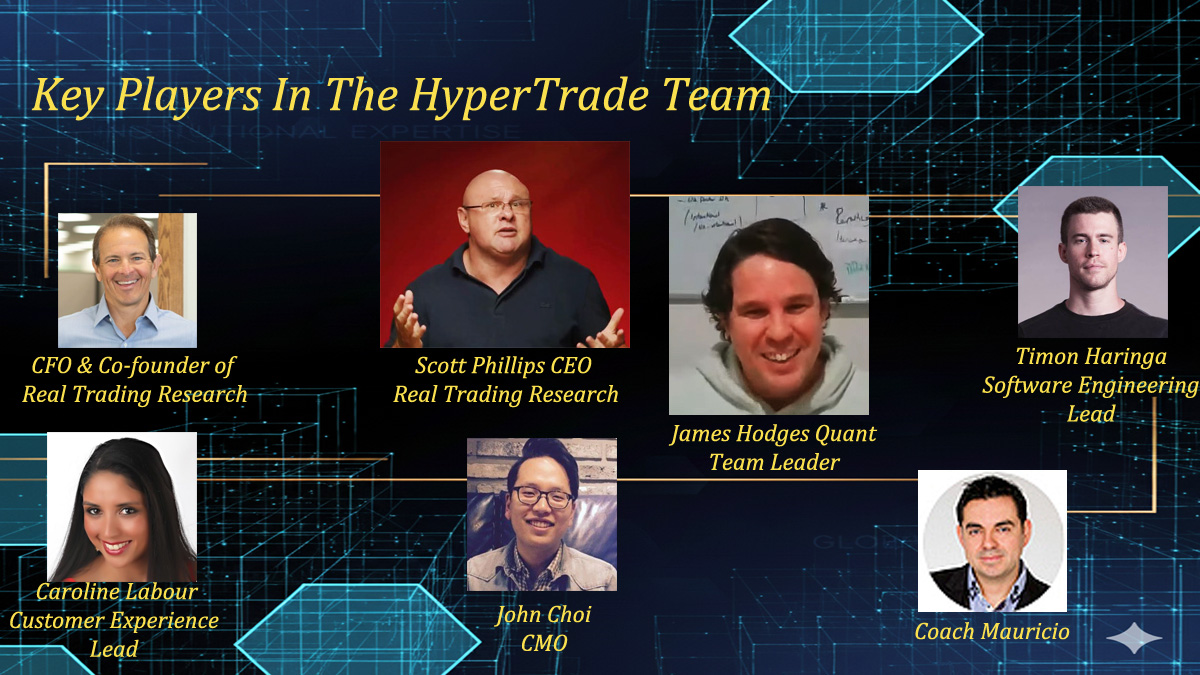
James Hodges (Robot James): The BlackRock Quant Who Got Bored
Current role: Head of Quantitative Research, leading HyperTrend development with Dark Forest Technologies Background: Physics PhD, ex-BlackRock quant, worked for multiple investment banks
Why he matters: When Scott says, “I think I’m the sixth smartest guy in the company now,” he’s talking about people like James.
Why James Left BlackRock for This
Managing other people’s money at a big institution caps your upside. Building something from scratch with an equity stake? That’s how quants get rich.
In Video 3, James walks through HyperTrend’s architecture with the casual confidence of someone who’s actually built trading systems at institutional scale.
Substance over polish: James Hodges (BlackRock quant, Physics PhD) explaining system architecture with hand-drawn diagrams – the authentic expertise behind HyperTrend’s institutional-grade strategies (Source: Technical Deep-Dive, member video)
This isn’t a salesman. This is a quant explaining boring things like smoothing, trading costs, and signal validation.
From Scott’s description of their Dark Forest partnership:
“We’ve partnered with Dark Forest Technology, a leading DeFi high-frequency trading firm. They’re taking a 5% stake in our company. These are top guys—second or third fastest in most speed races. Better execution than most market makers, and better execution translates directly into more profits and fewer drawdowns.”
James is leading that integration. The “Finrev had sex with HFT” architecture in action.
📘 KEY TERM: Institutional Quant Background
James Hodges credentials:
Physics PhD
Ex-BlackRock quantitative analyst
Multiple investment bank experience
Head of Quantitative Research for HyperTrend
Why BlackRock experience matters: BlackRock manages $10+ trillion.Source: BlackRock, Inc. Fourth Quarter and Full Year 2025 Earnings Release (issued January 15, 2026). Their quants build trading systems at institutional scale with rigorous backtesting, risk management, and execution standards retail traders never encounter.
Why he left: Managing other people’s money at big institutions caps your upside. Building something from scratch with equity stake? That’s how quants get wealthy.
Artem: The Ukrainian Refugee Who Outpaced James
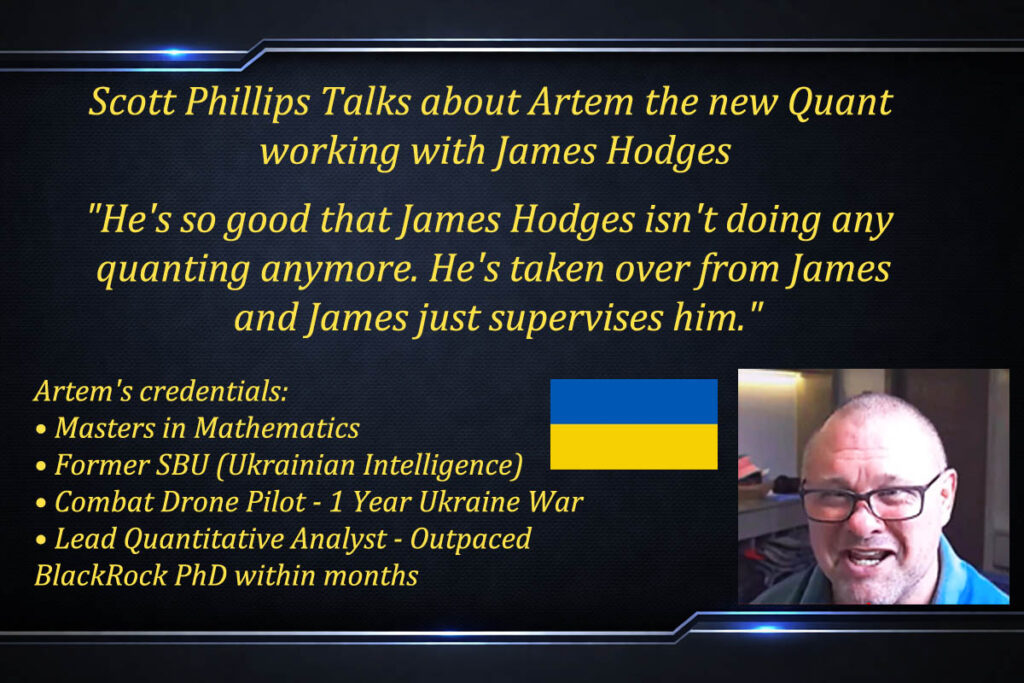
Background: Master’s in mathematics, former SBU (Ukrainian spy service), spent a year piloting drones in Ukraine war Current role: Lead quantitative analyst (yes, he’s now ahead of James Hodges)
Why he matters: Smart enough that James Hodges supervises him instead of doing the quant work himself.
The Negotiation Story
Scott tells members in a recent video:
“We got James an underling a couple of months ago, a little Ukrainian guy called Artem and he’s fucking good. He got on a negotiating call and was so eager Howard said, ‘I think that kid would have paid us to work for him.’ I came back, ‘What are you paying him? Give him an extra grand a month. He’s a fucking Ukrainian refugee for fuck’s sake. I know he’s got a math PhD, but like just give him some money. Help him, mate.'”
What this reveals about company culture: Scott would rather overpay good people than extract maximum value. That’s rare in any industry, unheard of in crypto.
The Technical Prowess
Artem’s remarkable journey: Masters in mathematics, served in Ukrainian intelligence (SBU), piloted combat drones for a year in Ukraine war, then joined Finrev and within months was running quant work that James Hodges (BlackRock Physics PhD) now supervises. ‘He used to kill Russians with drones. Now he finds trades.’ (Source: Scott Phillips, member video)
“He’s so good that James Hodges isn’t doing any quanting anymore. He’s taken over from James and James just supervises him.”
For context: James Hodges is a Physics PhD who worked at BlackRock. Artem came in as the “underling” and within months was running the quant work.
Artem’s background: Spent a year “killing Russians with drones” in Ukraine. Then pivoted to finding trading edges in crypto markets.
Why this matters: The team isn’t built on hierarchy—it’s built on “who’s best at what.” When the new guy is better at quant work than the ex-BlackRock PhD, you let him run it.
Mauricio: The Practical Trader’s Trader
Background: Runs the 100x coin clubs, head trader for various systems in development Current role: Lead coach, mentor for Finrev members, practical trading implementation
Why he matters: “Mauricio is one of the best traders you’ll ever meet in this life.”
The Complementary Skill Set
Scott speaking to members in a recent video:
“Mauricio’s got more practical experience. Artem’s got more maths.”
What this means: Mauricio doesn’t need to be the best mathematician—he needs to translate mathematical edges into actual profitable trades. That’s a completely different skill.
His role: Finding many of the 100x coin opportunities, running live trading calls, mentoring members through the psychological reality of trend following (the hard part nobody talks about).
The “Scott’s Trading Army” Reality: 40 People Who Actually Trade
Here’s what most people don’t know about the 40-person team: Most of them aren’t developers or customer service reps—they’re traders Scott personally trained.
This is unprecedented in crypto:
Scott created livelihoods for people who learned his systematic approach
They’re not reading scripts when you call—they’re sharing actual trading experience
Deep loyalty = consistent culture = better member experience
The onboarding process is first-rate because coaches actually understand the emotional reality of trend following
The Coaching Advantage
Unlike most crypto “mentors” who are customer service reps reading scripts, when you book a call with Finrev you’re talking to:
Traders who actually use the systems
People who’ve traded with Scott for years
Coaches who understand the psychology of drawdowns
“In those live calls you get direct mentorship from Mauricio and Artem.”
Not customer support. Mentorship.
The Member Forum Advantage
Beyond the coaching, there’s a private forum where:
Resources shared between members
Staff actively participate (not ghost moderators)
Real P&L discussions (not just theory)
Community-driven edge discovery
This explains:
Why 2,000 subscribers stick around (community + coaching > just software)
How they maintain quality at scale (trained traders, not outsourced support)
Why members follow Scott through infrastructure changes (trust built over time)
The Quality-Over-Scale Philosophy
Scott, in a briefing to members at the launch of Finrev:
“It’s critical that we make our customers happy. It’s critical that everyone gets it right. We’re only selling 200 of these [initially], and it’s critical that we have 200 success stories.”
Why cap at 200? Better to have 200 people who succeed and tell others than 2,000 people who get mediocre support and churn. The goal: Each member becomes a case study, not a statistic.
The Team Structure: Why “40+ People” Actually Matters
Scott:
“We achieved these returns by hiring the guys who did the same thing for hedge funds: Team of 40+ people working day in, day out. World-class developers. Incredible high-frequency trading traders. Lead quant James Hodgers (Physics PhD, ex-BlackRock). I think I’m the sixth smartest guy in the company now—I’m nowhere near the smartest, and that’s good.”
Let that sink in: The founder admits he’s the sixth smartest person in his own company.
Why This Matters
Most crypto projects are: 3 guys in a Telegram group, one developer copy-pasting code, everyone else doing “marketing.”
Finrev/HyperTrend is:
40+ actual employees
Multiple PhDs in relevant fields
Ex-institutional traders and developers
Partnership with leading HFT firm
Founder who’s comfortable being the sixth smartest guy
The VP of Engineering has awards for developing online banking software. This is production-grade infrastructure, not a startup MVP.
Scott:
“I’ve recently put together a group of elite traders to find trading edges in the market. We really do have a group of elite traders here.”
Not hyperbole. When your quant team includes a Physics PhD from BlackRock and a Ukrainian refugee mathematician who outpaced him, “elite” is accurate.
The Bootstrap Reality: No VCs, No Bullshit
Scott explains to members in webinar the philosophy driving Hypertrend:
Completely bootstrapped
No investors
No VCs
Community-first by design, not marketing
Why This Matters
“The thing is that institutional investors and people who want to buy in size will not touch a coin while it’s just me and my team who own it. So by me giving away a big chunk of the company, it’s smart. If you’re wondering why is Scott just giving this money away, I’m not giving this away because I’m a dumb motherfucker. I’m giving it away because I’m a smart cat.”
The Alignment
“We’re here to get our community rich and get ourselves rich, too, by aligning ourselves with our community. You guys helped build the thing. You guys deserve to get rich.”
The Vesting Proof
“You guys are going to get your coins way before I will. So if you want to cash out and dump on me, you can cash out and dump on me and I won’t even have access to my coins.”
The Transparency Test
“When we launch this, you should track my personal wallets to see what I’ve got. I don’t get my coins straight away. They vest very slowly. And they only vest if I make money for you guys. But you should be able to check my wallets to see if I’m cashing out. And if I cash out, you probably want to cash out, too.”
Why this matters: Words are cheap. On-chain transparency isn’t. When founders put their vesting schedule on-chain for anyone to verify, they’re either genuine or setting up an incredibly elaborate scam that makes no economic sense.
The Track Record: Not Theory, Reality
Finrev performance:
4,815% cumulative return since 2019
Beaten Bitcoin, Ethereum, Nvidia
Never had a losing year (both bull and bear markets)
2,000+ paying subscribers (not theoretical users)
$18M+ assets under management
The Honest Reality
Scott explains showing the backoffice detailed dashboard of Finrev results achieved:
“Over the last two years: 142% in 2 years. But you’ll see that it also came in kind of an annoying manner. And this is what we’re changing with the new system.”
Max drawdown: 35%
Average drawdown: <20%
Longest drawdown: 268 days
“All you have to do is shut the fuck up and reliably at the end of every year you get one or two big ass spikes. And the longer it goes between the spikes, the more likely the next one is coming up.”
Why this matters: Most trading “educators” show you backtests. Scott shows you live accounts with 2,000 actual subscribers and admits when it’s “kind of annoying.”
✓ VERIFIED CLAIM: Finrev Track Record
Performance since 2019:
4,815% cumulative return
Never had a losing year (both bull and bear markets)
2,000+ paying subscribers
$18M+ assets under management
Beaten Bitcoin, Ethereum, Nvidia
The honest reality: Max drawdown 35%, average drawdown <20%, longest drawdown 268 days. "Kind of annoying manner" (Scott's own words about the experience). Source: “Finding Ugly Edges in Crypto Markets,” Scott Phillips interview, March 2025 (and earlier 2021 sessions).
Why this credibility matters: Most crypto projects show backtests. Finrev shows live accounts with 2,000 actual subscribers and admits when it’s psychologically difficult.
The Skin-in-the-Game Test
Scott’s position (From Video 2):
“I’m liquidating my full stack to put into it. I’m either going big or going out. It’s ride or die for me.”
The team’s commitment:
“Our team are working really as hard as they can. I’m sprinting for the goal. I know I’ve been kind of half-ass with the emails lately because I just go to bed every day exhausted after work.”
The vision:
“The goal here is to create a billion dollar asset and share it with our community. We’re going to create something that’s worth a billion dollars that’s going to provide a lot of value for the whole world and we’re all going to get rich off it. And there’s no road to me getting rich that doesn’t end with everybody getting rich first.”
The honest admission:
“If this doesn’t work, my butthole’s going to be a bit sore.”
Translation: The founder has more skin in the game than you do. If it fails, he loses more than you. If it succeeds, you get paid first.
Why These Backgrounds Actually Matter
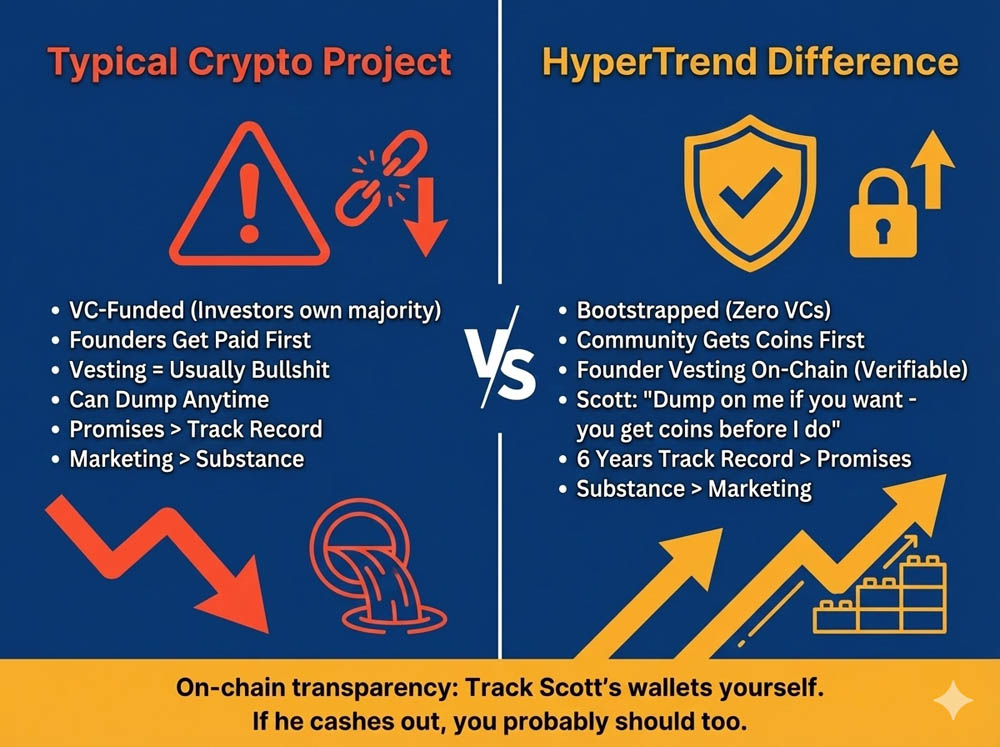
Why HyperTrend is different: Completely bootstrapped with zero VCs, community receives token allocation before founders (vesting schedule verifiable on-chain), track record over promises – ‘If I cash out, you probably should too’ transparency vs. typical crypto extraction
Most crypto projects fail one of three tests:
1. Do they have institutional-grade skills?
❌ Most crypto: Self-taught devs, no quant background, learning as they go
✅ Finrev/HyperTrend: Physics PhD from BlackRock, Ukrainian mathematician, 20-year systematic trader, partnership with leading HFT firm
2. Do they have skin in the game?
❌ Most crypto: VCs own majority, founders can dump anytime, vesting is bullshit
✅ Finrev/HyperTrend: Bootstrapped, community gets coins first, founder’s vesting on-chain and verifiable, personal capital in system
3. Do they tell you about the losses?
❌ Most crypto: Only show wins, hide drawdowns, promise consistent returns
✅ Finrev/HyperTrend: “I sold Bitcoin at $21,” “268-day drawdowns,” “kind of annoying manner,” “you’ll hate the flat periods”
When a team passes all three tests: They might actually be building something real. When they fail any one: Run.
📊 THE THREE-TEST FRAMEWORK: Real Teams vs Marketing
Test
Most Crypto Projects
Finrev/HyperTrend
Institutional Skills?
Self-taught devs, no quant background, learning as they go
VCs own majority, founders can dump anytime, vesting is theater
Bootstrapped, community gets coins first, founder vesting on-chain/verifiable
Honest About Losses?
Only show wins, hide drawdowns, promise consistent returns
“Sold Bitcoin at $21,” “268-day drawdowns,” “kind of annoying manner”
The decision framework: When a team passes all three tests, they might be building something real. When they fail any one—run.
What This Means for You
You now know who’s building HyperTrend:
An ex-convict who got clean, learned from trading legends, built a track record, and tells you about his losses
A BlackRock quant who left institutional security to build something with equity stake
A Ukrainian refugee mathematician who proved he’s better than the BlackRock guy
A team of 40+ traders (not customer service reps) working “exhausted after work every day”
A community of 2,000 subscribers who’ve stuck around through drawdowns
The decision is simpler than it seems: Do you want tools built by ex-institutional traders with track records and skin in the game? Or do you want tools built by marketing people who learned to code last year?
Next Steps
If you’re already a Finrev user:
You know the team delivers
The HyperTrend evolution is your choice to follow or not
Access the members’ forum for migration discussions
Once you have watched the “Introduction video,” you will be invited to book a call to talk to one of the onboarding coaches who are all actual traders.
Understand this is a 5-10 year wealth-building journey, not a get-rich-quick scheme.
If you’re sceptical: Good. You should be. Verify Scott’s vesting schedule on-chain when Trend coin launches. Track his personal wallets (he’s asking you to). Judge by actions, not words.
Disclosure: This article discusses Finrev and HyperTrend systems. The author may have positions in the mentioned assets. This is educational content, not financial advice. Crypto trading involves substantial risk of loss. Past performance doesn’t guarantee future results. Team backgrounds and credentials don’t guarantee trading system performance. Do your own research and verify all claims independently.
Vince is a researcher and active investor focused on automated crypto trading systems. With a professional background in analyzing complex ecological systems and data, he applies that same rigorous, scientific methodology to evaluating algorithmic trading performance. A former educator with decades of personal trading experience in Forex and stocks, Vince now documents his own capital allocation and risk management within the Finrev ecosystem, prioritizing data over hype.
🎧 Audio Discussion Available An AI-generated podcast explores this article’s concepts through conversational debate format—useful for audio learners or those wanting to hear multiple perspectives. Duration: 16 minutes ▶ Listen 📄 Read Transcript I’ve tracked Finrev performance through bull markets, bear markets, and the FTX collapse—the question I hear most often isn’t “does this work?”…
🎧 Audio Discussion Available An AI-generated podcast explores this article’s concepts through conversational debate format—useful for audio learners or those wanting to hear multiple perspectives. Duration: 16 minutes ▶ Listen 📄 Read Transcript If you’ve spent more than five minutes in the crypto world, you’ve probably seen the “Magic Bean” sales pitch. It usually involves…
🎧 Audio Discussion Available An AI-generated podcast explores this article’s concepts through conversational debate format—useful for audio learners or those wanting to hear multiple perspectives. Duration: 16 minutes ▶ Listen 📄 Read Transcript If you’ve explored DeFi yield farming, you’ve probably encountered what Scott Phillips calls “magic beans”—tokens that promise high yields by paying you…
This post may contain affiliate links 🎧 Audio Discussion Available An AI-generated podcast explores this article’s concepts through conversational debate format—useful for audio learners or those wanting to hear multiple perspectives. Duration: 16 minutes ▶ Listen 📄 Read Transcript Your crypto Twitter feed won’t shut up about Hyperliquid. Lightning-fast execution. The HYPE token—crypto’s most successful…
This post may contain affiliate links 🎧 Audio Discussion Available An AI-generated podcast explores this article’s concepts through conversational debate format—useful for audio learners or those wanting to hear multiple perspectives. Duration: 16 minutes ▶ Listen 📄 Read Transcript Crypto trading with hedge funds returns averaged 40%+ annual returns while you struggled to break even….
🎧 Audio Discussion Available An AI-generated podcast explores this article’s concepts through conversational debate format—useful for audio learners or those wanting to hear multiple perspectives. Duration: 16 minutes ▶ Listen 📄 Read Transcript After three years of systematic research into professional crypto trading systems, I’ve identified a disturbing pattern: 5 critical retail trading mistakes are…