This post may contain affiliate links
Table of Contents
🎧 Audio Discussion Available
An AI-generated podcast explores this article’s concepts through conversational debate format—useful for audio learners or those wanting to hear multiple perspectives.
Duration: 16 minutes
Your crypto Twitter feed won’t shut up about Hyperliquid. Lightning-fast execution. The HYPE token—crypto’s most successful airdrop ever, turning early users into millionaires overnight. A DEX that’s stealing market share from Binance and Bybit at unprecedented speed, and a market-leading autotrading infrastructure solution in its Hyperliquid vault trading option.
But here’s what nobody’s talking about: when a crypto trading system managing capital for 2,000 paying subscribers announces it’s completely rebuilding its execution infrastructure, most would assume something went wrong.
When that system has maintained hedge-fund-level Sharpe ratios through multiple market cycles—including the 2022 bear market, the FTX collapse, and 2023’s regulatory chaos—you realize something went very right. And they’re about to make it better.
Welcome to HyperTrend: the evolution of Finrev’s proven trend-following system, rebuilt from the ground up on Hyperliquid’s vault architecture. This isn’t a startup promising future returns. This is an established winner migrating 2,000 subscribers to cutting-edge infrastructure that solves problems most retail traders don’t even know exist yet.
If you’re still trading on centralized exchanges through API-connected bots, this is the future coming for your setup. Here’s why it matters.
The Track Record That Makes This Migration Worth Watching

Before we dive into what’s changing, let’s establish why anyone should care about Finrev’s infrastructure decisions.
Finrev isn’t vaporware. Since launching in 2022, the system has:
- Maintained 2,000+ paying subscribers through multiple market cycles
- Delivered Sharpe ratios competitive with top crypto hedge funds (1.5+)
- Survived the FTX collapse without losing subscriber funds (more on that later)
- Documented years of auditable performance across bull and bear markets
- Built a proven trend-following system that works in conditions where most retail bots fail
Sharpe Ratio = A measure of risk-adjusted returns that compares your gains to the volatility (ups and downs) you endured to achieve them. A higher number means better returns per unit of risk.
Why it matters: A 50% return with wild swings (Sharpe 0.5) is worse than a 30% return with steady growth (Sharpe 1.5)—the second preserves capital and compounds reliably. Finrev maintains 1.5+ Sharpe ratios, placing it in top-tier hedge fund territory.
The founder’s personal capital trades on the system. The team’s capital trades on the system. When you have 2,000 people trusting their money to your algorithms, you don’t rebuild infrastructure on a whim.
So when Finrev announces it’s evolving into HyperTrend and migrating to Hyperliquid vaults, the question isn’t “Will this work?” The question is: “What do they see that everyone else is missing?”
The CeFi Ceiling: Why Winners Eventually Hit Infrastructure Limits
Here’s the uncomfortable truth about centralized exchange trading: even when your strategy works, the infrastructure eventually becomes the bottleneck.
How Finrev Works Today (And Its Limitations)
Currently, Finrev operates like most sophisticated crypto trading systems:
- Centralized server calculates trading signals and positions
- API connections to subscriber exchange accounts (Binance, Bybit, Hyperliquid, etc.)
- Staggered execution across 2,000 individual accounts
- Exchange custody of subscriber funds (your crypto sits on Binance/Bybit)
This model has proven successful—but it has ceilings:
- Execution Fragmentation: With 2,000 accounts, each trade order is split and staggered. Sometimes you get lucky in the execution queue. Sometimes you don’t. Position sizing becomes a coordination problem across thousands of individual accounts rather than one unified strategy.
- Fee Inefficiency: Individual accounts each pay retail trading fees. Even with maker rebates, the cost adds up when you’re executing across thousands of accounts multiple times daily.
- Exchange Risk: The FTX collapse was a gut punch for the entire industry. Finrev users on FTX watched their profits become trapped in “Hotel California”—you’re up and you can never leave. The platform showed gains right up until withdrawal became impossible.
- Scaling Constraints: As more subscribers join, execution coordination becomes exponentially harder. There’s a reason hedge funds operate pooled capital—it’s simply more efficient.
- API Limitations: Centralized exchanges control your API access. Rate limits, sudden policy changes, geo-restrictions—you’re always at their mercy.
After FTX, every sophisticated crypto trader eventually asks: “How do I get professional-grade execution without giving up control of my funds?” Until recently, the answer was: “You can’t. Pick one.” Hyperliquid vaults changed the equation.
Claim: Finrev users on FTX saw their funds trapped despite showing profits
Context: FTX filed bankruptcy Nov 11, 2022, freezing $8B+ in customer funds. Platforms showed account balances right up until withdrawals stopped—profits became unrealizable gains locked in bankruptcy proceedings.
Why custody matters now: Post-FTX, smart contract custody (where YOU control withdrawals) eliminates counterparty risk that centralized exchanges create. Source: FTX balance sheet revealed: $9bn in liabilities and $900m in liquid assets, Financial Times, Nov 14, 2022
The HyperTrend Architecture: The Future of Hyperliquid Vault Trading
This is where it gets technical—but stick with me, because understanding this architecture is understanding the future of professional crypto trading.
The Core Innovation: Pooled Capital + Smart Contract Execution
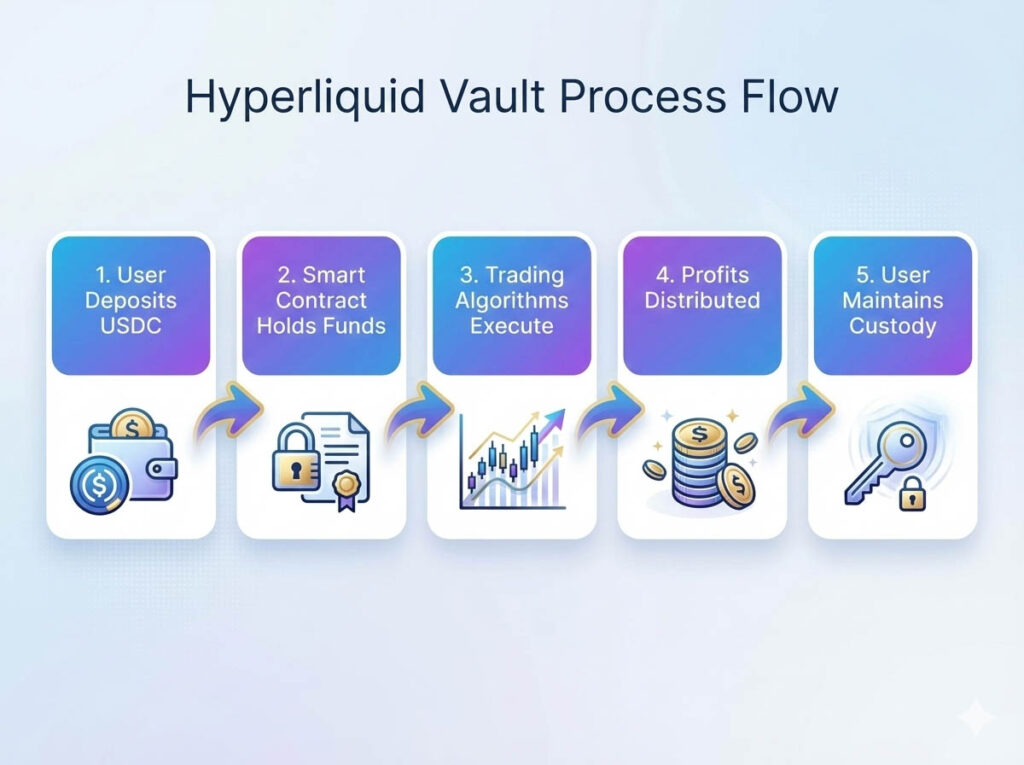
Here’s the fundamental breakthrough: Your funds stay in your wallet on Hyperliquid L1, but the HyperTrend vault can execute trades with them.
Think of it like this:
Traditional CeFi Bots:
- You deposit crypto to an exchange
- You grant API access to a bot
- Bot trades for you via exchange servers
- Exchange holds your funds
- You trust both the exchange AND the bot operator
HyperTrend Vault Model:
- Your funds remain in your Hyperliquid wallet (L1 blockchain)
- You deposit into HyperTrend vault smart contract
- Smart contract can execute trades but cannot withdraw funds
- You maintain custody at protocol level
- Trust is enforced by code, not promises
The analogy: It’s the difference between handing someone your car keys versus hiring a chauffeur. The chauffeur can drive but can’t steal the car. You maintain ownership.
Why Pooled Execution Changes Everything
One of the most underappreciated advantages in the migration: HyperTrend operates one unified pool of capital instead of 2,000 fragmented accounts.
Individual accounts (2,000 separate bots): Each trader competes for execution in the same queue. You might get filled at $50.10, someone else at $50.30. Staggered execution = unpredictable results.
Pooled capital (one vault): Complete position visibility. The system knows exactly what it’s building and can scale intelligently over time. Better fills, lower fees, coordinated risk management.
The difference: It’s like 2,000 people trying to buy concert tickets individually versus one buyer purchasing a block—the block buyer gets better pricing and guaranteed allocation.
As the team explains in their technical briefing:
“The advantage of trading one pool of capital is much better than the way we’re doing it now where everyone has 2,000 accounts and they all trade. We can have reduced fees on that stuff. The other is that we can scale into positions over time.”
What this means practically:
- Full Position Visibility: Instead of coordinating across thousands of accounts with staggered execution, HyperTrend has complete visibility over the entire position it’s building. No more “sometimes you get lucky in the queue, sometimes you don’t.”
- Better Fee Structure: Institutional-grade fee tiers on pooled capital versus retail tiers on individual accounts. The savings compound across every trade.
- Intelligent Scaling: The system gradually builds positions over hours or days, taking advantage of favorable price action without telegraphing intentions to the market.
- Coordinated Risk Management: Portfolio-level risk controls instead of account-level approximations enable sophisticated hedging and correlation management impossible with fragmented accounts.
Semi-HFT: Where Trend Following Meets High-Frequency Execution
HyperTrend occupies a unique middle ground:
- Traditional Finrev: Medium-term trend following. Average holding period of days to weeks. Signals update daily. Positions adjust gradually.
- Pure HFT: Holding periods of seconds to minutes. Signals update microseconds. Requires specialized infrastructure.
- HyperTrend: The hybrid that combines both strengths.
As the development team describes it: “If Finrev had sex with a high frequency trading system, this is the baby. It’s the bastard child of Finrev and a high frequency setup.”
Semi-HFT = A trading approach that combines medium-term trend following (holding periods of days to weeks) with continuous high-frequency execution (adjusting positions on seconds-to-minutes timeframes).
How it works: The strategy identifies multi-day trends like traditional Finrev, but instead of executing once daily, it constantly refines positions—adding incrementally during favorable prices, trimming during unfavorable ones.
Why it’s powerful: Captures trend-following gains while opportunistically improving execution through intraday price inefficiencies that slower systems miss.
Here’s what that actually means:
- Constant Position Adjustment: The system trades continuously—not in discrete daily rebalances like traditional Finrev. It’s always gradually moving toward optimal positions and away from suboptimal ones.
- Opportunistic Execution: When market makers create temporary price dislocations (someone dumps a huge order and flushes out multiple levels), HyperTrend can act on seconds-to-minutes timeframes to capture better execution prices.
- Average Hold Time = Days, Trading Frequency = Constant: The strategy still identifies multi-day trends. But instead of executing once daily, it’s constantly refining positions—adding a bit here, trimming a bit there, taking advantage of intraday inefficiencies.
As the execution lead explains:
“When someone puts a massive buy order in or massive sell order in and they flush out a whole bunch of levels and the market takes a bit of time to come back—if we needed to sell something, we would sell very quickly. We would get aggressive at that point because we can take advantage of those short-term price things that happen over seconds and minutes.”
This wouldn’t be possible with 2,000 individual CeFi accounts. It requires unified capital on high-performance DEX infrastructure.
The Strategy Pyramid: Building on Proven Foundations
The team describes their approach as a pyramid with clear priorities:
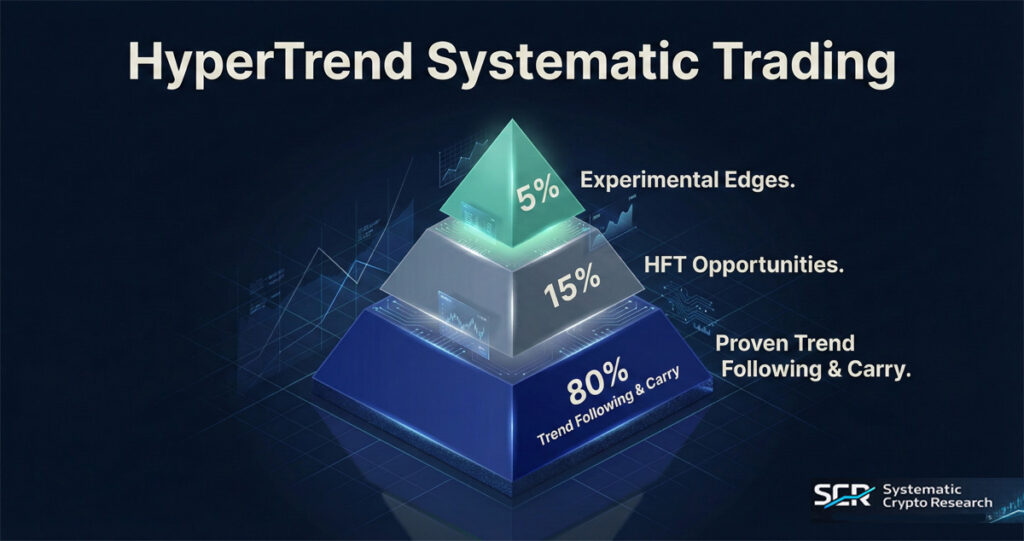
- Base Layer (80% of capital): Proven, robust strategies that work across decades and asset classes (Trend following, Momentum, Carry/yield plays, Multi-timeframe moving average crossovers, Breakout strategies).
- Mid Layer (15% of capital): Higher-frequency opportunities enabled by better execution (Order book aggression signals, Short-term mean reversion on liquid assets, Volume pattern exploitation, Funding rate arbitrage).
- Top Layer (5% of capital): Experimental edges and emerging opportunities (Seasonality patterns, New market structure opportunities, Proprietary signals developed from market research).
The philosophy is refreshingly honest:
“We want to massively overweight the stuff that is likely to make money even if things change, even if we’re a bit wrong. So we want forgiving stuff that has a long track record of making money.”
This is the opposite of most crypto bot marketing. Most bots promise cutting-edge AI, revolutionary algorithms, secret sauce. HyperTrend’s pitch: “We’re shamelessly copying ideas from everywhere. There is absolutely nothing really unique in the portfolio. But when we jam a whole load of good ideas together, we end up with an approach that’s quite likely to make money.”
Why this matters: The base layer (classic Finrev strategies) has proven itself through the 2022 crypto bear market, the FTX collapse volatility spike, 2023’s regulatory uncertainty, and 2024’s ETF-driven institutional adoption.
That foundation doesn’t change in HyperTrend. What changes is the ability to add intelligent layers on top because the execution infrastructure can now handle faster, more sophisticated strategies.
As the research lead explains:
“Even if everything changes and this stuff doesn’t work, or someone big comes into the market and gobbles up all of these opportunities such that we can’t take them, we still have this base of our portfolio that we’re very, very confident is going to make money.”
Risk management through diversification of strategy timeframes—not wild swings for performance.
What This Architecture Enables (That CeFi Can’t)
Let’s get concrete about what changes when you rebuild on Hyperliquid vaults versus staying on CeFi infrastructure.
1. Better Signal Implementation
One of HyperTrend’s core advantages: more sophisticated signals become tradeable.
Example from the research team: Order book aggression signals—tracking the ratio of aggressive buying versus aggressive selling across the order book. This predicts next-day returns with remarkable accuracy.
The problem with this signal on CeFi through individual accounts: it’s too noisy. By the time you coordinate execution across 2,000 accounts with API rate limits and staggered orders, the edge degrades.
On HyperTrend with pooled capital: the system can act on this signal continuously, smoothing entry over optimal timeframes without coordination overhead.
The research shows this clearly:
“We look at increases in aggressive buying happening now versus before. We can sort every asset and plot next day returns against it. You can see this lovely up and to the right pattern where more aggressive buying increases = higher returns next day.”
This type of signal requires fast, coordinated execution to capture effectively. CeFi makes it hard. Hyperliquid vaults make it natural.
2. Intelligent Cost Management
Here’s a non-obvious insight from the team’s development process: the goal isn’t to trade more—it’s to trade less while maintaining signal strength.
As they explain:
“Every time we trade, we lose money. We would much rather have something that looks smooth than something that looks jumpy. When we smooth our signals with exponentially weighted moving averages, we don’t actually take that much of a hit on performance—but we dramatically reduce trading costs.”
The smoothing process: Take a noisy signal that would trigger hundreds of small trades. Apply a 7-day half-life exponential moving average. Result: 70-80% of the predictive power, but 50-60% fewer trades.
This type of optimization matters more with pooled capital because you can see the aggregate impact clearly. With 2,000 individual accounts, cost optimization is approximated. With one vault, it’s measurable and improvable.
3. On-Chain Transparency
Every HyperTrend vault transaction happens on-chain. This means:
- Verifiable execution: You can audit exactly when trades happened and at what prices—not trust a centralized server’s logs.
- Performance validation: Returns aren’t self-reported by a company—they’re cryptographically verifiable on Hyperliquid L1.
- Custody transparency: You can see your vault balance in real-time. No waiting for exchange reports or trusting internal accounting.
This level of transparency doesn’t exist with CeFi API-connected bots. When your bot company says “you’re up 15% this month,” you’re trusting their numbers. When HyperTrend says it, you can verify on-chain.
4. Foundation for Trend Coin Integration
Here’s where the vision extends beyond just better execution: HyperTrend’s vault architecture enables the upcoming Trend coin launch (scheduled for early 2025).
Without diving into white paper details yet (that’s a future article), the key concept: Trend coin creates member benefits and incentive alignment that aren’t possible with traditional subscription models.
The vault architecture is prerequisite infrastructure for this. You can’t build sophisticated token economics on top of 2,000 fragmented CeFi accounts. You can build them on top of unified vault contracts on L1 infrastructure.
The Trading Engine: How HyperTrend Actually Works
Let’s pull back the curtain on the technical architecture—simplified for clarity but accurate in substance.
The Continuous Trading Loop
Unlike traditional bots that rebalance once per day (or once per hour), HyperTrend operates as a continuous loop:
- Signal Calculation: System analyzes every traded asset continuously. Generates expected return forecasts for next 1-24 hours. Incorporates trend, momentum, order book data, funding rates, etc.
- Position Targeting: Calculates ideal position size for each asset based on expected returns, asset volatility, portfolio-level risk constraints, and current market liquidity.
- Position Delta Analysis: Compares current positions to ideal positions. Calculates the “gap” for each asset and determines which positions need adjustment.
- Execution Decision: If position gap exceeds tolerance threshold → trigger trading. If within tolerance → do nothing (save costs). Tolerance dynamically adjusts based on market conditions.
- Deep Forest Research Execution: HyperTrend’s execution partner (Deep Forest Research) handles order routing. Trades gradually toward target positions, taking advantage of favorable short-term prices.
- Loop Back to Step 1: Continuous monitoring. Positions constantly adjusting toward optimal allocation. System never “sleeps”—it’s always evaluating and refining.
As the team describes it:
“Our actual trading is going to happen constantly all the time. We’re just going to be trading constantly and in tiny amounts into positions and out of positions. And those positions are going to be changing underneath us.”
Signal Development: The “Boring” Work That Makes It Profitable
Here’s where the team’s humility becomes their competitive advantage. Most crypto bot marketing focuses on AI, machine learning, revolutionary algorithms.
HyperTrend’s approach:
“We’re not trying to be smart. We’re not trying to reinvent anything that doesn’t already exist. We’re not trying to come up with particularly new fangled ideas. We just need to make money.”
The process:
- Identify proven edges from traditional markets: What worked in stocks for decades? What works in futures markets?
- Test if it works in crypto: Does the edge translate? Is it strong enough to overcome higher costs?
- Confront real-world constraints: What does this cost to trade? How liquid are the assets? Can we smooth the signal to reduce turnover?
- Optimize for portfolio fit: Is this signal correlated with existing strategies? Does it add diversification?
The result: dozens of signals that individually might seem boring, but collectively create a robust system.
As the research lead notes:
“Nearly everything that used to work in stocks, nearly everything that still works in futures markets tends to still work in crypto and work much better because it’s an immature market and relatively distributed around various venues.”
Performance Context: What to Actually Expect
Let’s address the elephant in the room: what kind of returns should you realistically expect from HyperTrend?
Recent Historical Performance
From the team’s technical briefing on simulation results:
“In the last half of the year it did very well. Probably some of that is luck, some of it is not, some of it is skill.”
This honest assessment matters. The team isn’t claiming 1000% returns or guaranteed moon shots. They’re saying: “Our core models work, and we had favorable conditions recently.”
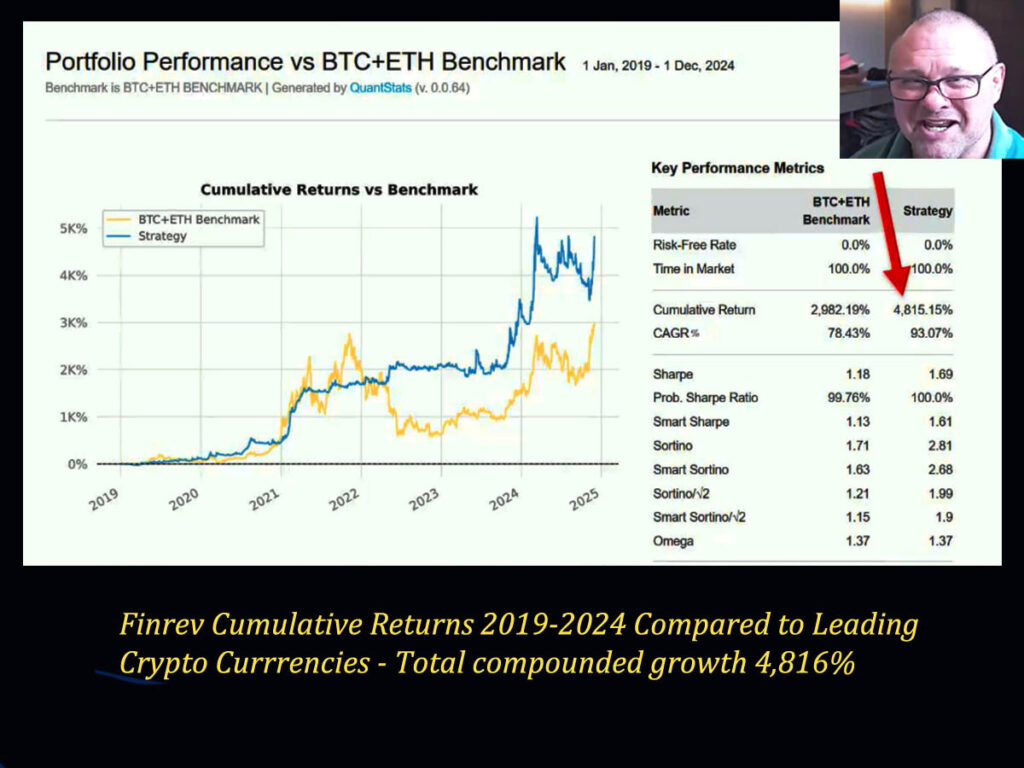
Here’s what we know from documented Finrev performance:
- Sharpe ratio: Consistently in the 1.5+ range (competitive with top hedge funds)
- Drawdowns: Expect periods of 10-20% drawdowns that last months (this is normal for trend following)
- Win rate: Trend following is NOT high win-rate. You lose frequently but win big when you win.
- Timeline: You need 6-12 months minimum to judge performance (randomness dominates shorter periods)
What HyperTrend Improves
The migration to Hyperliquid vaults isn’t about dramatically higher returns—it’s about:
- More consistent execution: Less slippage, better fills, coordinated position building.
- Lower costs: Pooled capital fee advantages compound over time.
- Expanded opportunity set: Ability to trade faster signals that were previously untradeable.
- Better risk management: Portfolio-level controls versus account-level approximations.
- Verifiable transparency: On-chain performance validation.
If HyperTrend delivers the same Sharpe ratio as Finrev (1.5+) but with 15-20% better execution efficiency due to infrastructure advantages, that compounds to significant outperformance over multi-year timeframes.
The Honest Drawdown Reality
Let’s be clear about something most bot marketing ignores: trend following systems have drawdowns. Long ones. Painful ones.
From the team:
“It can go nowhere for a long time. It can shoot up. It can go nowhere for like a year or something. It can shoot up.”
This is not a bug—it’s the nature of positive skew strategies. You endure sideways periods (or small losses) in exchange for capturing large trend moves when they happen.
Why this matters: If you can’t psychologically handle watching your account go sideways for 6-8 months, trend following (even optimized HyperTrend) is not for you. The system isn’t broken during drawdowns—it’s waiting for the next trend.
Trend following systems (including HyperTrend) experience:
- Sideways periods lasting 6-12 months with no gains
- Drawdowns of 10-20% that persist for months
- Low win rates (you lose frequently, win big occasionally)
Ask yourself: Can you watch your account go flat for 8 months without panicking and exiting? If no, this strategy isn’t for you—regardless of how good the infrastructure is.
The trade-off: Endure long quiet periods in exchange for capturing large trend moves when they happen (positive skew). Sources: “A Century of Evidence on Trend-Following Investing” (2017/2018) by Brian Hurst, Yao Hua Ooi, and Lasse Heje Pedersen (AQR Capital Management). And: The SG Trend Index (formerly Newedge)
Why 2,000 Subscribers Are Following This Evolution
Here’s the ultimate validation: Finrev’s existing subscriber base is migrating to HyperTrend.
These aren’t speculative retail traders chasing the next shiny object. These are people who’ve already:
- Experienced the Finrev system through multiple market cycles
- Seen it perform in bull markets, bear markets, and chaos
- Watched it survive the FTX collapse
- Validated the team’s technical capabilities
- Built trust over years, not weeks
When 2,000 paying subscribers follow a system through a complete infrastructure rebuild, it signals:
- The core strategy works (they wouldn’t migrate if it didn’t).
- The team has credibility (trust is hard-won in crypto).
- The infrastructure upgrade solves real problems (not just marketing hype).
- The custody model matters (post-FTX, control of funds is non-negotiable).
This is the opposite of a startup launch. This is an established winner evolving—and bringing its proven track record forward.
The Migration Timeline & What Comes Next
Current State (Now):
Finrev continues operating on existing infrastructure. 2,000+ subscribers trading across multiple exchanges. Proven performance, stable operations.
HyperTrend Launch (Next Few Months):
Complete migration to a Hyperliquid vault architecture. All subscribers transition to a pooled capital model. Smart contract custody replaces CeFi exchange custody. Semi-HFT execution capabilities go live.
Trend Coin Launch (Early 2025):
Token economics layer added to ecosystem. Member benefits and incentive alignment. Foundation built on HyperTrend vault infrastructure.
The Bottom Line: Why Infrastructure Evolutions Matter
Here’s the meta-lesson from HyperTrend’s migration: the best trading systems eventually outgrow their infrastructure.
Finrev proved the strategies work. Now it’s upgrading the engine to handle what comes next—higher capital, faster execution, better coordination, custody control, token integration.
Most crypto traders focus on which bot to choose. Sophisticated traders ask: “Which infrastructure can scale with my success?”
CeFi API-connected bots work—until they don’t. They hit exchange limits, custody concerns, coordination overhead. HyperTrend’s vault architecture is designed for what happens when you’re too successful for retail infrastructure.
That’s the difference between a product and a platform.
If you’re still trading on centralized exchanges through API-connected bots, this is the future coming for your setup. The question isn’t if professional crypto trading moves to vault-based DEX infrastructure—it’s when, and whether you’re positioned to benefit from the transition.
Next in series:
- The Math Behind Hedge Fund Returns: Sharpe Ratios, Monte Carlo Simulations & Realistic Expectations
- Inside the Finrev Team: Traditional Finance Meets Crypto Innovation
- Hyperliquid Vaults Explained: Smart Contract Custody for Professional Traders
If you’re evaluating Finrev/HyperTrend:
- Click here to watch the special introduction video with Scott to learn more about HyperTrend, Finrev, and the process of becoming a member.
- Once you have watched the “Introduction video,” you will be invited to book a call to talk to one of the onboarding coaches who are all actual traders.
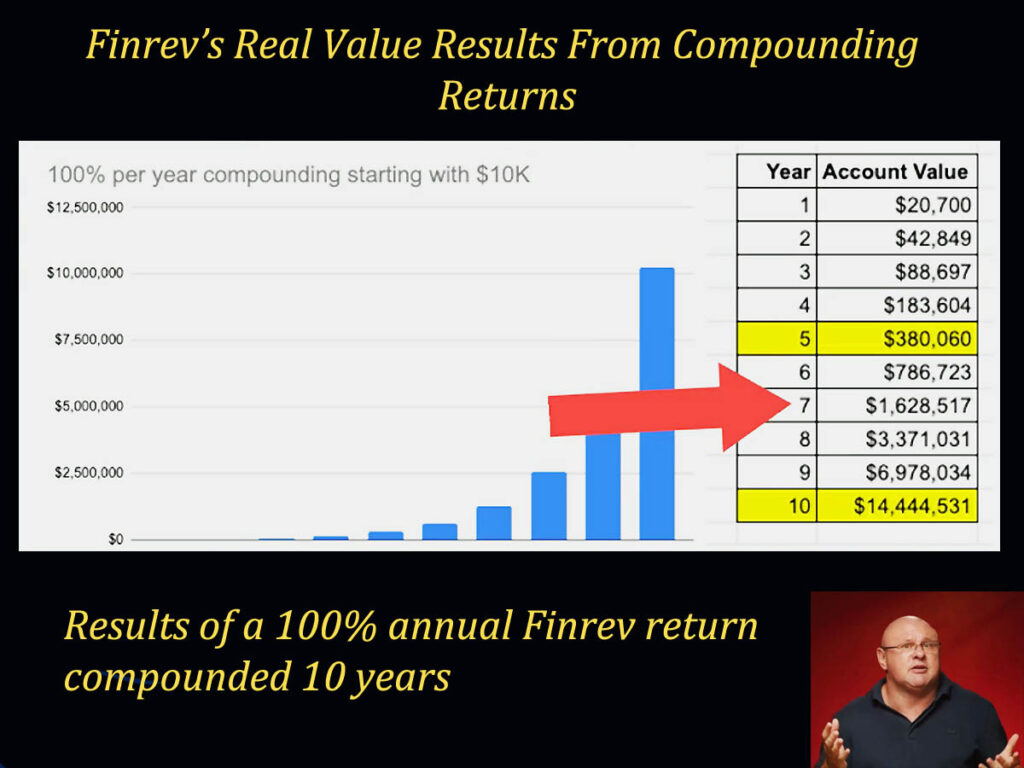
- Understand this is a 5-10 year wealth-building journey, not a get-rich-quick scheme.
If you’re sceptical:
Good. You should be. Verify Scott’s vesting schedule on-chain when Trend coin launches. Track his personal wallets (he’s asking you to). Judge by actions, not words.
📄 Full Podcast Transcript: FINREV’s Radical Pivot to Hyperliquid Vaults
Disclosure: This article discusses Finrev and HyperTrend systems. The author may have positions in mentioned assets. This is educational content, not financial advice. Crypto trading involves substantial risk of loss. Past performance doesn’t guarantee future results. Do your own research.