Three Counterarguments the HyperTrend Token Model Hasn’t Fully Answered
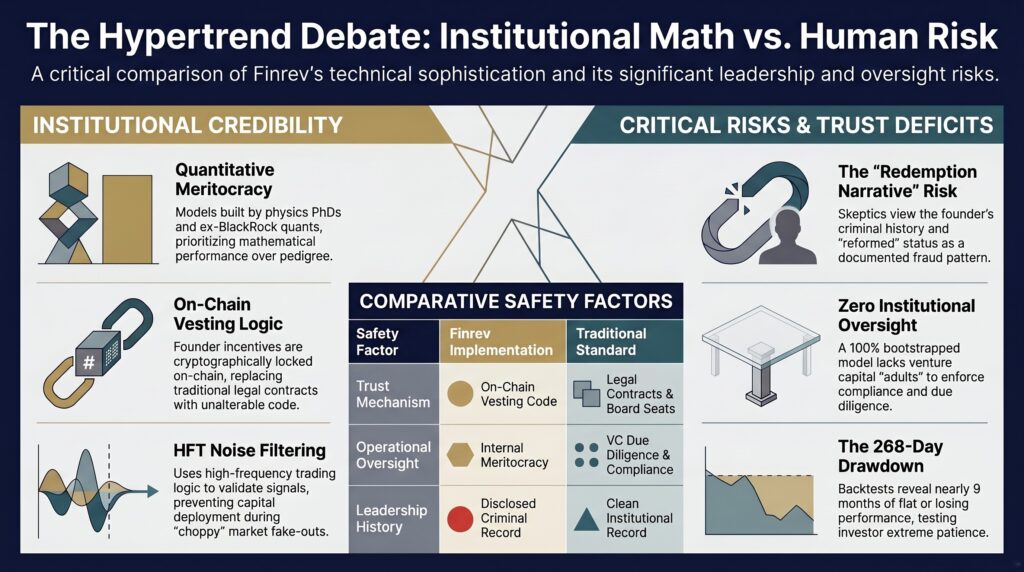
This is the podcast debate transcript companion to the pillar article on HyperTrend’s token economics and USDC yield model. The debate format examines the objections the article’s bullish tokenomics case leaves open: that paying rewards in cash creates rational incentive to dump the token, that the two-year lockup is a genuine liquidity risk the article underplays, and that the 63% CAGR projection is the most dangerous number on the page if treated as a planning baseline rather than a historical data point.
“For the full tokenomics architecture — fixed 100M supply, buyback flywheel mechanics, and the performance-based Sharpe ratio vesting that locks team equity behind results — read the pillar article this debate was built on.”
⚡Listen to the Article 05 Podcast on Spotify
📖 Read the Full Article 05: Beyond the “Magic Bean” Trap: Trend Coin Tokenomics
Podcast Episode: 05 – From Magic Beans to Institutional Precision
Duration: ~22 minutes
Published: February 2026
Topic: How HyperTrend generates real yield from market volatility instead of printing worthless tokens
📻 About This Podcast
This podcast was generated using Google’s NotebookLM from the research in this article. The conversational debate format explores the concepts from multiple perspectives—examining both advantages and potential concerns—which can help clarify complex ideas that might be dense in written form.
This is a supplementary tool. The article contains the full technical analysis and primary sources. The podcast is for those who prefer audio learning or want to hear counterarguments explored through discussion.
The pillar article makes the case for real yield tokenomics. The debate surfaces three challenges the skeptical investor perspective raises that the article doesn’t fully address:
- If you pay in cash, why hold the token at all? The Expert’s most pointed pushback: if USDC rewards are distributed directly, the rational move is to collect cash and dump the Trend token. The debate’s answer — fixed 100M supply means the protocol must buy tokens from the market to pay boosted rewards, creating structural buying pressure — is the real counter. But this circular mechanic only works if trading profits remain consistently positive. The article assumes competence; the debate makes the dependency on it explicit.
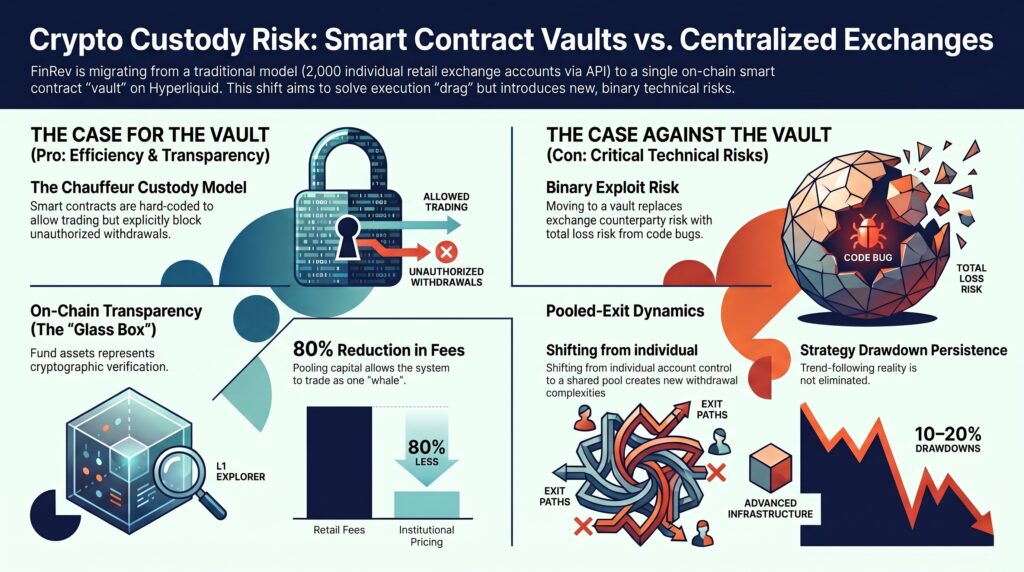
- The two-year lockup is genuinely dangerous. The Expert’s liquidity risk challenge deserves more weight than the article gives it. Locking capital for maximum yield multiplier in a 5-10 year growth strategy is rational in theory, but the debate is honest that a medical emergency, life event, or market crash during that window leaves you watching from inside a locked room. This is not a theoretical risk — it is a real constraint retail investors must factor into position sizing.
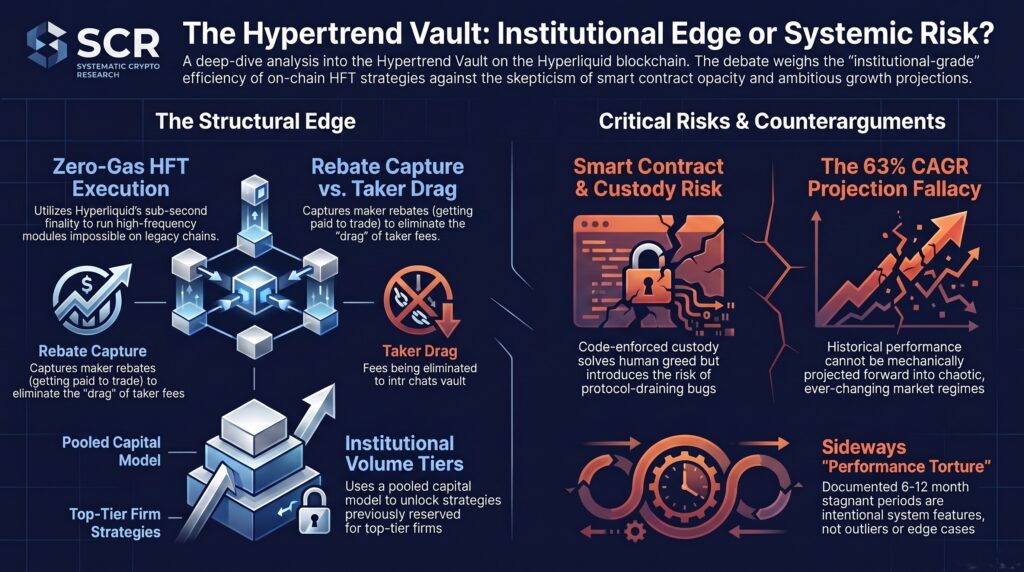
- The 63% CAGR extrapolation is the most dangerous number on the page. The Expert calls it out correctly: past performance in a period that included a historic bull run and bear market survival cannot be mechanically projected forward. The debate’s responsible response — focus on the conservative 35% scenario as the planning baseline, not the 100% optimistic one — is the intellectually honest framing the article underplays.
The Expert’s closing position is the correct landing point: “It doesn’t treat me like a gambler. It treats me like a shareholder.” That shift in framing — from speculator chasing dopamine hits to equity owner with a 5-10 year horizon — is the structural difference between this model and 99% of DeFi tokenomics. The Sharpe ratio vesting clause (performance-based, not time-based) is the single most important architectural innovation in the entire system and the one most invisible to retail investors evaluating return metrics alone.
The magic bean critique is not dismissed — it is used as the analytical anchor throughout. The debate correctly identifies that the distinguishing question is not “what APY does it promise?” but “where does the yield actually come from?” USDC distributions from real trading profits versus token dilution from minting are not variations of the same model. They are structurally opposite models, and the debate makes that distinction audible in a way the pillar article’s prose alone cannot.
The SCR verdict: The thesis holds. Real yield backed by algorithmic trading profits, fixed supply mechanics, and performance-gated vesting creates a fundamentally different risk/reward structure than inflationary DeFi. The liquidity risk from lockup periods is real and honestly disclosed — which is itself a differentiator. The two-year lock is a genuine constraint, not a feature to minimise. Investors approaching this as a long-term equity position with a 5-10 year horizon and appropriate position sizing are operating correctly. Those approaching it as a high-yield savings account are not.
A Real yield refers to income generated by a protocol from actual economic activity — in this context, trading profits extracted from market volatility — and distributed to token holders in a stable external currency (USDC). This is structurally different from printed APY, where protocols mint new tokens to pay staking rewards, creating the appearance of yield while diluting every existing holder’s share. In printed APY models, the 400% headline rate is mathematically circular: new tokens fund the reward, but new supply devalues the token being rewarded. Real yield breaks this loop by sourcing distributions from outside the token’s own supply. The distinction matters because printed APY schemes can sustain high headline numbers indefinitely while the underlying token trends to zero — whereas real yield is inherently bounded by actual trading performance and honest in its floor.
“The real yield vs printed APY distinction introduced in this episode’s Key Concept callout is explored in full — with scenario modelling — in the pillar article on Trend Coin tokenomics.”
Read Article 05 – Beyond the “Magic Bean” Trap: Trend Coin Tokenomics
Episode Summary
This episode explores the transition from inflationary “magic bean” DeFi schemes toward institutional precision through the HyperTrend vault. Instead of printing valueless tokens, the protocol employs a Trader Army of quants and scientists to extract real yield from market volatility using sophisticated algorithmic strategies. The ecosystem operates through three core mechanisms: distributing profits in USDC to prevent dilution, a buyback flywheel using trading gains to support token value, and performance-based vesting that locks team incentives behind strict risk-adjusted benchmarks. While offering a sophisticated alternative to retail “mousetraps,” the system carries significant liquidity and strategy risks, requiring investors to prioritize long-term equity over short-term gambling.
May 10th 2026 update: The date for public launch of HyperTrend Vault and TREND coin has not yet been made public, but the HyperTrend algorithm is up and running and making money in its Hyperliquid Vault. Currently, the algorithm is running in beta mode testing with internal funds. Reports are that it is performing well.
Full Transcript
Host: You know that feeling, right? It’s like two in the morning. Your eyes are burning from the screen and you think you found it. The holy grail.
Expert: Oh, I know it well.
Host: You’re looking at some staking protocol. It’s promising 400% APY. You start doing the mental math. If I put in 10 grand now, you know, I can retire in 6 months. You feel like an absolute genius. You buy the token. You stake it. You watch the rewards pile up.
Expert: And then maybe 3 weeks later, that APY is still 400%. But your initial investment is down what, 90%?
Host: Exactly. It is the classic DeFi trap. Suddenly you have a million tokens, but they’re worth less than the electricity it takes to even see them on your screen. It’s what we’re calling the magic bean problem, right?
Expert: You buy the beans, you plant the beans, and the protocol pays you in more beans. And the kicker is the only reason the beans have any value is because new people keep buying them to plant.
Host: It’s a closed loop of dilution. It works perfectly until the music stops and then well, everyone rushes for the exit at once.
Expert: Right? And I’m usually the guy stuck holding the bag at the door. So, when I saw the research stack for today all about this HyperTrend vault and the Trend coin, my immediate reaction was, “Okay, here we go. Another mousetrap.”
Host: I can see why you’d think that. But the sources, they’re claiming something pretty bold. They’re saying we’re moving from Ponzi mechanics to something they call institutional precision.
Expert: It is a bold claim, but I think the data actually supports it. We’re looking at a fundamental shift in how yield is even generated. Instead of printing tokens from nothing, this system is about extracting real value from the market’s volatility.
Host: See, that’s where my ears perk up. “Extracting value.” It sounds like corporate speak. My whole mission today is to be the voice for that burned retail investor. I want to know if this is actually different or if it’s just a rug pull with a really nice website.
Expert: Fair. You’re here to defend the strategy. So, convince me. What makes this different from the 10 other revolutionary protocols I lost money on last year?
Host: Okay. Fair challenge. The difference really starts with the engine. Most DeFi protocols are basically farming operations. HyperTrend isn’t a farm. It’s more like a hedge fund architecture that’s built on-chain. We have to talk about the Trader Army.
Expert: Trader Army. That sounds aggressive. Are we talking about a bunch of guys in a Discord chat just shouting “buy”?
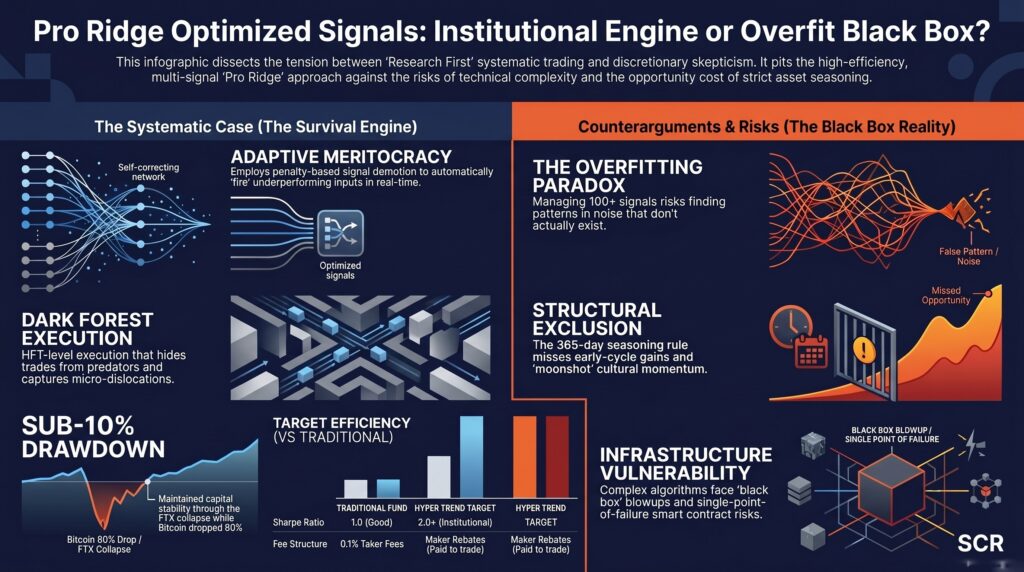
Host: No. No, not at all. We’re talking about physics PhDs. We’re talking mathematicians, ex-BlackRock quants. The source material is really clear that this isn’t just some trading bot. It’s a full suite of algorithmic strategies. Mean reversion, trend following, high-frequency arbitrage.
Expert: Okay, stop there. Mean reversion. Translate that for me, someone who didn’t major in statistics.
Host: Think of it like a rubber band. Prices stretch away from their average. Maybe they go way too high because of hype or they drop too low because of panic. Mean reversion is just the bet that the price will eventually snap back to that average.
Expert: So you’re not betting on “number go up” or “number go down.”
Host: Exactly. It’s a bet on the movement itself.
Expert: So they’re not gambling on Bitcoin $100,000. They’re just making money on all the chop along the way.
Host: You got it. They’re harvesting the noise. And this actually brings us to Vince. You saw the notes from Vince in the research, right?
Expert: Yeah. Marine ecologist. That threw me for a loop. We’ve got finance guys, tech guys, and then a guy who studies coral reefs. I mean, why is he relevant here?
Host: Because Vince studies complex adaptive systems. A coral reef is a chaotic environment, you know, with inputs, outputs, predators, prey. The market is the exact same thing. Vince’s perspective is that most crypto traders are just trying to predict the weather. The HyperTrend strategy isn’t predicting the weather. It’s building a windmill to catch the wind no matter which way it blows.
Expert: I like that. The windmill analogy. But even a windmill can break if the storm’s strong enough. The sources mentioned this is moving to the Hyperliquid blockchain. Why does that matter? Is that just more technical jargon?
Host: It really matters because of speed. If you’re doing high-frequency trading, I’m talking thousands of trades a day, you can’t be on a slow chain like Ethereum where gas fees are 50 bucks a trade, right?
Expert: Right?
Host: Hyperliquid is like a Formula 1 track. It’s purpose-built for this kind of thing. It lets this Trader Army of algorithms execute with the speed of a centralized exchange like Binance, but you still get the transparency of DeFi.
Expert: Okay, so a fast car, good track, and you’ve got these PhDs driving. But let’s look at the scoreboard. What kind of numbers are we talking about? Because if you say “guaranteed 20%,” I’m walking out.
Host: No, no guarantees. The sources are very clear on that. It’s “research first, hype never.” But historically, the system this is all based on has achieved a 63% compound annual growth rate over the last 3 years.
Expert: 63%. That’s that’s high. That’s suspiciously high.
Host: It is aggressive. But the context is key here. That 63% includes the bull run, the bear market, and all the chop in between. It’s not a straight line up. The target for the vault, though, is an annual return of somewhere between 35% and 100%.
Expert: All right, let’s just assume for a second the engine works. The windmill spins. Money comes in. In a normal protocol, that money usually just stays with the devs or it gets paid out in a token that immediately collapses. How does HyperTrend actually pay me?
Host: This is where we get into the mechanics and this is the critical part. Mechanism number one, real yield.
Expert: Define “real” because in crypto “real” usually means “really confusing.”
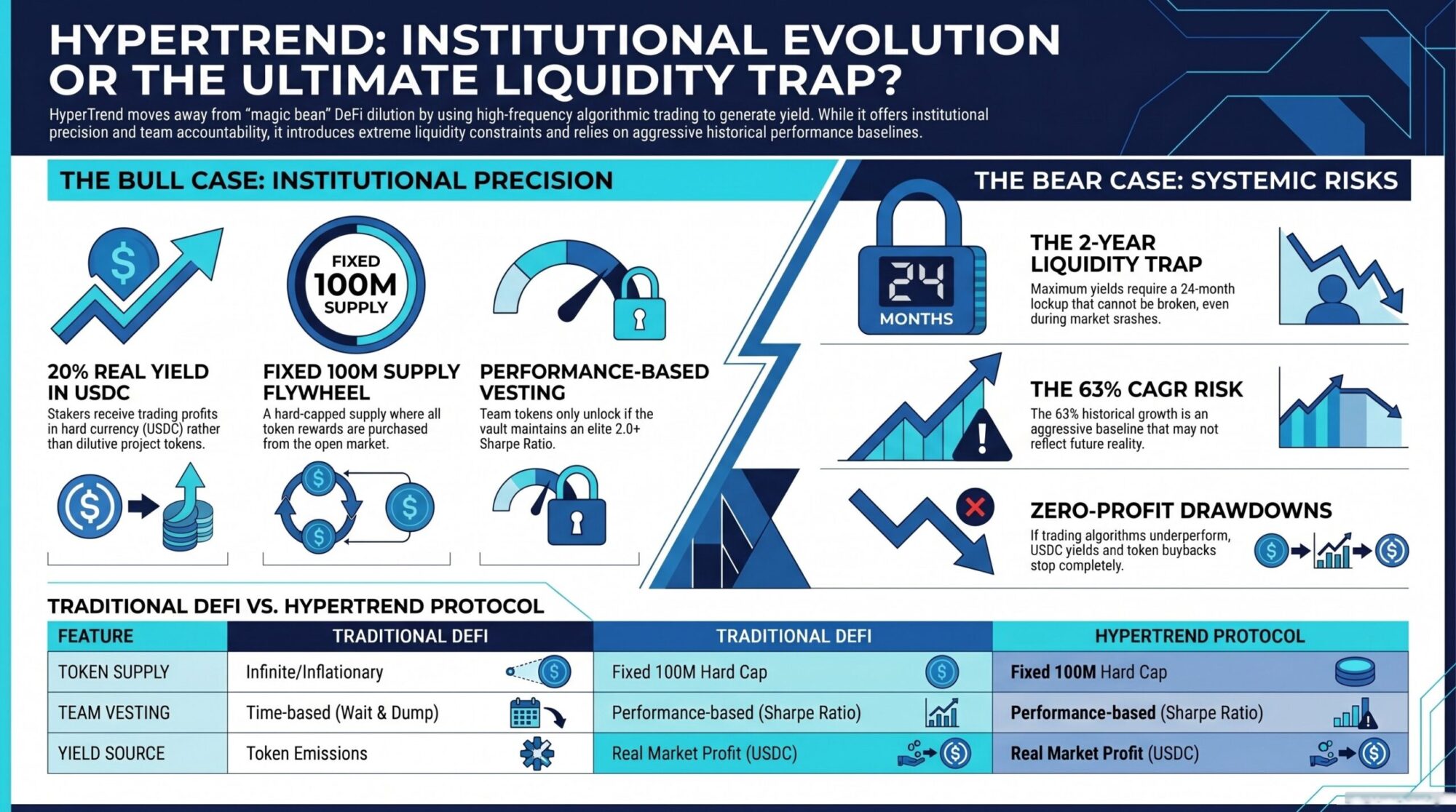
Host: In this case, real means hard currency. USDC, the stable coin pegged to the dollar. Stakers of the Trend token receive 20% of all the trading profits from the vault and they get it in USDC.
Expert: Wait, hold on. Pause. They pay you in USDC?
Host: USDC. Yeah.
Expert: Okay. So, I mean I have to push back on that. If I’m a crypto degenerate, which let’s be honest is the target audience, I don’t want stable coins. I want a token that does 100x. If you pay me in cash, that’s kind of boring.
Host: I hear you. But—
Expert: And more importantly, if they pay in cash, why would I even hold the Trend token? I just dump the token and keep the cash.
Host: You’ve just hit on the core debate, but look at the math. If you hold a token that just pays you in more of the same token, you’re just getting diluted. Your slice of the pizza stays the same size. They just cut it into more pieces.
Expert: Right.
Host: Here, the pizza, the USDC is external money coming in from the market.
Expert: Okay. But walk me through the numbers. Let’s say the vault has a hundred million in it and they have a decent year. They make 35%. That’s 35 million in profit, right?
Host: So 20% of that profit, $7 million goes directly to the stakers. If the market cap of the token is also a hundred million, that’s a 7% yield paid in dollars.
Expert: 7%. That’s better than a bank. Sure, beats a dividend stock, but it’s not exactly moon money, is it?
Host: That’s the conservative estimate. Now, look at the optimistic scenario from the research. If the vault hits a 100% return, which their historical data suggests is possible, that yield jumps to 20%.
Expert: 20%.
Host: Where else are you getting a 20% cash dividend on a liquid asset?
Expert: Real estate, maybe. But then I have to, you know, fix toilets.
Host: Exactly. And Bitcoin pays 0% yield.
Expert: Yeah.
Host: Gold pays zero. This is a real income generating asset.
Expert: Yeah.
Host: But to answer your question about moon money, how the token price goes up if everyone is just collecting rent. That brings us to mechanism number two. The buyback flywheel.
Expert: Flywheel. Another buzzword. Explain it to me like I’m five.
Host: Okay, imagine the vault makes a million dollars in profit today. A portion of that profit is used to buy Trend tokens right off the open market.
Expert: Okay, so there’s a constant buyer in the market.
Host: Correct. But here’s the twist. As a staker, you get a choice. You can take your rewards in USDC, the cash, or you can take them in boosted Trend tokens.
Expert: Ah, okay. Here it is. The greed toggle.
Host: Precisely.
Expert: Oh, yeah.
Host: If you choose the tokens, the protocol doesn’t just mint new ones to give you. The supply is fixed at 100 million. It’s hard-capped like Bitcoin.
Expert: So—
Host: So to pay you in tokens, the protocol must go out to the market, buy them with the trading profits, and then hand them to you.
Expert: So, my own greed forces the protocol to buy its own stock.
Host: Essentially, yes. If the vault is profitable, there is perpetual buying pressure. It creates a kind of floor. And if people sell the token, the protocol just buys it back cheaper and can burn it or redistribute it, which increases the value for everyone who’s still holding.
Expert: Okay, I’m starting to see the picture. It connects the trading performance directly to the token’s chart. But I have a massive problem with this whole Trader Army idea.
Host: Go on.
Expert: We’ve seen this play out. A team launches a project, they hype it up, the token pumps, and then the team dumps their entire allocation and buys a private island. The retail investors get rugged. What stops these physics PhDs from doing exactly that?
Host: This is maybe the strongest part of their entire architecture. It’s mechanism number three, the skin in the game vesting. And this is not normal vesting.
Expert: Vesting usually just means wait a year and then dump.
Host: Usually, yes, it’s time based. But HyperTrend uses performance-based vesting. The team literally cannot access their tokens unless they perform. Specifically, they have a Sharpe ratio clause.
Expert: Okay, we definitely need an analogy here. Sharpe ratio sounds like a class I’d fail in college.
Host: Think of it like a professional gambler. Anyone can walk into a casino, put it all on red, and double their money. That’s 100% return.
Expert: But it’s insanely high risk.
Host: Exactly. A Sharpe ratio just measures how much money you made compared to how much risk you took to make it.
Expert: So, putting it all on red has a really bad Sharpe ratio.
Host: Terrible. A Sharpe ratio of 1.0 is considered good. Means you’re winning consistently without betting recklessly. A Sharpe ratio of 2.0. That’s elite. That’s card counting levels of precision. That is top tier hedge fund territory.
Expert: And the team’s tokens are tied to this.
Host: 10% of the team’s total token supply is locked behind a smart contract. It only unlocks if the vault maintains a Sharpe ratio of 2.0 or higher over rolling six-month periods.
Expert: Whoa. So, if they make a ton of money, but they took crazy risks to get there, they don’t get paid.
Host: Correct. And obviously, if they lose money, they don’t get paid. There’s another 5% that’s tied to total value locked milestones. They have to grow the fund to a hundred million, 200 million just to unlock those shares.
Expert: That is actually aggressive. I was expecting you to say, “Oh, they promise not to sell.” But this is code. This is a smart contract literally saying, “Do your job or you starve.”
Host: It aligns their incentives perfectly with yours. They don’t want to pump and dump. They want steady, high-quality returns because that is the only way they unlock their own equity.
Expert: Okay, that buys them some serious trust. But let’s talk about the launch because usually when I hear “institutional grade” and “ex-BlackRock,” I assume the VCs already bought the whole thing. I assume I’m just buying their bags at a 50x markup.
Host: That is the standard playbook. Seed round for the insiders, public sale for the suckers. HyperTrend did zero VC funding.
Expert: Zero in this market?
Host: Zero. It’s all community bootstrapped. And this leads to a really interesting idea they have called the equity refund.
Expert: A refund. That sounds like I’m returning a pair of pants. I don’t—
Host: It’s for the existing users of their platform, FINREV. These are people who paid monthly subscriptions, some up to $9,500 to the platinum tier just to use the trading software.
Expert: That’s a serious subscription fee.
Host: It is, but HyperTrend is taking all those fees and converting them into Trend tokens at the launch valuation.
Expert: Wait, hold on. So, these people paid to rent the tool and now the project is saying, “Here, take that money back, but in the form of equity.”
Host: Exactly. They are moving from renting the software to owning the protocol. Scott Phillips, one of the voices in the source material, he calls it “dancing with the one who brought us.” They’re rewarding the people who funded the development with actual ownership.
Expert: That’s rare. Usually early users just get a “thank you” email. What about new people? People listening to this who didn’t spend 10 grand on software.
Host: There’s a massive airdrop. 32% of the total supply is going to the community. The sources claim this is actually the largest distribution on the Hyper EVM network.
Expert: Okay, airdrop always makes my ears perk up. But there’s always a catch, right? It’s not just free money.
Host: It’s based on contribution. You have to deposit into the vault. But here’s the catch you were looking for. It’s about time preference. There are multipliers.
Expert: Explain that.
Host: If you deposit your capital and stake the rewards, you can choose how long to lock them. If you lock for just 3 months, you get 50% of your yield share. If you lock for two years, you get 100%.
Expert: Two years in crypto. I mean, two years is practically a century. Empires rise and fall in two years.
Host: It’s a lifetime. I know. And that brings us right to the risks. We have to take off the rose-colored glasses now. Research first, hype never. What happens if you lock your money for 2 years?
Expert: I assume I’m just stuck.
Host: You’re trapped. This is the liquidity risk. If you lock for that maximum multiplier to get the juicy yield and then you have a medical emergency or your car breaks down or the market crashes 50% tomorrow, you cannot touch that capital.
Expert: So, I just have to watch the house burn down from inside the locked room.
Host: Essentially. Yes.
Expert: Yeah.
Host: And that’s exactly why Vince, our marine ecologist, treats this like a growth stock. He’s going into this knowing he can’t sell. He’s looking at a 5 to 10 year horizon. If you’re looking for money to pay next month’s rent, this is absolutely not the place for it.
Expert: That is a crucial warning. What about the machine itself? We talked about the Trader Army. What if they just well, what if they just suck?
Host: That’s the vault performance risk. Strategies degrade over time. A trading algorithm that prints money in 2024 might lose money in 2026 because the market conditions change. The source notes admit that extended drawdowns of 6 to 12 months are possible.
Expert: So we could go a full year with no profits.
Host: Yes. And if there are no profits, there are no buybacks. There is no USDC yield. The flywheel just stops spinning and the price of the Trend token would likely plummet because it’s priced based on expected future earnings.
Expert: So the entire thing really just rests on the competence of these quants.
Host: It does. You’re betting on the jockey, not just the horse. And then there’s regulatory risk, too. I mean, we’re talking about profit sharing. The SEC might look and say “that looks an awful lot like a security.”
Expert: It walks like a duck and quacks like a dividend.
Host: Exactly. So regulatory changes could force them to alter the structure or even geo-block certain regions. And smart contract risk is always there. Even with audits, code can have bugs. One exploit could drain the whole vault.
Expert: So it’s not a savings account. It’s a high risk, high-reward bet on algorithmic execution.
Host: Precisely. It is institutional precision, but it is still crypto.
Expert: Okay, let’s wrap this up. We’ve looked at the physics of yield. We’ve looked at the magic beans. I have to admit, I came into this ready to tear it apart. And while I’m still terrified of that two-year lockup, the structure itself, it respects my intelligence.
Host: How so?
Expert: It doesn’t treat me like a gambler. It treats me like a shareholder. The fact that the team only gets paid if I get paid, that Sharpe ratio clause, that’s the game changer for me. It feels like we’re finally growing up a little bit in this space.
Host: I agree. We’re seeing the evolution from the DeFi casino to a DeFi business. It’s like the difference between playing a slot machine and actually owning a piece of the casino.
Expert: That is the perfect analogy. And if the casino is managed by physics PhDs who understand the odds better than anyone else, well, that’s a compelling proposition.
Host: But, and this is the big but I want to leave everyone with, you have to check the water before you dive in. Don’t just take our word for it. Read the documents. Look at the Article 5 source material yourself. Check the historical performance.
Expert: Research first, hype never.
Host: Exactly. Vince wouldn’t jump into a shark tank without checking the cage. You shouldn’t jump into a vault without checking the code.
Expert: And you have to ask yourself the hard question. Are you here to gamble or are you here to build equity? Because this is a long-term build.
Host: A long-term build with a Trader Army behind it. It’s definitely one to watch. All right, that’s all we have time for on this deep dive. Fascinating stuff. We’ll catch you on the next one.
Expert: Keep analyzing.
📖 Read the Full Article: Beyond the “Magic Bean” Trap: Why Trend Coin Tokenomics Could Redefine Passive Income in Crypto
Key Takeaways
- Real Yield in USDC Prevents Dilution Death Spiral – 20% of trading profits distributed as stable coins, not inflationary protocol tokens that crash to zero. External money from market volatility, not printed beans.
- Buyback Flywheel Creates Perpetual Buying Pressure – Trading profits used to buy Trend tokens from open market. Fixed 100M supply means protocol must purchase (not mint) to pay boosted rewards, creating price floor.
- Performance-Based Vesting Eliminates Pump-and-Dump Risk – 10% of team tokens locked behind 2.0 Sharpe ratio requirement. Making money recklessly doesn’t unlock equity—only consistent, risk-adjusted returns do.
- Zero VC Funding, Community Bootstrap Model – No seed round insiders. FINREV users’ subscription fees converted to equity at launch valuation. 32% airdrop to community (largest on Hyper EVM).
- Two-Year Lock Creates Severe Liquidity Risk – Maximum yield multiplier requires 2-year capital lock. No emergency exits. Medical bills, market crashes, life events—you’re trapped. Only for 5-10 year horizon capital.
- Vault Performance Risk is Existential – Extended 6-12 month drawdowns possible. No profits = no buybacks, no yield, flywheel stops. Token value crashes if Trader Army strategies degrade.
🎯 From Magic Beans to Real Equity
The difference between DeFi casino and DeFi business is whether you’re gambling for dopamine hits or building long-term ownership in a profitable system.
Next Step: Watch the introduction video to understand:
- The three-mechanism yield engine (USDC distribution, buyback flywheel, performance vesting)
- The equity refund model and airdrop structure
- Why 2-year lockups demand 5-10 year mental frameworks
Once you have watched the “Introduction video,” you’ll be invited to book a call to talk to one of the onboarding coaches who are all actual traders.
Critical Question: Are you here to gamble or build equity? This is a long-term wealth journey, not a retirement-by-Tuesday scheme.
If you’re skeptical: Good. You should be. The code is on-chain, the performance is auditable. Judge by actions, not promises.
Continue Learning
Related Deep Dives:
- Sharpe Ratio 2.0: Why Elite Hedge Funds Target This Benchmark
- The Magic Bean Problem: Anatomy of Inflationary DeFi Death Spirals
- Equity Refunds and Fair Launches: Rewarding Early Supporters Without VC Extraction
Resources Mentioned
- HyperTrend Vault – On-chain hedge fund architecture extracting real yield from volatility
- Trend Token – Fixed 100M supply earning 20% of trading profits in USDC
- FINREV – Legacy platform with $9,500/year platinum subscriptions being converted to equity
- Vince (Marine Ecologist) – Lead researcher applying complex adaptive systems to yield generation
- Trader Army – Physics PhDs and ex-BlackRock quants managing algorithmic strategies
- Sharpe Ratio 2.0 Vesting – Performance-based unlock requiring elite risk-adjusted returns
- Scott Phillips – Co-founder explaining “dance with the one who brought us” equity model
- Hyperliquid – Layer 1 enabling zero-gas HFT execution for yield strategies
About This Podcast
This episode dissects the fundamental economics separating sustainable DeFi protocols from inflationary Ponzi schemes. For investors burned by 400% APY mousetraps, understanding real yield mechanics, buyback flywheels, and performance-based vesting is essential to evaluating whether a protocol generates value or just dilutes holders.
Related Articles:
- Real Yield vs. Fake Yield: How to Identify Sustainable DeFi Protocols
- The Buyback Flywheel: Game Theory of Fixed Supply Token Economics
- Performance-Based Vesting: Why Sharpe Ratios Matter More Than Total Returns
Transcript generated from Notebook LM podcast discussion. Edited for clarity and formatted for web publication.
HyperTrend Vault Update — September 2026
HyperTrend has spent months building out a dedicated Hyperliquid Vault — a self-contained on-chain trading structure, not just an account executing trades on the exchange — and it’s now running company and staff capital through that Vault in beta. The Vault runs the legacy Finrev algorithms with edge modules HyperTrend’s own quant team has built and fully integrated into their platform. That Vault infrastructure is what the public will get access to when it launches, alongside the $Trend Coin airdrop, both on HyperTrend’s roadmap for late 2026.
I’m a personal investor in HyperTrend and have tracked this project for years — the Vault’s smart contracts and trade history will be on-chain and auditable, which is the kind of transparency I look for.
Subscriptions to the legacy API-based HyperTrend system are now paused while they prepare for the public launch of the HyperTrend Vault on the Hyperliquid platform. More details will be coming out over the coming weeks, including the whitepaper on the $Trend Coin tokenomics. Leading up to the public launch, this is where I’ll post what I learn, as I learn it.
Want updates directly? Email me at vince1@systematiccryptoresearch.com — happy to answer questions too.